By Okoi Obono-Obla
Leadership Is Not Sainthood: Why Smear Campaigns Do Not Win Elections
One Joseph Eleh, in response to one of my essays, veered away from the substantive issue I raised and wrote thus:
*“Please, I have some questions to enable us support President Tinubu, if only you can assist in resolving them.
Which other president in the world forfeited money to the US over drug-related transactions?
Which other president’s background is so shrouded in secrecy that citizens do not know the primary and secondary schools he attended?
Which other president(s) in the world do not have classmates?
Which other president(s) has/have multiple dates of birth?
Which other president(s) appropriated another person’s picture as childhood pictures?
Some of us are curious; Awolowo, Zik, Balewa, and even Buhari’s background are in the public domain.
Is this also a sign of consistency?”*

My reply to him, exasperated by the pettiness and bad belle, was very terse:
@Joseph Eleh
Granted everything you have said here, leadership is not sainthood.
In the characteristic Nigerian fashion, especially during electioneering campaigns, we run away from policy issues and instead dwell on frivolities, irrelevancies, smears, and character assassination. What many fail to understand is that leadership is not sainthood.
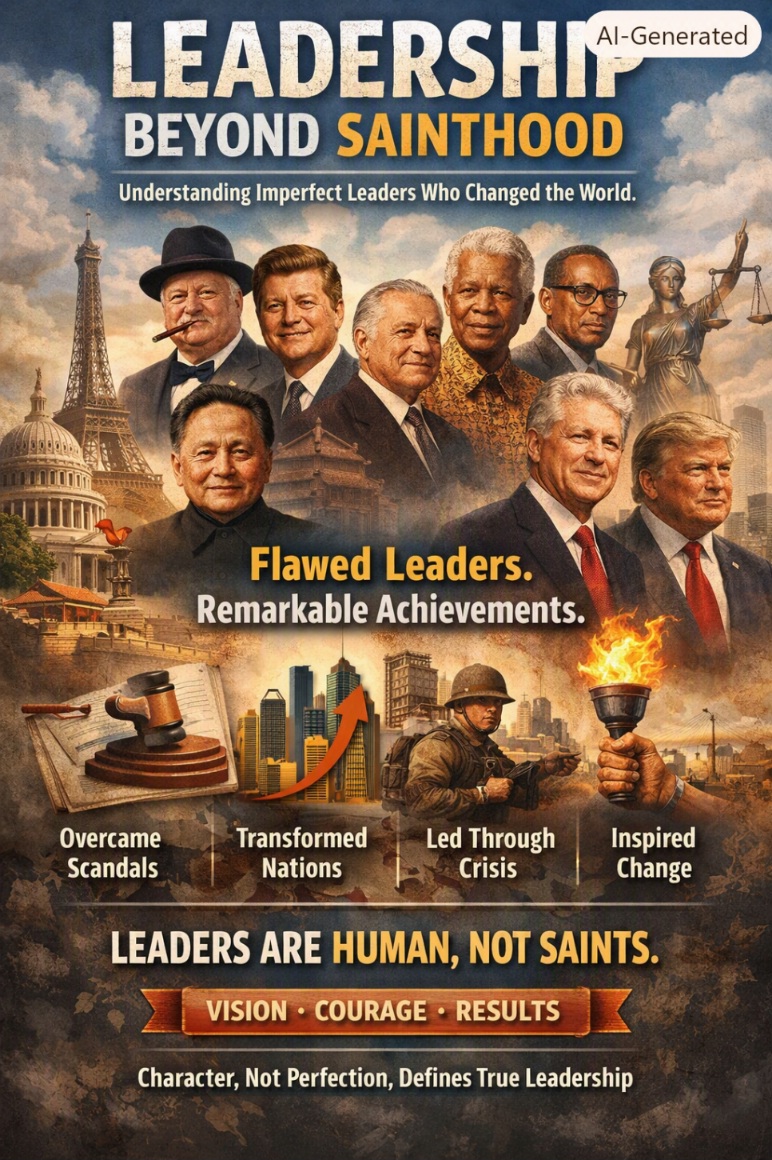
Since the Middle Ages, political thought has moved from the idealism of Aristotle and St. Thomas Aquinas, who insisted on the moral goodness and virtuousness of the leader, to the realism of Niccolò Machiavelli, who recognized that leaders are ordinary mortals, susceptible to human frailties and shaped by the circumstances that make them who they are. History is replete with flawed men and women who, despite grave personal scandals and character defects, provided inspirational and transformational leadership and lifted their countries from the nadir.
In Europe, Winston Churchill is today revered as the saviour of Britain and Western democracy, yet he was widely seen in his time as a failed, reckless opportunist. He was blamed for the Gallipoli disaster in World War I, was a notorious heavy drinker, and held views now considered deeply anachronistic. Yet in 1940, it was this flawed man who summoned the courage to stand against Hitler when all of Europe had capitulated. In France, Charles de Gaulle was arrogant and authoritarian, and François Mitterrand concealed a secret second family for decades and was dogged by allegations of wartime collaboration and financial scandal, yet he redefined modern France.
In the United States, the White House has never been a monastery. Franklin D. Roosevelt, who lifted America from the Great Depression and led it through World War II, had a long-running extramarital affair and misled the public about his paralysis. John F. Kennedy, whose youth and vision inspired a generation, was a serial womanizer with serious health issues hidden from the public. Bill Clinton was impeached over the Monica Lewinsky scandal, yet he left office with the longest peacetime economic expansion in American history.
In Asia, Deng Xiaoping, the architect of modern China, was purged twice by his own party and was accused of ordering the Tiananmen Square crackdown in 1989, yet he pulled over 800 million Chinese out of Maoist poverty and laid the foundation for China as a superpower. In Singapore, Lee Kuan Yew was criticized as a high-handed autocrat who muzzled the press and jailed opponents without trial, yet from a swampy, resourceless island, he built one of the most prosperous and efficient nations on earth.
In Africa, Kwame Nkrumah of Ghana, despite his authoritarian turn and economic missteps, remains the towering symbol of Pan-Africanism. Jerry Rawlings of Ghana came to power via a coup and executed former heads of state, yet he later engineered Ghana’s economic recovery and return to stable democracy. In Rwanda, Paul Kagame faces credible accusations of authoritarianism, yet he took a nation from the ashes of a genocide that killed 800,000 people to become Africa’s most striking example of order and growth.
In South Africa, Nelson Mandela is a global icon today, but his personal life was deeply troubled. His marriages ended in divorce and scandal, and in his youth he embraced armed struggle and was branded a terrorist. Yet from his personal flaws and 27 years in prison emerged the transformational leader who prevented a racial bloodbath and built the Rainbow Nation.
In Australia, Bob Hawke, arguably Australia’s most beloved and reformist Prime Minister who modernized its economy, was a self-confessed womanizer and heavy drinker who was once expelled from university for his excesses.
Even in contemporary America, President Donald Trump provides the most compelling example. He was embroiled in several scandals, including a conviction for falsifying business records relating to a hush-money payment made through his lawyer to a woman, and other civil liabilities over his financial disclosures. Despite all of this, Americans shunned the smears and elected him twice to the White House.
The lesson is clear: smear campaigns do not win elections.
If we insist on sainthood as a precondition for leadership, we will never find a leader to elect. Voters, in mature democracies, ultimately look beyond gossip and sensationalism. What nations need are not sinless men, but men and women with clarity of vision, strength of character, capacity for hard decisions, and the political will to deliver. That is the true test of leadership.