By Okoi Obono-Obla
Joseph Greenberg and the Fourfold Classification of African Languages: Dismantling the Hamitic Myth
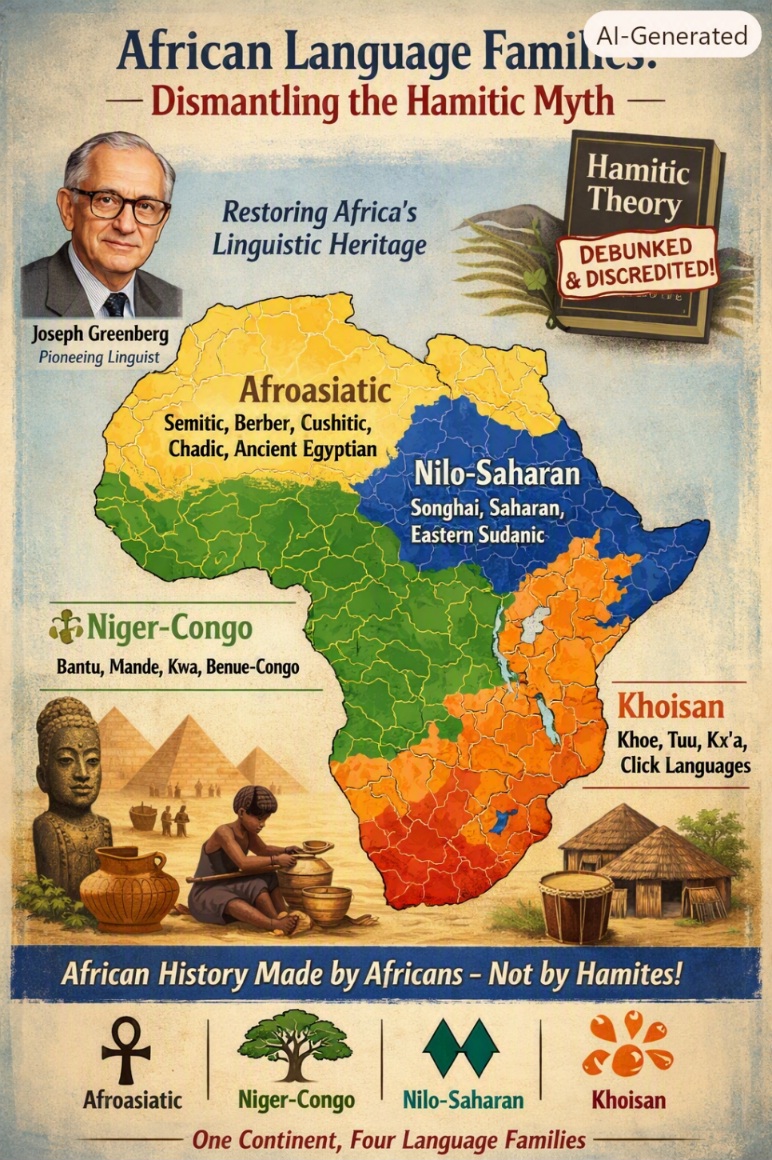
American linguist Joseph Greenberg revolutionized African language studies by grouping all of Africa’s languages into just four major phylogenetic families: Afroasiatic, Niger-Congo (originally Niger-Kordofanian), Nilo-Saharan, and Khoisan.
1. Afroasiatic: Spoken widely across North Africa, the Horn of Africa, and parts of the Sahel and the Middle East. Its key branches include Semitic (e.g., Arabic, Amharic), Berber, Chadic (e.g., Hausa), Cushitic (e.g., Oromo, Somali), and the extinct Egyptian language.
2. Niger-Congo: The largest language family in Africa by number of speakers and distinct languages, stretching across West, Central, East, and Southern Africa. Its key branches include Mande, Atlantic, Kwa, Gur, Benue-Congo, and Adamawa-Ubangi.
3. Nilo-Saharan: A diverse and geographically fragmented group spread across the upper Nile and central Sahara regions. Its key branches include Songhai, Saharan (e.g., Kanuri), Maban, Fur, Eastern Sudanic, and Central Sudanic.
4. Khoisan: Spoken primarily in southwestern and eastern Africa, this family is famous for using click consonants. Its key groups include Khoe, Tuu, and Kx’a, historically grouped together primarily based on typological features like clicks rather than solid genetic proof.
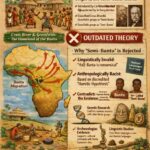
It was Greenberg’s work that dismantled the widely discredited Hamitic theory. This was a 19th-century ethnological and linguistic concept introduced by some European scholars, ethnographers, and anthropologists to justify colonialism and to give the false impression that Africa was in darkness and therefore in gross need of a Euro-Christian civilizing mission which colonialism would provide.
The Hamitic theory, or Hamitic hypothesis, is a now-discredited concept rooted in a mixture of biblical misinterpretation, colonialism, and scientific racism. It asserted that all complex civilizations, advanced technologies, and governing structures in Sub-Saharan Africa were introduced by a superior, lighter-skinned “Caucasian” race known as the Hamites. The theory was used to strip indigenous African populations of credit for their own historical achievements.
Crucially, it was also Greenberg who rejected the false dichotomy between Bantu and Semi-Bantu. Under the old, racially motivated framework, the so-called “Semi-Bantu” were described as groups that had not been influenced by the purported movement of Hamitic groups into the homelands of Negroes, while the Bantu were supposedly the product of Hamitic groups moving into those homelands and mixing with the indigenous population.
Greenberg proved this distinction was linguistically baseless. His major milestone was demonstrating that the massive Bantu group is not a standalone, Hamitic-influenced family, but rather a sub-branch nested deep within the Benue-Congo branch of the Niger-Congo family. In doing so, he established that both Bantu and Semi-Bantu languages share a common indigenous origin.
Most of the languages in the Cross River Basin, for example, are grouped under the Benue-Congo branch of the Niger-Congo family.
Which of these groups does your own language belong to?
Conclusion:
In essence, Greenberg’s classification did more than organize languages; it restored intellectual agency to Africa. By proving that the vast majority of Sub-Saharan languages share a deep, indigenous common ancestry in Niger-Congo, and by demolishing both the Hamitic hypothesis and the artificial Bantu/Semi-Bantu divide, he showed that African history, languages, and civilizations were products of African peoples themselves, not of external Hamitic invaders. His four-family model remains the foundational framework for all modern study of African languages.