by Khaleed Yazeed
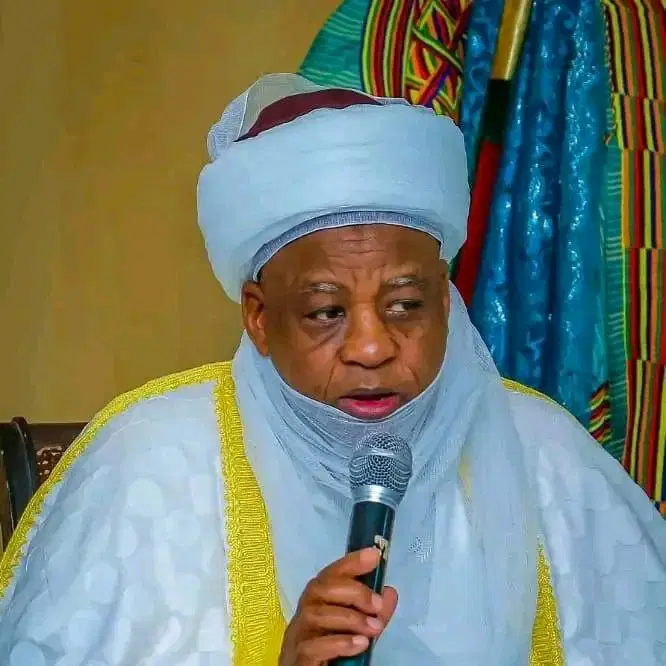
The Sultan of Sokoto, Alhaji Muhammad Sa’ad Abubakar III, has finally found his voice. After years of silence while Hausa farmers were slaughtered, while villages were razed, while a retired general was abducted and killed in captivity, the Sultan has emerged from his palace to demand a thorough investigation into the killing of the Benue State Chairman of the Miyetti Allah Cattle Breeders Association of Nigeria (MACBAN), Alhaji Ardo Risku, and his son. He insists that “everyone involved in the attack must be brought to justice”.
Where was this voice when Fulani bandits turned Hausaland into a graveyard? Where was this voice when retired Major General Rabe Abubakar was abducted and killed in captivity? The Sultan did not demand a thorough investigation when a retired military officer, a man who served his nation with distinction, was murdered by the very criminals the Sultan’s silence has protected. He did not call for justice when Hausa farmers were killed in their fields, when Hausa mothers buried their sons, when Hausa villages were erased from the map. The Sultan’s outrage is not a commitment to justice, it is a commitment to his own.
An open letter published in TheCable described the Sultan’s “prolonged silence in the face of the escalating menace of Fulani banditry and terrorism across vast swathes of Nigeria” as “no longer neutral”. The letter warned that “silence, at this moment in our history, increasingly projects an image closer to complicity than innocence”. It named bandit warlords like Bello Turji and Dogo Gide, calling on the Sultan to condemn them unequivocally. The Sultan has remained silent.

A former US mayor, Mike Arnold, challenged the Sultan to provide evidence that he is not involved in what he described as “jihad genocide” and mass killings in northern Nigeria. Arnold asked, “The Nigerian government estimates that at least $9bn a year in minerals are looted from his hereditary lands. Why hasn’t he tried to stop this? He has powerful armed militias under his authority, does he not? So why aren’t the illicit miners being stopped?”. The Sultan’s response? Silence. The Sultanate Council dismissed the accusations as baseless, refusing to dignify them with a reply. When the world asks if the Sultan is complicit in genocide, silence is not neutrality. Silence is a verdict.
Instead of condemning the well-documented killings, kidnappings, and land seizures perpetrated by Fulani terrorists over the past decade, the Sultan appears more concerned with the digital platforms exposing these heinous acts. He has called social media “a terrorist organisation”. But he has never called Bello Turji a terrorist. He has never publicly named and shamed the Fulani bandit leaders who have turned the Northwest into a killing field. He has never demanded justice for the Hausa victims of Fulani banditry. His outrage is reserved for his own people, and his silence is a service to the system that has kept the Hausa masses in chains.
The Hypocrisy of the Sultan’s Statement
The Sultan has exonerated Miyetti Allah of any culpability in the killings of farmers, saying that “we have no control over any Fulani man” and that “any Fulani man caught killing is a criminal and should be treated as such”. But these are empty words. They are the words of a man who knows that the killers are his people, but refuses to name them. They are the words of a man who knows that the system protects the killers, but refuses to challenge it.
Neither Miyetti Allah nor Kautal Pulaaku has ever called for firm action against notorious Fulani bandit leaders such as Bello Turji or Ado Aleru. Instead, their gatherings are routinely reduced to propaganda about Fulani victimhood. The Sultan is the Chairman of the Board of Trustees of MACBAN, the Grand Patron of Fulani associations, yet he has never used his position to demand that Fulani bandits be treated as criminals rather than freedom fighters. He has never called for the arrest of Bello Turji. He has never demanded that the government take action against the Fulani terrorists who are killing innocent Nigerians.
The Sultan has said that “not all Fulani herdsmen are bandits”. This is true. But he has never said that Fulani bandits are criminals who must be stopped. He has never said that the Fulani elite who protect the bandits are complicit in their crimes. He has never said that the Fulani people must take responsibility for the criminals among them. Instead, he has used his spiritual authority to shield the guilty and silence the victims.
The Sultan’s silence is not neutrality; it is complicity. When a man of his influence, his spiritual authority, and his historical weight refuses to speak against the atrocities committed by Fulani bandits, he is giving them a license to kill. He is telling them that they can murder Hausa farmers, kidnap Hausa children, and burn Hausa villages without consequence. He is telling the world that the Hausa people are expendable, that their suffering is not worthy of his voice, and that his only concern is the welfare of his own ethnic kin.
The Sultan was not an eyewitness to the killings. But he does not need to be. He is the spiritual leader of millions of Muslims in Nigeria. His voice carries weight. His words can move mountains. And yet, he has chosen silence. He has chosen to protect his own people while the Hausa masses are slaughtered. He has chosen to defend the Fulani elite while the Hausa are subjugated. He has chosen to preserve the system that has kept the Hausa in chains for two centuries.
The Sultan once issued a fatwa against Boko Haram after the sect challenged his authority, but “no similar action has been taken against Fulani militants”. There have been more than 7,000 Christians massacred in his territory, and Arnold asked: “If his own statement that no killing happens without traditional rulers knowing about it is true, then he knows more than anybody else”. The Sultan knows. And his silence is a confession.
The Sultan’s throne is not a symbol of Islamic unity, it is a monument to ethnic domination. The Sokoto Caliphate was built on the blood of the Hausa people. The Fulani jihad of 1804 was not a reformation; it was a conquest. It replaced Hausa kings with Fulani emirs, burned Hausa libraries, and enslaved millions of Hausa people. And every time the Sultan speaks, he speaks not as a spiritual leader, but as the defender of a system that has kept the Hausa masses in poverty, ignorance, and subjugation for two centuries.
The Sultan can demand all the investigations he wants. He can call for justice for Ardo Risku. He can weep for his own people. But the Hausa people will not forget his silence. They will not forget his complicity. They will not forget that when they were being killed, the Sultan was silent; when their villages were being burned, the Sultan was silent; when their children were being kidnapped, the Sultan was silent.
The Hausa people are waking up. They are rejecting the Sultan’s hypocrisy. They are rejecting the system that the Sultan defends. The Hausa Zalla movement is not a rebellion against Islam, it is a rebellion against the Fulani elite who have used Islam to justify their domination. The Orange Union is not a dream, it is a necessity. And the Sultan’s selective outrage is a reminder that the Fulani elite will never be the allies of the Hausa people. They will only ever be their conquerors.
The Sultan’s crown is a symbol of conquest, not unity. And the Hausa people are no longer bowing.
The Sultan of Sokoto does not deserve to be a leader, not in Islam, and not in any tradition that claims to serve justice. Islamic leadership is built on Shura (consultation), Adl (justice), and Amanah (trust). A leader who speaks only when his own are hurt, who shields criminals while the innocent bleed, who uses his spiritual authority to protect the oppressor and silence the oppressed, has abandoned the very foundation of his office. The Prophet (SAW) said: “The best of your rulers are those whom you love and who love you… and the worst of your rulers are those whom you hate and who hate you.” The Sultan has become a symbol of that hatred, not because the people hate him, but because he has refused to stand for truth. He has failed the moral test of leadership. He has failed the capacity test of service. He has become a custodian of conquest, not a servant of the Ummah (community). And a leader who cannot serve justice cannot claim to serve Allah.
Khaleed Yazeed
Founder, Wakilin Yamma Youth Development Network
Katsina State, Nigeria