by Agbonmagbe Kazeem
Once a year, the usually quiet town of Ijebu-Ode in south-western Nigeria transforms into a majestic theatre of colour, rhythm, and ancestral pride.
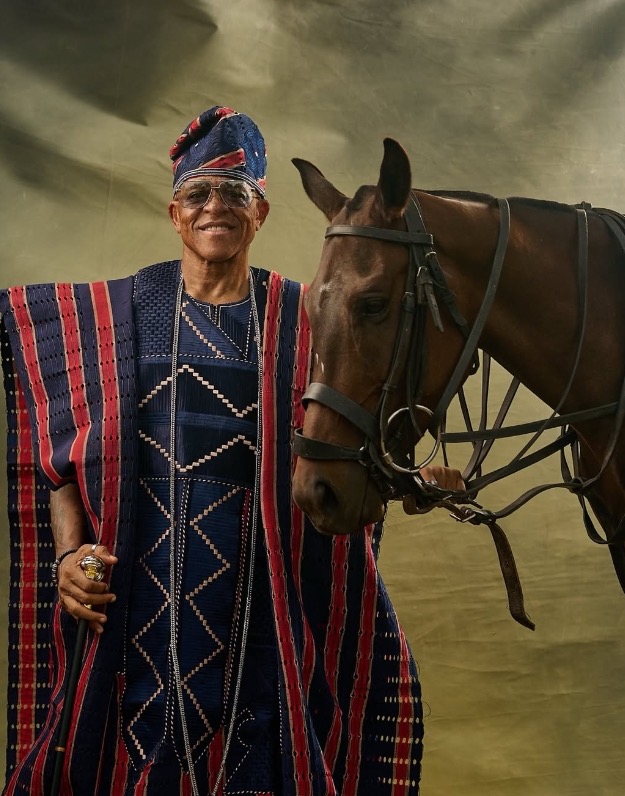
Tens of thousands converge in a communal pilgrimage: men draped in majestic agbadas that billow like sails of history; women crowned in radiant geles that gleam like sculpted sunbursts; children dancing with the joyful abandon of inherited rhythm.
Horses regal, robed in velvet and gold, trot proudly past the throng, ridden by nobles in sunglasses and embroidered sashes, a modern swagger married to royal lineage.

All eyes, eventually, turn toward the Awujale’s palace, the ancestral and ceremonial heartbeat of Ijebuland.
In an era increasingly defined by the erosion of borders: cultural, digital, even existential, Ojude Oba resists the flattening of memory into monotony. It defies the quiet violence of assimilation. It is not just a celebration; it is a declaration of heritage, of unity, of who the Ijebu people are and have always been.
Ojude Oba is to know how memory becomes ritual, and how ritual becomes a mirror through which a people see themselves more clearly.
The story of Ojude Oba begins not as the grand spectacle it is today, but as an intimate gesture of gratitude and reverence. In the late 19th century, during the reign of Oba Adesumbo Tunwase, Islam had begun to take root among the Ijebu people.
This was a significant shift in a region historically grounded in traditional Yoruba religious beliefs. As Islam spread, many new converts found themselves in a delicate position—how could they honour their spiritual convictions while also respecting the authority and customs of the Oba?
The solution was elegant and deeply rooted in Yoruba culture, reflecting a compromise. Shortly after the Muslim festival of Eid-el-Kabir, the newly converted Muslims would visit the Awujale’s palace to pay homage. It was their way of saying, “We may pray differently, but we are still your people.” This gathering came to be known as Ojude Oba, which translates to “the king’s forecourt”, a literal description of where the homage was paid, and a metaphor for the enduring loyalty between the people and their monarch.
Over time, what began as a modest religious courtesy evolved into a full-fledged cultural festival. Age-grade groups, known as egbe, began to participate, parading in coordinated attire and performing choreographed displays.
The festival absorbed layers of meaning with each passing decade, growing in size and symbolism. It became less about religion and more about identity. Christians joined in. Traditionalists, too. It was no longer just a Muslim gathering; it became an Ijebu one.
By the late 20th century, Ojude Oba had transformed into one of the most important cultural events in Nigeria. Yet, even as it expanded, the core of its identity remained: a people’s love for their king, their heritage, and their shared story. In many ways, Ojude Oba exemplifies the Yoruba genius for synthesis—blending faith, monarchy, and modernity without losing coherence.
It is this layered origin that gives the festival its soul. It is not just about celebration; it is about affirmation that the Ijebu people, regardless of religion or geography, remain bound by a common ancestry and a profound respect for their traditions.
To truly grasp the weight of Ojude Oba, one must first understand the stature of the Awujale. In Ijebu culture, the Awujale is not merely a ceremonial figurehead; he is the spiritual anchor, the moral compass, and the custodian of ancestral memory. His presence is both a link to the past and a guidepost for the future.
The title of Awujale dates back centuries, forming part of the larger Yoruba chieftaincy system, which balances power, spirituality, and governance in intricate ways. The Awujale is considered oba alade merindinlogun, a king with sixteen crowns, signifying his authority over the various quarters and families of Ijebuland. He is the unifier of a people whose pride in their identity is almost mythic.
In modern, democratic Nigeria, the role of traditional rulers may appear symbolic at first glance. But for the Ijebu, and indeed for many Yoruba communities, that symbolism carries real power. The Awujale is the living embodiment of continuity, a figure who transcends the transient nature of political office. Presidents come and go, but the Awujale remains, his voice echoing across generations.
At Ojude Oba, this reverence is made visible. Each age-grade group marches toward the palace with disciplined precision, stopping to kneel or bow before the king. Horses are paraded in his honour. And they do not kneel before the man alone; they kneel before history.
They kneel before the memory of Ijebu heroes and matriarchs, before the lands their ancestors farmed, before the gods their ancestors served, and the dreams their ancestors dared to dream. The Awujale becomes a mirror, reflecting not only himself but also the accumulated dignity of his people.
The late Awujale, Oba Sikiru Kayode Adetona, held the throne for 65 years, one of the longest-reigning monarchs in Nigerian history. Under his stewardship, Ojude Oba has grown from a local religious tradition into an internationally recognized cultural festival. His legacy extends not only to the length of his reign but also to the strength of the institution he continues to uphold.
In many ways, Ojude Oba is less about monarchy and more about meaning. It is a communal ritual that says: We still believe in something older than ourselves. We still believe in honour. We still believe in home.
If heritage is the soul of Ojude Oba, then regalia is its skin: vivid, bold, and unapologetically expressive. Every detail, from the stitching on an agbada to the ornaments on a horse, is a visual declaration of pride. It is here that aesthetics meet identity, where the body becomes a canvas for history, and where fashion is not just a statement but a legacy passed down through generations.
Central to this spectacular display are the egbe, the age-grade groups that form the social and structural backbone of Ijebu society. These groups, divided by gender and generational year, play a crucial role not only in the organisation of the festival but in the ongoing development of the community. Members contribute to public projects, support one another economically, and serve as an informal governance network. But on Ojude Oba day, their civic duty transforms into ceremonial splendour.
Each (egbe) groups appears before the Awujale in coordinated attire. Think of it as Yoruba couture at its most ambitious. No two groups dress alike, yet every ensemble exudes intentionality. Some opt for classical interpretations of Yoruba dress, featuring layers of lace, velvet, and intricate embroidery.
Others embrace avant-garde interpretations, fusing traditional silhouettes with modern tailoring, Swarovski embellishments, and international flair. The result is a parade that rivals any fashion week in the world, but with deeper roots.
The men often arrive on horseback, another powerful symbol of wealth, status, and nobility. These horses are not just transportation; they are extensions of the self, meticulously groomed and dressed in fabrics that match their rider’s attire.
The procession is choreographed with military-like precision—riders rearing their steeds in sync, performers waving to the crowd, drummers punctuating each entrance with thunderous rhythm.
Women, too, make their entrance with unrivalled elegance. Head ties (gele) rise like sculpted monuments, jewelry glistens under the sun, and faces are adorned with careful makeup that enhances rather than hides. These are not passive adornments. They are active declarations: I am here. I am Ijebu. I belong.
This dazzling display is not about vanity. It is about visibility. In a world that often renders African identity as peripheral, Ojude Oba insists on being seen on its own terms, with its own standards of beauty, authority, and prestige.
In these moments, the lines between the personal and the collective blur. Dressing up becomes a form of storytelling. The regalia becomes a flag, unfurled not for conquest, but for memory.
For all its extravagance, Ojude Oba is ultimately a gathering of meaning. Beneath the gold-threaded agbadas and regal horseback processions lies something more profound: a shared affirmation of who the Ijebu people are and what they continue to represent in a changing world. It is a festival where identity is not merely celebrated—it is performed, renewed, and reinforced.
In an age where identity is often fragmented, split across geographies, cultures, languages, and ideologies, Ojude Oba offers something rare: a unified narrative. Whether you are a devout Muslim, a Sunday churchgoer, a diaspora returnee, or a secular technocrat, you can come home to Ijebu-Ode and find your place in the story. It is not just tolerance that holds the festival together; it is the belief in a shared lineage, a collective origin that transcends the differences of today.
This is most visible in the multigenerational attendance. Grandfathers ride horses with their sons and grandsons marching behind. Women in their fifties twirl in rhythm beside their twenty-year-old daughters. Elders remember what Ojude Oba looked like fifty years ago, while children are introduced to the rituals for the very first time. It is a living archive of Ijebu history—one that updates itself every year.
And while Ojude Oba is firmly rooted in tradition, it is far from static. The festival has welcomed evolution without losing its soul. Sponsors from across the country—banks, telcos, FMCG giants—now support the event. Digital creators livestream it to audiences around the world. Young people document the celebration in high-resolution Instagram reels, giving it a new digital permanence. Yet even with these modern additions, the core message remains intact: we are Ijebu, and we honour where we come from.
In this sense, Ojude Oba achieves what few cultural events manage, it becomes both a personal ritual and a public declaration. It reminds the world that tradition is not the opposite of progress, but the foundation of it.
And in a country like Nigeria, where ethnic and religious divisions are often amplified, a festival that unites people under a shared identity is not just cultural, it is political in the most affirming way.
At its heart, Ojude Oba says something many of us long to hear: You are part of something greater. You are not alone. You belong.
Economic and Cultural Impact of Ojude Oba
For all the tradition and heritage on display at Ojude Oba, the festival is also a powerful economic engine. In just a few days, Ijebu-Ode becomes one of the busiest micro-economies in Nigeria. Hotels sell out weeks in advance. Tailors, fashion designers, makeup artists, and fabric merchants record some of their highest sales of the year. Event decorators, sound engineers, caterers, and transport operators all find work during the festival season. For many small and mid-sized businesses, Ojude Oba is more than a cultural celebration; it’s a business opportunity.
This surge in commerce is not accidental—it’s deeply tied to how the festival has grown in both scale and sophistication. Today, Ojude Oba attracts visitors from across Nigeria, West Africa, and the global diaspora. It’s not unusual to see guests fly in from London, New York, or Toronto just to attend. This movement of people brings with it capital, investment, and interest. It also fosters a deeper connection between the Ijebu homeland and its scattered children abroad.
Corporate Nigeria has also taken notice. In recent years, major banks, telecommunications companies, and multinational corporations have become consistent sponsors of the festival. They set up booths, run ads, and engage directly with a valuable and influential demographic. For these companies, Ojude Oba is not just a party, it’s a gateway. The Ijebu people are known for their entrepreneurial spirit, and the festival is an efficient way to tap into a tightly knit, high-value community.
Culturally, Ojude Oba is an important soft power asset. In a country that has struggled to project a consistent national identity, festivals like this offer a counter-narrative: that Nigeria’s strength lies in its local cultures, in their ability to organise, perform, and inspire. The festival has the potential to become a tourism anchor, much like the Calabar Carnival or the Osun-Osogbo Festival, drawing visitors, researchers, creatives, and investors who are interested in authentic African experiences.
For the diaspora, Ojude Oba offers something even more personal: cultural reconnection. Many young Nigerians raised abroad often wrestle with the challenge of fragmented identity. A festival like this provides a visceral, joyful, and immersive way to bridge that gap—to experience not just the idea of being Yoruba or Ijebu, but to feel it in their bones, their skin, their senses. That emotional return, when nurtured, can translate into investment, philanthropy, and cultural preservation.
At Risevest, we exist to help Africans grow and protect their wealth; these moments of cultural pride are more than symbolic. They’re reminders of why wealth matters in the first place, not just to spend, but to preserve. Not just to accumulate, but to anchor. To support the communities, histories, and futures that we hold dear.
Ojude Oba is a festival, yes—but it is also a blueprint. A model of how heritage, identity, and economics can work together to elevate a people.
In a time when the past is often romanticised or forgotten, Ojude Oba stands as a living contradiction: it remembers while evolving. It reminds us that culture isn’t static—it breathes, adapts, and continually reinvents itself. What began as a small, post-Eid homage by Ijebu Muslims has grown into a grand festival of belonging that transcends religion, generations, class, and geography.
In many ways, Ojude Oba answers a question so many Nigerians—and Africans in general—grapple with silently: Where do I truly belong? In a world of rapid migration, economic uncertainty, and digital fragmentation, the assurance of belonging to a people, to a story, to a tradition, becomes both rare and priceless.
Ojude Oba matters because it centres heritage without turning it into a relic. It’s not nostalgia for the sake of spectacle—it’s memory as performance, legacy as practice. And for every young person watching their parents ride proudly through the crowd, for every designer stitching tradition into modern silhouettes, for every child clapping to the rhythm of talking drums they don’t yet understand, the festival plants seeds that will bloom in decades to come.
It also reminds us that progress and tradition don’t have to exist at odds. The regalia may be ancient, but the organisation is modern. The roots may be religious, but the impact is economic and cultural. The language may be local, but the resonance is global. In Ojude Oba, we see a festival that has managed to preserve dignity while embracing relevance.
For Nigeria—a country often reduced to its dysfunctions—Ojude Oba offers a different story: one of excellence, organisation, beauty, and pride. It tells us what is possible when culture is respected, when leadership is rooted in history, and when a people come together not just to celebrate, but to remember.
And perhaps that’s the most powerful lesson of all. In remembering who we are, we build a better path to where we’re going.
Conclusion
Ojude Oba reminds us that true wealth is more than income or assets—it’s the ability to show up for your people, to preserve your culture, and to take pride in your identity. It’s in the fabrics passed down through generations, the horses ridden in honour, the community gathered in joy. It’s in the legacy you inherit—and the one you choose to build.
At Risevest, that’s what we believe wealth should empower. The freedom to build for tomorrow without losing sight of where you come from. The ability to invest in your future while honouring your past.
So whether you’re in Ijebu-Ode this season or watching from afar, let Ojude Oba remind you: your story is rich, your roots are deep, and your journey is worth investing in.
With Risevest, you’re not just growing your money—you’re investing in everything that makes you, you.
Unlike the transactional nature of modern politics, where allegiance is often fleeting and conditional, the loyalty shown to the Awujale at Ojude Oba is enduring, almost sacred. This is not about power in the coercive sense. It is about legitimacy—the kind that grows from a deep, historical trust, handed down through generations. The Awujale is a reminder that not all leadership is elected. Some is inherited—not just through blood, but through burden, sacrifice, and spiritual calling.
In Yoruba tradition, kings are not merely rulers; they are considered iroko trees—anchors of spiritual order in a world that often feels chaotic. They mediate between the visible and the invisible, between the ancestors and the living. The Awujale occupies this sacred middle ground. And Ojude Oba, for all its colour and spectacle, is at its heart a solemn reaffirmation of this sacred bond.
E WE SO E
“THE HISTORIAN”
AGBONMAGBE REMILEKUN KAZEEM
+2348036472826