By Okoi Obono-Obla
The South Eastern State was created on 27 May 1967 from the Eastern Region of Nigeria, with Brigadier General Jacob Udoka Esuene appointed as its Military Governor. However, he did not assume office until June 1968 because Biafran troops had occupied Calabar, the state capital. In the interim, Chief Michael Ani, the Secretary to the South Eastern State, administered the state as Sole Administrator from Ogoja, which served as the temporary capital until Calabar was liberated.
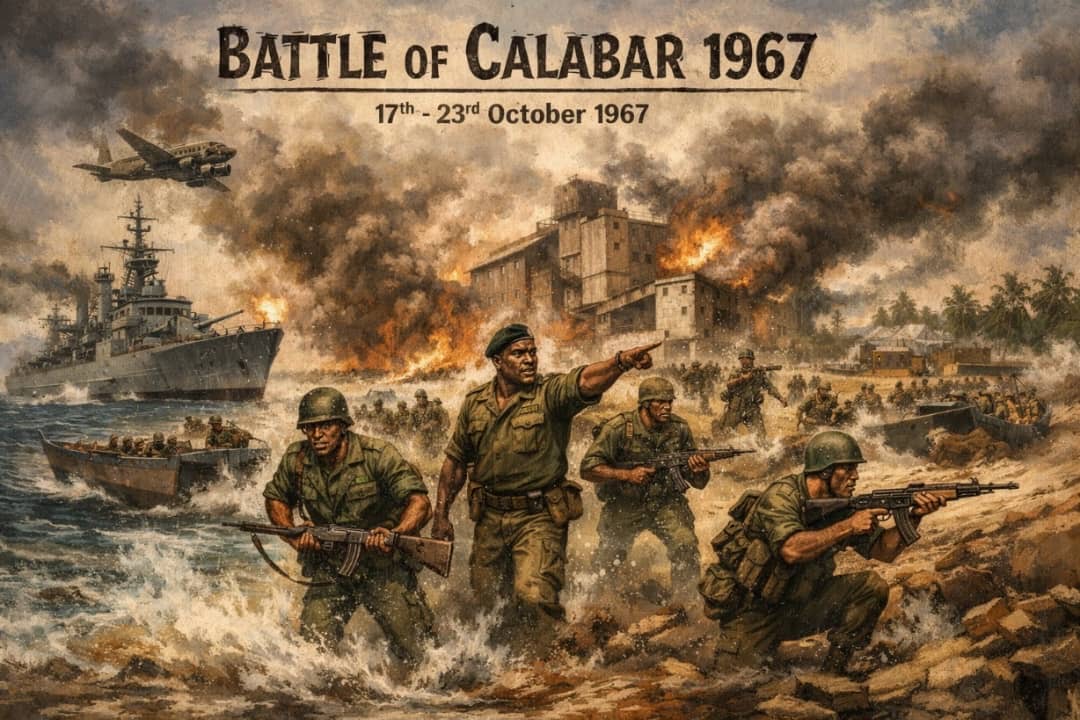
The battle for the liberation of Calabar was essentially an amphibious military operation carried out by combined Nigerian Navy forces and the Nigerian Army under the command of Brigadier General Benjamin Adekunle. On October 16, 1967, the naval force assembled, including the frigate NNS Nigeria, landing craft tank Lokoja, patrol ship Ogoja, survey ship Penelope, seaward defence boats Enugu and Bonny, along with civilian ships MV Bode Thomas, MV Oduduwa, and MV Warigi. The force departed for Calabar that same day.
On board the frigate NNS Nigeria was Major Anthony Ochefu of the 8th Battalion of the Nigerian Army, who on 17 October 1967 disembarked from Lokoja and successfully captured Calabar’s cement factory. Later that day, the Nigerian 33rd Battalion landed on Calabar’s beach, among them Colonel Adekunle himself. The small Biafran resistance was quickly overwhelmed, and Federal troops from the warships completed the landing in Calabar on 23 October 1967, securing the city.

This decisive operation not only marked a turning point in the Nigerian Civil War but also paved the way for the restoration of governance in the South Eastern State. With Calabar liberated, Brigadier General Esuene could finally assume office, ending the interim administration and ushering in a new phase of stability.
Conclusion:
The liberation of Calabar stands as a testament to the resilience of the Nigerian armed forces and the determination to restore order during one of the nation’s most turbulent periods. It also highlights the crucial role of interim leadership in sustaining governance until normalcy was restored. The events of 1967–1968 remain a defining chapter in the history of Cross River State and Nigeria at large.