By Okoi Obono-Obla
It is saddening and horrifying when misrepresentations, falsehoods, and distortions of historical events are propagated, especially concerning events that took place within living memory. In Nigeria, this tendency is often driven by political motives or sheer revisionism. Human memory can be treacherous, and some deliberately twist or misrepresent records, particularly in a country where politics is contentious and frequently ethnicized.
History is vital to national development because it provides an account of events, the roles played by individuals, and the factors that shaped a given epoch. Future generations must be able to study, analyze, and understand these events to chart the trajectory of their society.
General Ibrahim Babangida toppled the military regime of General Muhammadu Buhari, who had earlier overthrown the democratically elected government of President Shehu Shagari on October 1, 1979. By the late 1980s and early 1990s, global winds of change were blowing, particularly after the collapse of the Soviet Union following Perestroika and Glasnost. This reverberated in Nigeria, where pressure mounted on the military to return to the barracks and hand over power to a democratically elected government.

Babangida introduced a political transition program in 1985, scheduled to terminate in 1993. Initially, several political parties emerged after the lifting of the ban on political activities, but the regime later dissolved them by decree. In their place, the government created two parties: the National Republican Convention (NRC), leaning slightly to the right, and the Social Democratic Party (SDP), leaning slightly to the left.
These two parties contested the 1993 elections. Chief MKO Abiola was the presidential candidate of the SDP, while Alhaji Bashir Tofa represented the NRC. Bola Ahmed Tinubu was elected senator under the SDP, while Atiku Abubakar also sought the SDP presidential ticket but lost to Abiola at the Jos convention.
The military annulled the election results, despite Abiola’s victory. The ensuing crisis culminated in General Sani Abacha’s takeover of the Interim National Government in November 1993. Abacha dissolved democratic institutions and banned both the SDP and NRC, marking the end of the original SDP.
In the early 2000s, however, a new Social Democratic Party (SDP) was formed by a coalition of 13 parties. This revived SDP contested elections, including the 2015 general elections.
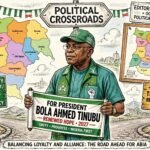
Therefore, it is ignorance, misrepresentation, and distortion for anyone to suggest that President Tinubu defected from the SDP to the Alliance for Democracy (AD), then to the Action Congress (AC), and later to the All Progressives Congress (APC). The truth is that the old SDP died in 1993, and the new SDP formed in the 2000s was an entirely different entity.
Conclusion:
The Nigerian experience underscores the importance of preserving historical truth. Distortions not only mislead future generations but also weaken national development by obscuring lessons from the past. History must be recorded faithfully, studied critically, and defended against revisionism, for it is the compass by which societies navigate their future.