
By Otunba (Dr.) Abdulfalil Abayomi Odunowo
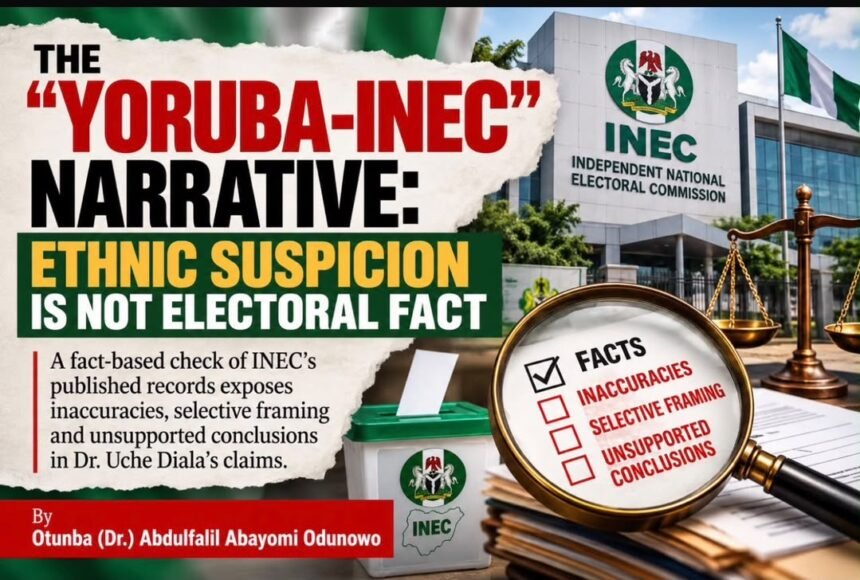
A review grounded in INEC’s own published records reveals factual errors, selective presentation and conclusions in Dr. Uche Diala’s claims that the evidence does not support.
There is an important difference between scrutinising a public institution and creating suspicion from partial facts. The former reinforces democracy; the latter weakens the very institutions democracy depends on. That distinction is blurred in the widely circulated article, “Is I-NEC Now YORUBA-NEC?”, attributed to Dr. Uche Diala. The article argues that INEC is drifting into Yoruba control through the appointment and redeployment of directors. It identifies seven departments as supposedly controlled by South-West interests, points to a recent redeployment, and encourages readers to see all this as a danger to electoral integrity. Allegations of that magnitude demand solid evidence. When measured against INEC’s official directors page and contemporaneous media reports, the case falls short.
The numbers do not support the claim

Diala’s argument starts from a count of 16 departments, seven of which he says are headed by South-West Yoruba officials. But INEC’s published headquarters directory contains 24 director-level entries. Earlier organisational references have also referred to 20 departments and directorates. The difference matters. Seven out of 16 is about 44 per cent. Seven out of 20 is 35 per cent. Seven out of 24 is roughly 29 per cent. Those are not minor variations; they produce substantially different impressions. Any claim of ethnic dominance must begin with an agreed denominator and verified ethnic classifications, not with disputed figures and untested assumptions.
Some of the ethnic classifications are plainly incorrect
The article presents the Planning and Monitoring Department as part of the supposed South-West bloc. INEC lists its director as Ajayi Helen O. Available biographical material identifies Helen Omozua Ajayi as an indigene of Ihievbe in Owan East Local Government Area of Edo State, which is in the South-South, not the South-West. A surname does not establish a person’s state of origin.
The Commission’s Secretariat is headed by Olayide Dorcas Okuonghae. Available information has linked her to Kwara State in the North-Central zone. Yoruba communities are not confined to the South-West, and ethnicity is not the same thing as geopolitical zone. Any serious federal character assessment must rely on verified states of origin rather than assumptions drawn from names.
A redeployment took place, but motive has not been proved
In October 2026, Isah Magaji Gummi was transferred from Electoral Operations to Voter Registry, and Titilayo Oluyemi Adeyemi-Showunmi moved from INEC’s Lagos office to Electoral Operations. That change appears in INEC’s published directory and was reported by Daily Trust and other outlets. It is entirely proper to question such a move.
But an acknowledged administrative redeployment is not, by itself, evidence of an ethnic plot. Who approved it? What explanation was given? Were the proper procedures observed? Was it one part of a wider reshuffle? The article offers no documentary proof that the change was designed to place political control of elections in the hands of any ethnic group. To move from an established personnel decision to an implied tribal agenda requires evidence the piece does not provide.
Federal character is a constitutional principle, not an ethnic instrument
Section 14(3) of the Constitution establishes the federal character principle to prevent sectional domination. If INEC appointments have disproportionately favoured a particular state, region or group in violation of that principle, Nigerians have every right to demand disclosure and correction. But that judgment must be based on documented states of origin, staffing rules, recruitment and promotion procedures, and the institutional composition of INEC as a whole, not on a selective list of names assigned ethnic labels.
A Yoruba professional is not automatically compromised because the President is Yoruba. The same principle applies to every other Nigerian. Public officials should be assessed by their conduct, qualifications, obedience to the law and the integrity of the systems they administer.
Departmental leadership is not the same as control of elections
INEC does not function as a patchwork of ethnic enclaves. Its operations involve the Commission’s constitutional leadership, national commissioners, Resident Electoral Commissioners, administrative departments, electoral officers, party agents, observers and legal processes. Departments such as ICT, Electoral Operations, Procurement, Voter Registry and Audit handle sensitive responsibilities, but those functions are meant to be governed by strong safeguards, including documented approvals, separation of duties, audit trails, access controls and independent review. A director’s ethnicity does not, on its own, determine electoral outcomes. Nigeria’s electoral integrity cannot be reduced to a count of surnames.
Selective facts can manufacture political narratives
The “YORUBA-INEC” article begins with a provocative headline, names a group of supposedly connected directors, highlights a redeployment, and invites readers to infer ethnic capture. It says it is not suggesting more than what a reasonable Nigerian might conclude. Yet its wording plainly steers readers toward exactly that suspicion. Anyone demanding transparency from INEC should be willing to apply the same evidentiary standard to his own claims.
The material examined here does not establish that Diala acted with deliberate dishonesty or political intent. What it does show is that the argument contains significant factual weaknesses and reaches beyond what the evidence can bear. In a polarised climate, repeated assertions of ethnic capture can erode public confidence well before any misconduct is actually proved. That danger is particularly grave when the institution involved is responsible for conducting national elections.
What should have been done, and what INEC should still do
Before making allegations of this kind public, the author needed a complete list of headquarters directorates, verified states of origin for each director, a clear separation between ethnicity and geopolitical zone, and evidence connecting any imbalance to unlawful appointments, political interference or compromised procedures. Without those elements, the argument rests on incomplete ground.
That does not absolve INEC of responsibility. The Commission should publish an authenticated and current register of its headquarters departments, directors and verified states of origin. It should also explain the October 2026 redeployments and the procedures followed in making them. Where legitimate concerns arise, the Federal Character Commission should be ready to review compliance records. An independent electoral body must be transparent enough for Nigerians to judge its impartiality for themselves.
The real danger is allowing ethnicity to displace evidence
Nigeria has paid dearly for ethnic mistrust. Institutions must not become spaces where every appointment is interpreted through ancestry and every administrative action is assumed to conceal a tribal design. Real discrimination must be demonstrated with records, not inferred from surnames. If a federal character violation occurred, produce the documents. If procedure was breached in a redeployment, specify the breach. If an official interfered with an election, investigate and prosecute. Ethnic insinuation is no substitute for evidence, and an unverified claim should not be elevated into a national crisis simply because it is politically useful.
Conclusion
The “YORUBA-INEC” narrative does not withstand factual examination. It depends on incorrect or unsupported classifications, an unresolved contradiction in the number of directorates, and a documented redeployment whose alleged political purpose remains unproved. None of this means INEC should be immune from criticism or that its staffing necessarily complies fully with federal character requirements. It does mean the available evidence does not support the claim that INEC has become an institution under Yoruba political control.
Dr. Diala has every right to question appointments and insist on transparency. But those rights come with a corresponding obligation to present accurate information and to distinguish between fact and allegation. Nigeria’s democracy is not strengthened by treating every Yoruba official as an agent of the President, every redeployment as a conspiracy, or every incomplete personnel list as proof that elections have been captured.
What Nigeria needs is an INEC that is independent, capable, transparent and accountable to all Nigerians. It also needs public commentary that meets the same standard of evidence. Appointments should be investigated without demonising ethnic identity. Federal character should be defended without bending the facts. And the credibility of elections should be protected without drawing conclusions the evidence cannot support.
Otunba (Dr.) Abdulfalil Abayomi Odunowo writes on governance, democratic institutions, national development and public accountability.