by Okoi Obono-Obla
Background
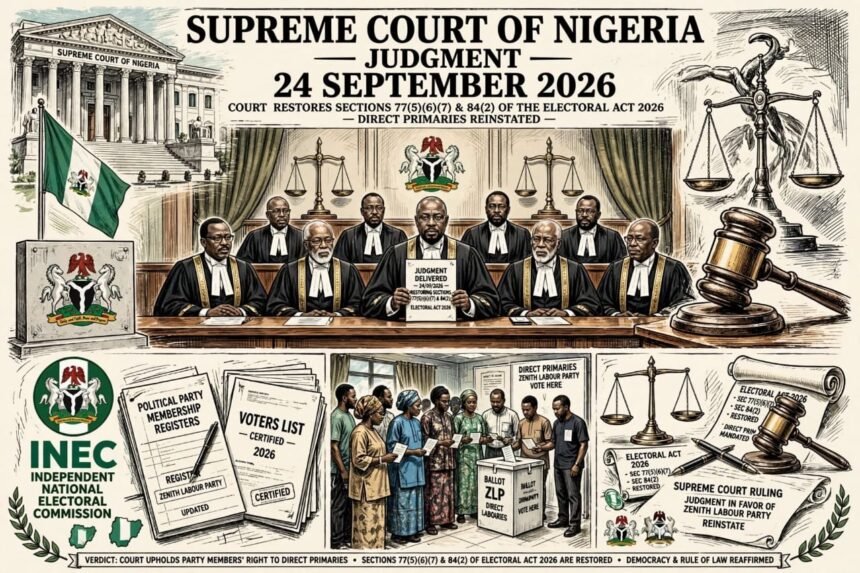
On Thursday, September 24, 2026, a seven-member panel of the Supreme Court led by Justice Adamu Jauro allowed the appeal filed by the Independent National Electoral Commission in SC/CR/495/2026 and set aside the judgment of the Court of Appeal, Abuja Division delivered on July 16, 2026.
The origin was Suit No. FHC/ABJ/509/2026 filed by Zenith Labour Party (ZLP) challenging the constitutionality of Sections 77(5), 77(6), 77(7) and 84(2) of the Electoral Act 2026.

Justice Mohammed Umar of the Federal High Court Abuja had on May 5, 2026 dismissed ZLP’s suit for lacking merit. On appeal in CA/ABJ/CV/750/2026, the Court of Appeal partly allowed ZLP’s appeal and struck down the provisions, holding they conflicted with Sections 221 and 222 of the 1999 Constitution governing political parties.
INEC, represented by Dr Alex Izinyon, SAN, appealed to the Supreme Court. On September 24, the apex court reversed the Court of Appeal, restored the Federal High Court judgment, held that the provisions are not inconsistent with the Constitution, and awarded N2 million costs against ZLP.
What the Restored Provisions Say
The judgment restores the full statutory regime for membership registers and nomination:
Section 77(5): Only persons whose names appear in the membership register submitted to INEC not later than 21 days before the date fixed for a primary, congress or convention are eligible to participate in the exercise.
Section 77(6): Prohibits a political party from using a membership register other than the one submitted to INEC for its primaries, congresses and conventions.
Section 77(7): A political party that fails to submit its membership register within the prescribed period is not eligible to field a candidate for the election.
Section 84(2): The procedure for nominating candidates for elective offices shall be by direct primaries or consensus. This excludes indirect primaries.
Immediate Legal Implications
1. Finality and Constitutional Settlement
The Supreme Court has settled the long-running debate on the relationship between party autonomy under Sections 221/222 of the Constitution and the National Assembly’s power to regulate elections under Section 228. The Court held that regulating membership registers and nomination methods is permissible electoral regulation, not an unconstitutional encroachment on internal party affairs. The Court of Appeal’s view that ordinary legislation cannot introduce disqualifying conditions has been rejected.
2. The Death of Indirect Primaries for 2027
Section 84(2) as restored makes direct primaries and consensus the only lawful modes. Any party constitution or guideline providing for indirect delegate primaries is now void to that extent. The litigation had generated considerable debate because it went to the relationship between constitutional autonomy of parties and the National Assembly’s power to prescribe rules.
3. Strict Enforcement of the Membership Register Regime
The combined effect of Sections 77(5)-(7) is far-reaching:
Submission must be at least 21 days before primaries. INEC fixed the last day for primaries for 2027 as May 30, 2026, meaning May 9, 2026 was the effective last day for submission.
Only members on the INEC-filed register can vote or be voted for.
Use of any other register, including a parallel or updated register created after submission, invalidates the exercise.
Failure to submit on time equals loss of right to field candidates.
The Supreme Court noted that the Court of Appeal had not removed the general obligation to maintain registers, but had invalidated the specific restrictions and consequences in 77(5)-(7). Those restrictions have now been restored.
4. INEC’s Powers Affirmed
With this judgment, INEC’s position that the statutory provisions should remain operative has prevailed. INEC can now legally:
Reject a primary monitored where voters were not on the submitted register
Reject a candidate whose party failed to submit register
Verify registers and enforce compliance during congresses and primaries
Reports also indicate that on the same day, the Supreme Court dismissed separate appeals filed by Social Democratic Party (SDP) and Youth Party against INEC, which formed part of a cluster of litigation concerning INEC’s electoral framework.
Political Implications for Parties
For Zenith Labour Party (ZLP):
ZLP loses its constitutional challenge entirely, bears N2m costs, and must now comply with the provisions it sought to invalidate. Its membership management and primary planning must conform to the direct/consensus model.
For All Other Parties, including NDC and ADC:
The judgment is in rem – it binds all parties. The rush by parties to meet INEC’s deadline which was extended from March 27 to May 10, 2026, now has constitutional backing. INEC confirmed that all 22 registered parties, including NDC and ADC, complied within the extended timeframe.
However, compliance now has teeth. A party that submitted a register but later conducts its primary with persons not on that register risks nullification.
The Unresolved Frontier: Post-Primary Defections and the Consensus Loophole
The judgment does not directly decide whether a politician who loses a primary in Party A can defect to Party B and be nominated via consensus after the register submission deadline.
Current practice shows parties using waiver and consensus to accommodate defectors like Senator Ovie Omo-Agege who resigned from APC on May 22 after losing the Delta Central primary and was granted NDC waiver on May 28 for the same seat. Lawyers argue the register requirement applies only to primaries, not consensus, creating a loophole.
The Supreme Court’s restoration of 77(5)-(7) significantly strengthens INEC’s argument that the register requirement is a condition precedent for any nomination, including consensus. If INEC’s pending appeals on this point succeed, such consensus nominations of post-deadline defectors could be disqualified.
Conclusion
The September 24 judgment is arguably the most important pre-election judgment for 2027. It:
Re-affirms the validity of Sections 77(5),(6),(7) and 84(2)
Makes direct primary or consensus mandatory
Makes the INEC-filed membership register the sole legal register for all party democratic exercises
Attaches severe consequence of disqualification for non-compliance
Political parties must now audit their registers, align their constitutions to exclude indirect primaries, and conduct their primaries strictly on the basis of registers already submitted to INEC. Any attempt to circumvent through late registers or parallel primaries will now fail the constitutional test as settled by the Supreme Court.