

By Okoi Obono-Obla
For decades, one of the most fundamental challenges to our national development has been a simple question: “Where are you?”
In many parts of Nigeria, an address is a description, not a location. “Behind St. John’s Church, after the second transformer, ask for Mama Emeka’s compound.” This informality has cost us dearly. It has delayed ambulances, frustrated e-commerce, defeated emergency responders, and according to estimates, caused between N50 billion and N80 billion annually in failed deliveries and logistics losses. A nation cannot plan, tax, or prosper when it does not know where its people live.
That era is now coming to an end with one of the most important yet quietest innovations in our information and communications sector – the National Digital Alphanumeric Postcode System.

This is, without doubt, one of the greatest achievements of the administration of President Bola Ahmed Tinubu, GCFR.
What Is It In Practical Terms?
A digital postcode is not the old six-digit postcode we knew – like 900001 for Garki. That old code covers thousands of buildings.
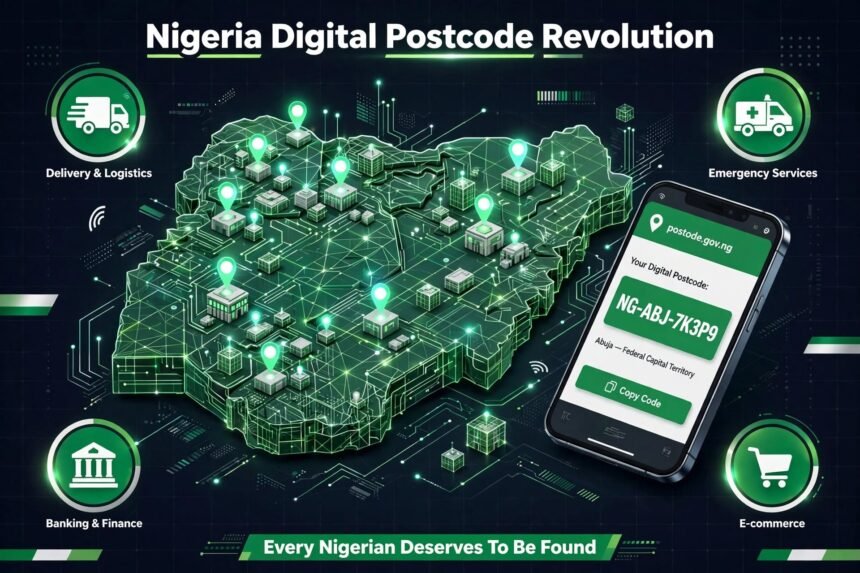
The new digital postcode is an 11-character code – a mix of letters and numbers – assigned to ONE building. Your house, your shop, your office, your factory now has its own unique digital identity on the national map.
Think of it as your building’s fingerprint. While the old postcode told a postman the area, the new digital postcode tells a drone, an ambulance, a courier, or a bank exactly which door is yours to within 4 metres.
How Does It Work?
The concept is simple but revolutionary. The Federal Government, through the Nigerian Postal Service (NIPOST), in collaboration with the Office of the Surveyor General of the Federation, the National Space Research and Development Agency (NASRDA) and the National Population Commission, has divided the entire Nigerian landmass into tiny grids.
Each grid is geo-coded using GPS coordinates.
The process for every Nigerian is now straightforward:
Visit the official portal: postcode.gov.ng or postcode.gov.ng/find
Allow the system to detect your location or type your address. The system searches through five levels: State, Local Government, District, Area and Building.
Verify your building on the map.
Copy your 11-character code, save it and begin to use it.
It is free for individuals. It can be accessed via the mobile app and even via USSD for those without smartphones. The code belongs to the building. If you move, you simply use the code of your new building. It complements, not replaces, your street address.
How Will It Enhance National Development?
The implications for national development are profound and far-reaching.
First, it unlocks the economy. With precise addressing, logistics and e-commerce will explode. Small businesses in Aba, Onitsha and Lagos can now dispatch goods with confidence. The cost of “last-mile delivery” – the most expensive part of commerce – will crash. More trust means more online transactions and more jobs.
Second, it revolutionizes governance and planning. For the first time, Nigeria will have a truly addressable population. Planning for schools, hospitals, roads, power and water can be based on actual, verifiable data of where people live, not estimates. Census, voter registration, and social intervention programmes can be targeted accurately.
Third, it saves lives. When every building is findable, the response time for ambulances, fire service and security agencies is cut drastically. In an emergency, you will not need to describe your location. You will simply share your digital postcode.
Fourth, it drives financial inclusion. One of the biggest barriers to credit and bank verification has been address verification. With a standardized digital address that can be verified across banks, fintechs and government KYC platforms, millions of previously “unaddressable” Nigerians can now access credit, open accounts and build a financial footprint.
This is what is meant by Digital Public Infrastructure. Like NIN and BVN, the digital postcode is a foundation upon which other innovations – from ride-hailing to drone delivery to insurance – will be built.
A Tribute To Quiet, Transformative Leadership
Great reforms are not always loud. Some of the most enduring achievements are done quietly, with focus and technical depth.
We must pay special tribute to President Bola Ahmed Tinubu for providing the political will and vision to see this through as part of his Renewed Hope agenda to build a $1 trillion digital economy. Where previous governments talked about addressing reform, this administration has delivered it.
In particular, Nigerians owe a debt of gratitude to the Honourable Minister of Communications, Innovation and Digital Economy, Dr. Bosun Tijani. Since his appointment, he has worked quietly, without noise or self-promotion, to modernize the very foundations of our digital economy. The digital postcode system, operated by NIPOST under his ministry, is a testament to that quiet, competent and revolutionary work.
He understood a simple truth: that every Nigerian, whether in Maitama or in a remote village in Cross River, deserves to be found, to be counted, and to be served.
It is now our duty as citizens to embrace it. I urge every Nigerian to go to postcode.gov.ng, find your code, and begin to use it. Share it with your family, your customers, and your business partners.
For when every Nigerian can be found, Nigeria itself will find its path to true development.