By Okoi Obono-Obla
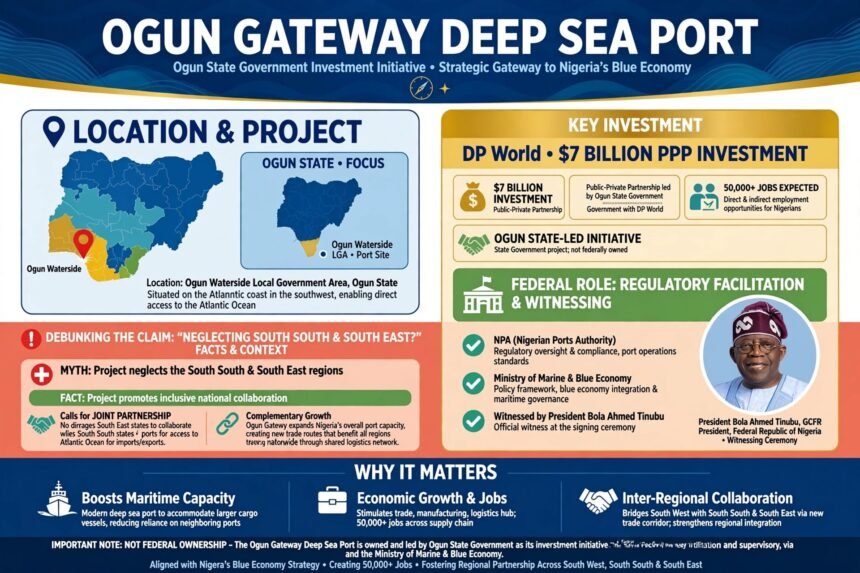
The announcement that construction of the $7 billion Gateway Deep Sea Port and Ogun State Blue Marine Special Economic Zone will commence in November has again triggered a familiar and misleading narrative — that the Federal Government is concentrating port development in the South-West while neglecting the South-South and South-East.
That impression is false and it deliberately conflates two different things: state-driven investment initiatives and federal port development.
The facts are clear. The Ogun Gateway Deep Sea Port is an investment initiative of the Government of Ogun State. The Ogun State Government is the sponsor, providing the land and the investment framework. The investor and operator is DP World MEA FZE, one of the world’s largest port operators, which is bringing over $7 billion in foreign direct investment and is expected to create more than 50,000 direct jobs. The project was revived by Governor Dapo Abiodun after being abandoned for over three decades.

The Federal Government’s role was what it should be for any state port — regulatory facilitation. President Bola Tinubu witnessed the signing of the MoU in Paris alongside the Minister of Marine and Blue Economy and the Director-General of the Nigerian Ports Authority. Witnessing and assuring investors of federal backing is not ownership, is not funding, and is not evidence of regional favouritism. Every deep sea port in Nigeria, wherever located, requires the same federal clearance.
This is the same model that delivered Lekki Deep Sea Port in Lagos — a Lagos State and private consortium project, not a federally funded port.
You cannot blame the Federal Government if some states have failed to get their priorities right and to do the hard work of making their port proposals bankable. A deep sea port does not happen by press statement. A state must acquire the land, fund feasibility studies, bathymetric surveys, Environmental and Social Impact Assessments, secure a credible global operator, and present a bankable business case that can attract billions of dollars.
The Federal Government cannot back what has not been presented in a bankable form.
Those who claim neglect must answer a simple question: Where is the evidence that the Nigerian Ports Authority, the Federal Ministry of Marine and Blue Economy, or any federal regulatory agency deliberately refused to grant approval or backing to a fully funded, technically complete deep sea port proposal from the South-South or South-East?
Until such evidence is presented, the complaint has no foundation. Regulatory backing is not denied on the basis of region. It is granted on the basis of readiness.
Ogun State has shown what readiness looks like. It went out, negotiated with a world-class operator, structured a $7 billion deal, and brought it to the point of groundbreaking. Other states are free and encouraged to do the same. The Federal Government has repeatedly stated its commitment to deep sea ports in Ibom, Calabar, Agge, Ogidigben and other locations. What those projects need is not social media agitation, but the same investor mobilization and project preparation that Ogun has demonstrated.
The Ogun Gateway Deep Sea Port is a victory for sub-national investment drive under a business-friendly federal environment. It should be celebrated as proof that Nigerian states can attract mega-investments, not twisted into a story of regional neglect.
South-South states that are interested in attracting similar investments should study and emulate what Ogun State did to get its own project on a sound footing, rather than the opposition raking up all sorts of flimsy excuses, blaming others instead of themselves, or simply crying wolf over nothing.
Furthermore, it is important to note the geographical reality: the South-East is landlocked. It has no direct coastline. For the South-East to have access to the sea, it would require a joint partnership and collaborative venture with one of the South-South states that have direct access to the Atlantic Ocean or the Gulf of Guinea. That is how regional economic integration works — through collaboration, not through unfounded accusations against the Federal Government.