By Okoi Obono-Obla
My attention has been drawn to a remark credited to Mr. Summer Sambo, Anchor on Arise Television, not as an interviewee but in the course of his analysis on air, where he stated:
“It is very clear that there is a pending case in court against any candidate which has not been exhausted yet. That judgment cannot be implemented retroactively because when INEC received some of those names and published them, it was based on a Court of Appeal judgment.”
For clarity, Mr. Sambo did not grant an interview to Arise TV; he made the remark as an anchor on Arise Television. With the greatest respect to him, the remark does not represent the correct statement of the law.

1. The concept of retroactivity applies to legislation, not to judgments.
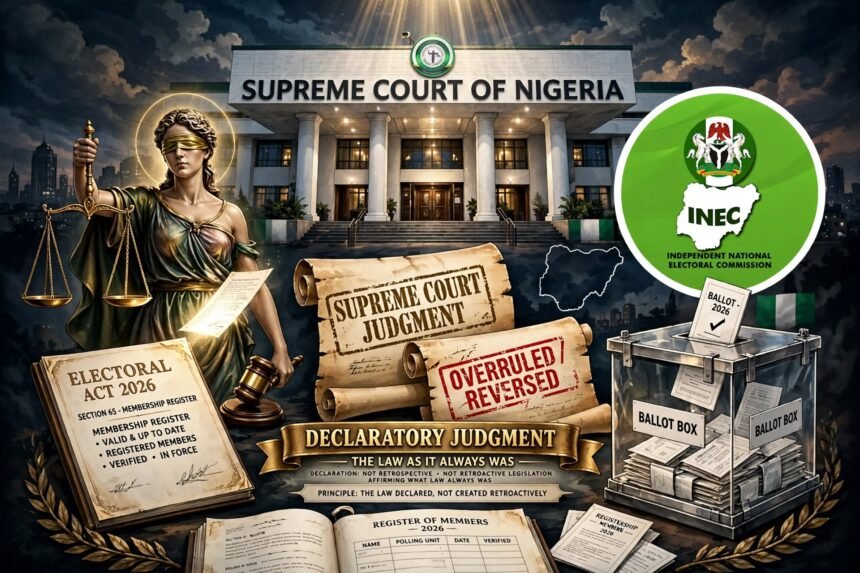
Mr. Sambo’s analysis confuses retroactive legislation with the declaratory nature of a judicial decision. The legislature makes law prospectively. The court declares what the law has always been.
The Supreme Court in Appeal No. SC/CR/495/2026 delivered on 24th September 2026 did not make new law. It set aside the judgment of the Court of Appeal, Abuja Division delivered on 16th July 2026 which voided Sections 77(5)(6)(7) and 84(2) of the Electoral Act 2026, and restored the judgment of the Federal High Court.
As Dr. Ahmed Raji SAN rightly observed on this issue: “The Supreme Court merely pronounced the state of the law. The issue of being retroactive does not arise. What it means is that the law has always been what the Supreme Court said it is.”
Once set aside, the Court of Appeal judgment is deemed never to have correctly stated the law. A party cannot claim a vested right to remain on INEC’s list on the basis of reliance on a judgment that no longer exists.
2. Section 287(1) of the 1999 Constitution (as amended).
Decisions of the Supreme Court are binding on all authorities and persons, including INEC. INEC is constitutionally obligated to give effect to the Supreme Court judgment, not to continue to act on a voided Court of Appeal judgment.
3. The proper distinction is between enforcement of a judgment and exercise of regulatory power.
It is correct that the Supreme Court judgment in INEC v Zenith Labour Party was not against any individual candidate and cannot be individually enforced against candidates or parties who were not parties to the suit.
However, it is incorrect to conclude that INEC is therefore barred from acting.
What the Supreme Court judgment did was to revive INEC’s regulatory authority under the Electoral Act 2026. INEC does not proceed as a judgment creditor executing a judgment against non-parties. It proceeds as a regulator applying the law as now validly declared.
There cannot be individualized enforcement of that judgment against candidates who violated Sections 77(5)(6)(7) and 84 as a result of the judgment, but INEC can proceed and invoke its regulatory authority and move against candidates filed by political parties that violated those sections. If on the face of INEC’s records a party failed to submit a membership register, used a different register from the one submitted, or nominated outside direct primaries or consensus, INEC can act under the Act.
That is not retroactive enforcement of a judgment; it is enforcement of extant law.
4. INEC must still act within due process.
Where compliance is patent on INEC’s records, INEC can reject. Where compliance is disputed and requires investigation of facts – when a person joined a party, whether his name was on the register, whether a primary was properly conducted – that raises a pre-election dispute to be ventilated under Section 285(14) and Section 84(14) of the Electoral Act, not by automatic administrative delisting.
To argue that the Supreme Court judgment “cannot be implemented retroactively” because INEC published names based on the Court of Appeal judgment is, with respect, not a correct statement of the law.