Otunba (Dr.) Abdulfalil Abayomi Odunowo
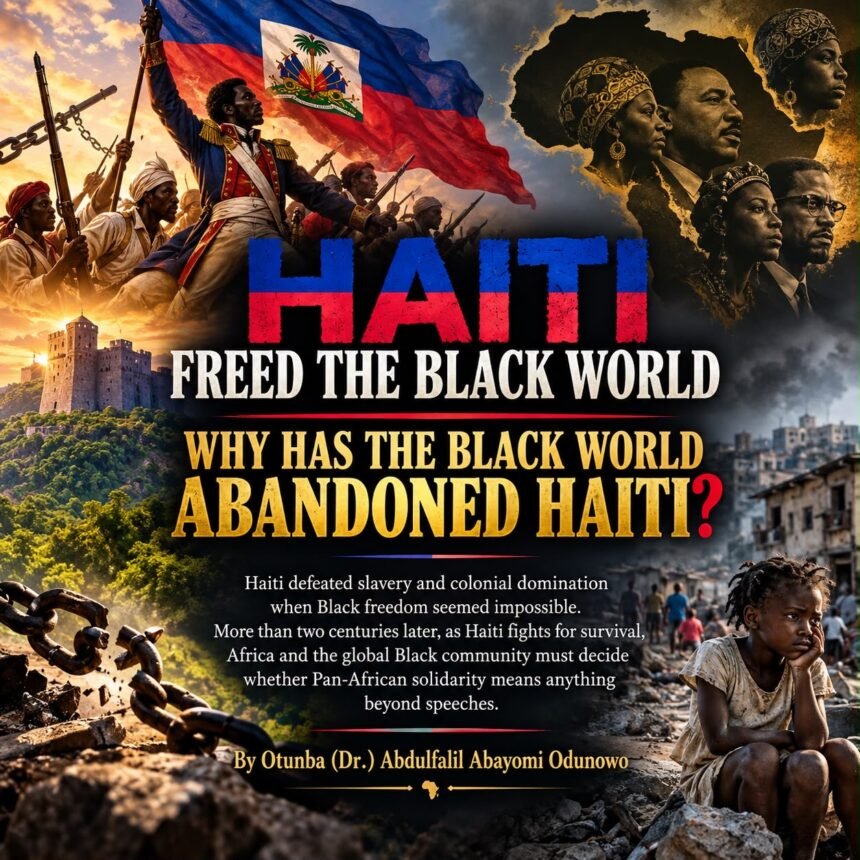
Haiti defeated slavery and colonial domination when Black freedom seemed impossible. More than two centuries later, as Haiti fights for survival, Africa and the global Black community must decide whether Pan-African solidarity means anything beyond speeches.
By Otunba (Dr.) Abdulfalil Abayomi Odunowo
There is a painful question the Black world can no longer avoid: Where are we while Haiti bleeds?

Where are Africa, the Caribbean, our business leaders, foundations, universities and institutions? Where are those of us who speak passionately about slavery, colonialism, racism, Pan-Africanism and Black liberation?
If there is one country whose history should command the attention of people of African descent, it is Haiti.
Haiti was not simply another colony that eventually became independent. Haiti shattered the assumption that Black people were destined to remain enslaved. In 1804, formerly enslaved Africans and their descendants defeated Napoleon’s forces, destroyed the colonial slave system and proclaimed an independent Black republic the first in the world. At a time when millions of Africans remained in chains across the Americas, Haiti announced something revolutionary: Black people could liberate themselves and govern themselves.
That victory belonged not only to Haiti. It belonged to Black humanity.
They Won Their Freedom Then Paid for It
Haiti’s punishment did not end on the battlefield. In 1825, France demanded an enormous indemnity in return for recognising Haiti’s independence. French warships appeared off Haiti’s coast. The original demand was 150 million gold francs later reduced to 90 million in 1838. To meet it, Haiti was forced to borrow, creating the infamous “double debt”: the indemnity itself plus the loans and interest required to pay former slaveholders for the loss of their “property.”
Historians and economists have calculated that Haiti paid roughly the equivalent of $560 million in today’s dollars. The long-term economic cost capital drained away that could have built roads, schools, hospitals and industry has been estimated between $21 billion and $115 billion in lost growth. Payments and related obligations stretched for generations.
Freedom had been won with blood. Then freedom came with a bill that crippled the young republic for more than a century.
This history does not excuse every failure of subsequent Haitian governments. Haiti has endured dictatorship, corruption, political violence and institutional weakness for which domestic actors also bear responsibility. Historical honesty requires us to acknowledge both realities: Haiti has suffered from internal failures, but it also entered independence carrying extraordinary external burdens that no other newly independent nation faced in the same way.
Today, Haiti Is Fighting Another War
The enemy today is different but no less deadly.
Haiti now confronts heavily armed criminal organisations that control large parts of Port-au-Prince (estimates range from 80 to 90 percent of the capital) and have expanded into Artibonite, Centre and other departments. By September 2026, nearly 1.5 million Haitians about 12 percent of the population had been internally displaced, according to the International Organization for Migration.
The United Nations estimates that approximately 6.4 million people more than half the population require humanitarian assistance. Roughly 5.8 million face acute food insecurity. Schools have closed, health facilities have been attacked or abandoned, businesses shuttered, families torn apart. Sexual violence is used as a weapon of control. Children are recruited by gangs. This is not another distant international news story. A historic Black republic is fighting to prevent the collapse of its state. And much of the Black world remains remarkably quiet.
What Africa Has Already Done and Why It Is Not Enough
It is not true that Africa has done nothing.
Kenya stepped forward to lead the Multinational Security Support mission, deploying hundreds of police officers at significant cost and risk. Chad has committed 1,500 troops to the expanded Gang Suppression Force, with the first contingents already arriving in 2026. Benin earlier pledged up to 2,000 personnel. Other African nations including Sierra Leone, Burkina Faso, Gambia and Burundi have offered contributions.
The African Union has repeatedly affirmed Haiti as part of Africa’s “Sixth Region” and used its voice at the United Nations through the A3+ group. Afreximbank provided half a million dollars in recovery support after Hurricane Melissa. After the 2010 earthquake, more than twenty African countries coordinated donations and solidarity, with Morocco, Ghana, the Democratic Republic of Congo, Equatorial Guinea, Nigeria and others contributing millions. These acts matter. They prove that African solidarity is possible.
But they remain limited relative to the scale of the crisis and relative to the debt of history. A few hundred or even a few thousand security personnel, modest financial pledges and diplomatic statements cannot substitute for sustained, continental-scale partnership. Haiti needs more than episodic gestures. It needs a generation of commitment.
Pan-Africanism Cannot End at the Atlantic
Africa cannot celebrate Haiti’s revolution while treating Haiti’s present struggle as somebody else’s problem. We invoke Nkrumah, Garvey and Lumumba. We remember the Middle Passage, condemn colonialism and speak of African unity. Those principles must have practical meaning or they become empty ritual.
Across Africa and its global diaspora stand governments, development institutions, major corporations, universities, philanthropists, doctors, engineers, agricultural experts, security specialists, educators and entrepreneurs. Africa alone cannot solve Haiti’s crisis, nor should outsiders determine Haiti’s political future. But the Black world can and must organise something more substantial than sympathy and sporadic deployments.
Haiti Needs Solidarity, Not Another Master
Helping Haiti must never mean controlling Haiti. Its history contains enough foreign interference to explain deep and justified suspicion of solutions designed elsewhere. The principle should be simple: Haitian sovereignty, Haitian leadership and Haitian institutions strengthened by international partnership. Foreign assistance should ultimately reduce Haiti’s dependence on foreign assistance. Anything else risks repeating history.
What Nigeria and Africa Must Do Now
The time for speeches is over. Nigeria, as Africa’s most populous nation and a historic voice for Black liberation, together with willing African governments, the African Union, CARICOM partners and the global African diaspora, should drive an Africa–Caribbean Haiti Recovery Compact with clear, measurable deliverables:
1. Establish a Haiti Reconstruction and Solidarity Fund. Transparent, professionally managed, open to contributions from private individuals and African governments, businesses, diaspora organisations, philanthropists and international partners. Prioritise hospitals, schools, clean water, electricity, agriculture, roads and small-business credit.
2. Scale up support for Haitian security and justice institutions. Training, equipment, intelligence cooperation, forensic capacity and institutional strengthening aimed at building lasting Haitian capacity, not permanent foreign presence. Honour and expand the contributions already made by Kenya, Chad and others.
3. Follow the weapons and the money. Target the transnational networks supplying arms, ammunition and finance to the gangs. Sanctions, investigations and prosecutions where evidence and law permit.
4. Launch a major Haitian scholarship and professional training programme across African universities. Reserve places in medicine, engineering, agriculture, education, public administration, information technology and other fields essential to reconstruction. Imagine a generation of Haitian professionals educated in Lagos, Accra, Nairobi, Kigali, Johannesburg, Dakar and elsewhere, equipped to return and rebuild their country. That is Pan-Africanism converted into human capital.
5. Build direct Africa–Caribbean trade and investment. Solidarity without economic relationships remains fragile. Expand shipping, aviation, telecommunications, agriculture and productive investment. Humanitarian aid can sustain life in an emergency. Productive capacity sustains a nation.
6. Put Haiti’s historic independence debt firmly on the international agenda. The circumstances of the 1825 indemnity deserve rigorous examination by historians, economists, diplomats and legal scholars. Reparatory justice and the hard work of building functioning institutions can and must coexist.
And immediately, without waiting for any compact: teach the Haitian Revolution in African schools. An African child should not complete secondary education knowing European revolutions in detail while knowing almost nothing of the revolution in which enslaved Africans defeated slavery themselves. Toussaint Louverture, Jean-Jacques Dessalines, the brutality of Saint-Domingue, the independence debt and Haiti’s subsequent struggles belong in the history of African liberation.
This Is Not Charity
Haiti does not need the Black world to arrive as a saviour. It needs partners willing to support Haitians as they restore security and rebuild functioning institutions. The question is not “How do we save Haiti?” It is “How can we support Haitians in rebuilding Haiti?” The distinction is fundamental. One assumes helplessness; the other respects sovereignty and dignity.
From Port-au-Prince to Lagos
The Atlantic separated Africa from millions of its children. Slavery and colonialism scattered and divided generations. Yet history remains connected.
A child in Port-au-Prince and a child in Lagos may carry different passports, speak different languages and inherit different national histories. But their stories meet in the larger narrative of African survival, resistance and the unbreakable demand for freedom.
Haiti demonstrated in 1804 that the chains surrounding Black people were not unbreakable. That message travelled far beyond the Caribbean. Today solidarity must travel in the other direction through education, investment, professional expertise, technology, institution-building, trade and capital. Not domination. Partnership.
Haiti Must Not Stand Alone
The greatest tribute we can pay to those who fought the Haitian Revolution is not another speech about what they accomplished more than two centuries ago. It is helping their descendants build a country worthy of their sacrifice.
Black unity means little if it exists only when unity costs nothing.
Let African institutions work with their Caribbean counterparts. Let universities create opportunities for Haitian students. Let businesses explore responsible investment. Let philanthropists support reconstruction. Let diplomats cooperate on security, development and historical justice. Let Nigeria, as a natural leader of continental ambition, convene and catalyse. And above all, let Haitians determine Haiti’s future.
In 1804, Haiti confronted an international order that treated Black human beings as property and proved that freedom could be seized even against extraordinary odds. That achievement echoed across generations. Now solidarity must echo back.
Not because Haiti is perfect. Not because its governments have never failed. Not because Africa possesses unlimited resources. But because history carries obligations, and solidarity becomes meaningful only when translated into action.
Haiti once stood at the front line of the struggle for Black freedom. The Black world led by Nigeria and the nations of Africa must not leave Haiti standing alone in the struggle to secure its future.
HAITI FOUGHT FOR FREEDOM.
NOW SOLIDARITY MUST BECOME ACTION.
Otunba (Dr.) Abdulfalil Abayomi Odunowo
National President SCN
SpeakUp Collective Nigeria.