
By Otunba (Dr.) Abdulfalil Abayomi Odunowo
Some dates fade into history. Others stay with us.
For the Nigerian military, September has come to hold too many of the latter.
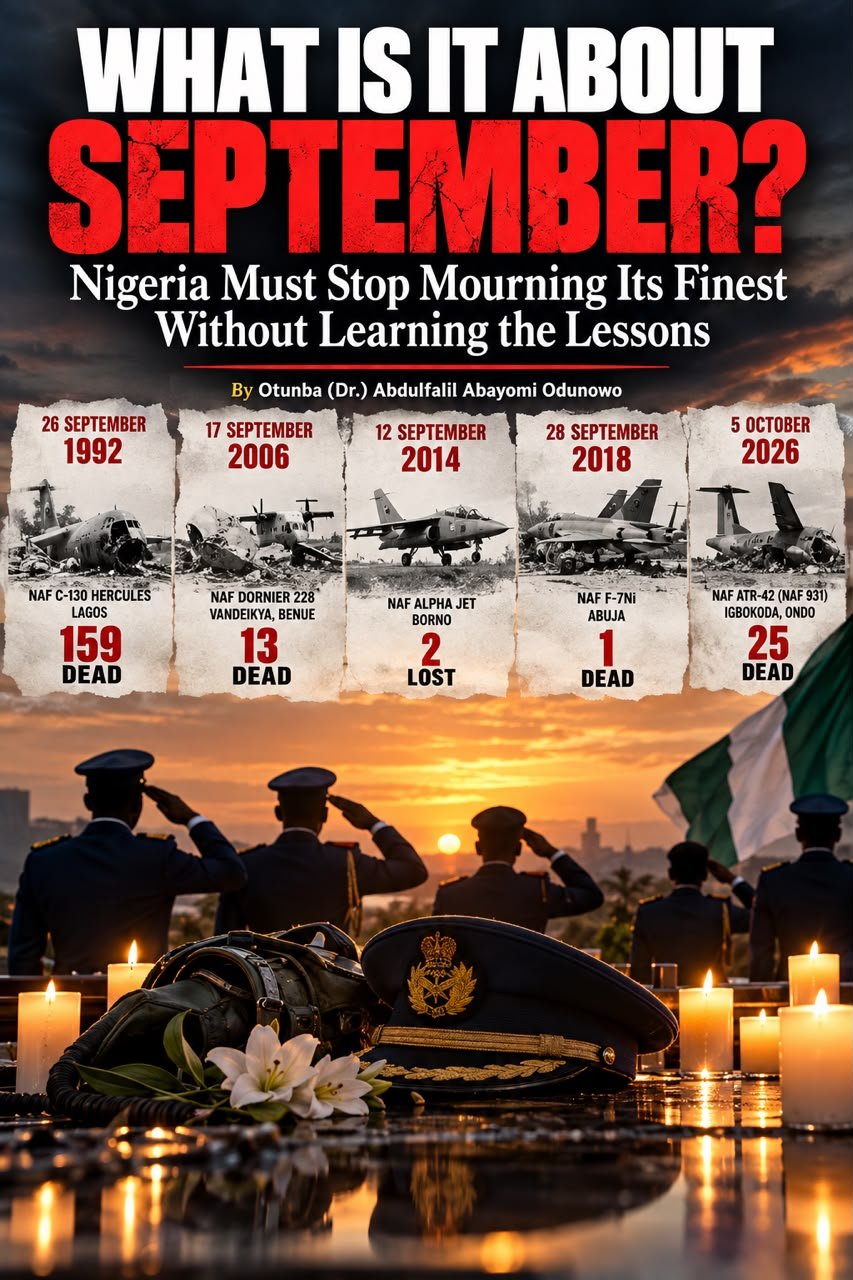
26 September 1992.
17 September 2006.
12 September 2014.
28 September 2018.
And now, just days after September closed, 5 October 2026 has joined the nation’s ledger of sorrow.

Twenty-five more lives.
Twenty-five families.
Twenty-five Nigerians who boarded a Nigerian Air Force aircraft expecting to reach their destination, but never did.
The Nigerian Air Force ATR-42, designated NAF 931 (also referred to as NGR 931), was travelling from Benin City to Lagos on Monday, 5 October 2026, when air traffic controllers lost contact with it at about 09:13 local time. The wreckage was later found in the Obe-Rebby swamp near Igbokoda, in Ilaje Local Government Area of Ondo State, close to a naval base. The Nigerian Air Force later clarified the manifest: 25 people were on board — five crew members and 20 passengers. There were no survivors. Earlier statements by the Aviation Minister had placed the figure higher, at 32. President Bola Ahmed Tinubu ordered an immediate investigation and declared three days of national mourning, with flags flown at half-mast.
Nigeria grieves. Condolence messages go out. Families bury their dead. Then, in time, the news cycle shifts elsewhere.
But should the country move on so quickly?
Looking back forces a difficult question: what, in truth, has Nigeria learned from the military aviation disasters that preceded this one?
The September That Nigeria Can Never Forget
On 26 September 1992, Nigerian Air Force Lockheed C-130H Hercules NAF 911 crashed shortly after taking off from Lagos (Murtala Muhammed Airport) on a flight bound for Kaduna and Jos. Specialist aviation accident records list 159 people on board — eight crew and 151 passengers. No one survived. Those who died included military personnel from Nigeria and several other African countries, including Ghana, Tanzania, Uganda and Zimbabwe. According to the recorded analysis, multiple engine failures occurred soon after liftoff, with contaminated fuel — water and bacteria — identified as the probable cause. It remains the deadliest crash involving a C-130 Hercules and stands as one of the bleakest days in Nigerian military aviation history.
Fourteen years later, September returned. On 17 September 2006, Nigerian Air Force Dornier 228-212 NAF 033 was flying from Abuja toward Obudu (Bebi airstrip). Eighteen people were aboard — three crew and 15 passengers, most of them senior army officers travelling for a retreat. The aircraft crashed in mountainous terrain near Vandeikya in Benue State. Thirteen people died and five survived. Accident records indicate that the aircraft encountered poor visibility and that the crew began descending too early, going below the prescribed minimum altitude before striking terrain — a controlled flight into terrain.
Then came 12 September 2014. Nigerian Air Force Alpha Jet NAF 466, flown by Group Captain Abdulrasheed Bamidele Braimoh and Wing Commander Chimda Hedima, was on counter-terrorism operations around Konduga/Kauri in Borno State. The aircraft crashed. Hedima was captured and later killed by insurgents. Braimoh was eventually declared killed in action. The Nigerian Air Force community still commemorates their sacrifice.
On 28 September 2018, two Nigerian Air Force F-7Ni (Chengdu) aircraft were rehearsing for the aerial display for Nigeria’s 58th Independence anniversary when they collided mid-air around Katampe (Katamkpe) Hill in Abuja. Three pilots ejected. One of them, Squadron Leader Bello Mohammed Baba-Ari, later died from injuries sustained after ejection.
Again: September.
Again: a uniform.
Again: a family receiving the kind of news no family should ever have to hear.
But Let Us Not Create a “September Curse”
Emotion must not replace evidence. These dates are unsettling, but there is currently no evidence showing that September itself causes or statistically predicts Nigerian military aviation accidents. Nigerian military aircraft have also crashed in other months.
On 21 February 2021, NAF Beechcraft King Air B350i NAF 201 crashed near Abuja after reporting engine failure while returning from a mission toward Minna. All seven personnel on board died.
On 21 May 2021, another NAF King Air 350 (NAF 203) crashed near Kaduna International Airport, killing all 11 people aboard, including the then Chief of Army Staff, Lt. Gen. Ibrahim Attahiru, and other senior officers.
So this is not an argument for superstition. It is an argument for institutional memory. September may be a coincidence that prompts reflection. Repeated military aviation fatalities, however, should compel investigation. And the deaths of highly trained Nigerian personnel should force us to insist that every earlier lesson is built into today’s safety system.
At Least 175 Lives in Four September Episodes
Look at the verified figures from these particular September incidents:
* 26 September 1992 — 159 dead
* 17 September 2006 — 13 dead
* 12 September 2014 — 2 personnel lost
* 28 September 2018 — 1 dead
That makes 175 lives lost across four major September episodes. If the 25 lives lost on 5 October 2026, only days after September ended, are included, then those selected incidents alone total 200 lives.
These are more than statistics. Each “1” was a person. Behind every uniform stood a family. Behind every trained pilot or military specialist were years of education, selection, training and public investment. A serious military does not assess an aircraft accident only by the cost of the aircraft. It also reckons with the irreplaceable human capital on board.
The Question Is No Longer Simply: What Caused This Crash?
President Tinubu was right to order an investigation into the latest disaster. But Nigeria should do more.
The investigation into NAF 931 must establish, through evidence and not speculation, the aircraft’s maintenance history and recent service record, its airworthiness, the weather conditions, crew qualifications and recent duty schedules, communications and air-traffic-control records, flight-data and cockpit information where recoverable, operational procedures, and every technical, environmental and human factor that may have contributed to the accident.
Emerging reports indicate that the aircraft developed an engine fault the previous day, Sunday, and was kept overnight in Benin City for repairs by technicians. It then departed on Monday morning after engineers said the fault had been fixed. The same aircraft had also spent an extended period — nearly four years — at a specialist maintenance facility in Germany before returning to Nigeria in late 2024. Investigators must examine these details thoroughly. No conclusion should be drawn before the evidence is established.
But Nigeria urgently needs another inquiry as well: an investigation into our investigations.
What became of the recommendations from earlier military aircraft accidents?
Which of those recommendations were carried out?
Which are still outstanding?
Who is responsible for tracking compliance?
What recurring dangers have appeared across different accidents — engine problems, weather and visibility, maintenance standards, operational pressure?
Are accident reports shared widely enough across the Armed Forces for one generation of commanders to pass institutionalised lessons to the next?
These are legitimate questions.
We Already Know Investigations Can Produce Actionable Lessons
There is already an important precedent. After the May 2021 King Air 350 crash in Kaduna, the Nigerian Air Force and the then Accident Investigation Bureau (AIB) carried out a joint investigation. By September 2021, the interim investigation had produced 27 initial findings and eight immediate safety recommendations. The NAF itself stated that the main purpose of such an investigation was not punishment, but the improvement of aviation safety. It also said that working with civilian accident investigators helped make the process more transparent and open.
That approach should now become institutional doctrine. The purpose of investigating an accident is not only to explain how people died. Its ultimate purpose is to stop the next crew from dying in the same way.
Possible Solutions: From Mourning to Systemic Reform
Nigeria should therefore create a permanent Military Aviation Safety Lessons Register — classified where necessary, but independently auditable.
Every military aviation accident and serious incident should produce documented findings, recommendations, responsible implementing authorities, deadlines, and compliance status. Safety recommendations should not vanish into filing cabinets whenever commanders change.
There should also be periodic independent technical review involving appropriate military aviation specialists and Nigeria’s civilian aviation-safety expertise — drawing, where appropriate, on the Nigeria Safety Investigation Bureau, formerly AIB, and the NCAA — while still protecting genuinely sensitive national-security information.
Parliamentary oversight committees responsible for Defence and the Air Force should receive suitable periodic compliance reports. National security can be protected without shielding institutional failure. Those are not the same thing.
Additional practical steps include:
* Mandatory publication — or a classified but auditable summary — of the implementation status of all prior safety recommendations within a fixed timeframe after each major accident.
* Stronger joint military-civilian investigation protocols as routine practice, not an exceptional measure.
* Greater emphasis on predictive maintenance, fuel quality control, crew rest and fatigue management, and weather decision-making — recurring issues across past incidents.
* Investment in flight-data and cockpit-voice recorder recovery capabilities, as well as real-time monitoring where operationally feasible.
* Regular independent audits of the NAF’s ageing transport and special-mission fleets — ATR-42s, King Airs and others — against international military aviation safety benchmarks.
Our Pilots Are Too Valuable to Become Statistics
Nigeria invests years in training military pilots, engineers, technicians, navigators and specialists. Their families also carry a burden. Every time these men and women take off, husbands, wives, mothers, fathers and children wait for them to come home. Some never see them return.
Military service will always involve danger. No serious person can promise an Armed Forces entirely free of accidents or casualties. But there is a profound difference between unavoidable operational risk and preventable institutional failure.
The investigation must establish where NAF 931 falls. Until that happens, no one should prejudge the cause. But neither should Nigeria allow this tragedy to pass without using it.
Let 5 October 2026 Be Different
Let us mourn the 25.
Let us honour them.
Let us support their families.
Let us fly our flags at half-mast.
But when the mourning period ends and the flags are raised again, one thing must remain: the determination to learn.
The greatest memorial we can build for fallen military personnel is not a concrete structure. It is a system that prevents another family from receiving the same telephone call.
September 1992 gave us 159 reasons to learn.
September 2006 gave us another 13.
September 2014 gave us two more.
September 2018 gave us another one.
And now 5 October 2026 has given Nigeria 25 more reasons.
So the real question is not: “What exactly is it about September?”
The more important question is this: what exactly have we learned from every September and every other month in which Nigeria has lost its brilliant, young and courageous military personnel?
Because remembrance without reform eventually becomes ritual.
Investigation without implementation becomes paperwork.
And condolences without lessons cannot protect the next aircraft that takes to the Nigerian sky.
May the souls of the departed rest in peace.
And may their sacrifice finally move us not only to mourn better, but to learn better.
Otunba (Dr.) Abdulfalil Abayomi Odunowo
National Chairman AATSG
Asiwaju Ahmed Tinubu support group