By Emmanuel Adebanjo
Author, Concerned Citizen & Public Awareness Advocate
Introduction: Who is protecting Nigeria’s national wealth?
Nigeria is blessed with human resources, natural resources, fertile land, and a population capable of building a strong and productive economy. Yet, despite these advantages, the country continues to struggle with unemployment, industrial decline, excessive dependence on imported goods, unreliable electricity, and rising living costs.

One question Nigerians must continue to ask is this: What happened to the industries and public enterprises established with the resources of the Nigerian people?
Over the years, successive governments have transferred numerous public enterprises into private hands through privatization. The argument for privatization has generally been that private investors can bring capital, expertise, efficiency, and better management to businesses that government has struggled to operate.
Privatization, in itself, is not necessarily wrong. The real question is whether the transactions served the public interest, whether the buyers fulfilled their contractual obligations, and whether the country obtained the economic benefits it was promised.
Where evidence suggests that public assets were undervalued, transactions were corruptly conducted, contractual obligations were ignored, or enterprises were left unproductive contrary to their agreements, Nigerians deserve answers.
A nation’s wealth should not become a source of private advantage at the expense of the people who created it.
1. The need for a national audit of privatized companies
I call on the Federal Government to commission a comprehensive, independent, and transparent audit of major public enterprises that have been privatized over the years.
The purpose should not be to punish private investors merely because they acquired public assets. Nor should it be to reverse every privatization transaction indiscriminately. The purpose should be to establish the facts and protect the national interest.
The audit should answer the following questions:
1. What was the original value of each enterprise and its assets at the time of sale?
2. How much did the successful bidder actually pay, and what liabilities or additional obligations were attached to the transaction?
3. Was the sale conducted through a transparent and competitive process?
4. Did the purchaser fulfil the investment, employment, production, and rehabilitation obligations contained in the agreement?
5. What happened to the enterprise after the sale? Is it operating productively, operating below capacity, or no longer producing?
6. Were there credible allegations of fraud, conflicts of interest, political favoritism, or other irregularities that warrant investigation?
The findings should be published, subject to lawful protections for confidential information, and the appropriate authorities should take action where wrongdoing is established.
Nigerians should not have to depend entirely on political arguments to understand what happened to their national assets.
2. Political interests must not override the national interest
Nigeria’s privatization history has generated considerable public debate, including questions about the valuation of enterprises, the selection of buyers, and the performance of some privatized companies.
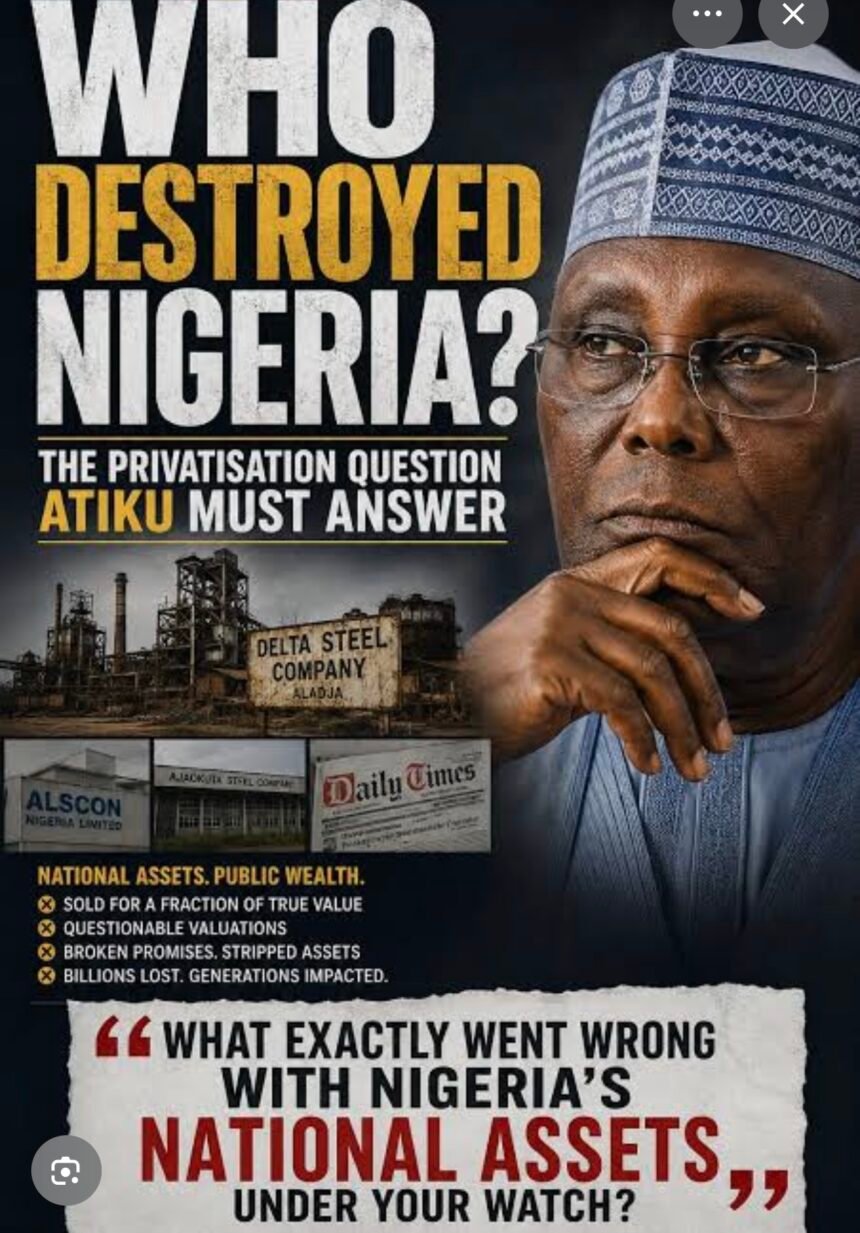
Atiku Abubakar served as vice-president and chaired the National Council on Privatization during the administrations of President Olusegun Obasanjo. The privatization programmed undertaken during that period remains an important subject for historical and economic examination.
Former President Obasanjo has also publicly discussed disagreements and issues arising from his administration. The relevant passages of his published accounts should be examined alongside transaction records, official reports, and responses from the people concerned.
The objective must be accountability based on evidence rather than political hostility.
Nigerians also deserve transparency when political leaders discuss enriching their associates. In January 2019, newspaper reports quoted Atiku Abubakar as saying that he would not enrich members of his family but that his friends were entitled to be enriched, provided there was no corruption. Such remarks make it particularly important to establish safeguards against conflicts of interest and favoritism in the award of public contracts.
The fundamental principle is straightforward: public contracts must be awarded on merit, not as rewards for political support. Every citizen should be able to examine how public money is spent and whether the public receives value in return.
3. Iwopin Paper Mill: A case that deserves closer examination
The history of Iwopin Pulp and Paper Company in Ogun State illustrates why Nigeria must examine the outcomes of its privatization programmed.
The mill was established as a major industrial project intended to support domestic paper production and reduce dependence on imported paper products.
According to published accounts, the privatization process began in the early 2000s. Beulah Technical Services emerged as the preferred bidder with an offer of ₦3.1 billion. Following legal disputes and a negotiated settlement, the transaction was concluded under revised terms, including a reported payment of ₦1 billion and other obligations.
A report published by The Guardian Nigeria in 2017 described the mill as having undergone physical improvements while substantial productive activity remained absent. The report also discussed the difficulties surrounding the transaction and the company’s failure to resume meaningful production.
This raises an important question: what is the economic value of transferring an industrial enterprise to private ownership if the country continues to lose the productive capacity the enterprise was established to provide?
I also recall an account involving former Ogun State Governor Olusegun Osoba and the recovery of the Iwopin Paper Mill following a disputed or unsatisfactory privatization arrangement. According to my recollection, Governor Osoba examined the transaction documents and sought to recover the mill by returning the agreed purchase consideration.
I have not independently verified the details of that particular account, including the original purchaser, the precise amount, and the legal mechanism used. These details should be established from official records before the story is presented as confirmed history.
Nevertheless, the broader lesson remains relevant: a government should examine inherited transactions rather than automatically accept them, and it should pursue lawful remedies when there are demonstrable grounds to do so.
Iwopin deserves a serious, independent assessment of its ownership history, current condition, production potential, and the feasibility of restoring it to productive operation.
4. Electricity privatization: Nigerians deserve reliable service
The electricity sector provides another important example.
The Power Holding Company of Nigeria (PHCN) was unbundled into successor companies, and private investors took over the distribution companies in November 2013. The Federal Government’s Bureau of Public Enterprises documented performance agreements intended to improve operational efficiency and reduce technical, commercial, and collection losses.
Yet persistent electricity supply problems have continued to generate public concern.
In 2017, former Minister of Power, Works and Housing Babatunde Raji Fashola argued against cancelling the privatization exercise wholesale, maintaining that existing contracts should be respected and the relevant laws enforced. In 2019, he stated that the Nigerian Electricity Regulatory Commission had the authority to revoke the licenses of non-performing operators.
His position highlights an important distinction: enforcing a contract is not the same as automatically cancelling a privatization.
Where an investor fails to fulfil legally binding obligations, the government and regulators must act within their respective powers. Where the existing arrangements cannot deliver reliable electricity, the authorities should transparently examine available remedies, including regulatory enforcement, restructuring, replacement of operators, renegotiation, or recovery where the law permits.
The ultimate objective must be reliable electricity for households, farmers, schools, hospitals, and industries.
Nigeria cannot build a strong manufacturing economy if businesses must continually depend on expensive alternative sources of power.
5. Recovery must be lawful and economically responsible
I am not calling for the government to seize every privatized company or to take private property without due process.
That would create uncertainty, discourage legitimate investment, and expose the country to costly litigation.
Instead, I propose a clear distinction between three categories of enterprises.
Category A: Companies sold through demonstrably unlawful or corrupt transactions.
Where credible evidence establishes fraud, unlawful conduct, or other grounds for setting aside a transaction, the government should pursue the appropriate legal remedies, including recovery where justified.
Category B: Companies whose buyers failed to fulfil contractual obligations.
Where investors breached enforceable commitments, the government should apply the remedies provided by the agreements and applicable law. These may include financial penalties, enforcement orders, renegotiation, termination, or recovery, depending on the circumstances.
Category C: Companies sold through lawful transactions that subsequently became unproductive.
In these cases, the government should first determine whether the enterprise can be restored through private investment, a new investor, restructuring, or a different operating arrangement. Public acquisition should be considered only where a sound business case and a clear public-interest justification exist.
This approach would protect the national interest without treating every private investor as an offender.
6. What should happen to recovered companies?
Recovering an enterprise is only the first step. The greater challenge is making it productive.
Nigeria must not recover a company only to leave it idle under a new management team. Every recovered enterprise should have a rehabilitation and operational plan before the government commits substantial public funds.
Such a plan should include:
– An independent assessment of the company’s assets, liabilities, machinery, and production potential.
– A realistic business plan with measurable production and financial targets.
– Competent management selected on professional merit.
– Transparent procurement and financial reporting.
– A clear employment and workforce development strategy.
– Regular independent performance audits.
– Public reporting on production, revenue, employment, and the use of government funds.
Where private capital and technical expertise are needed, the government should be open to credible investors under transparent arrangements that protect the public interest.
Where a company can operate commercially without permanent government subsidies, it should be expected to do so. Where temporary public support is justified by strategic national interests, that support must have clear conditions, measurable results, and an exit or sustainability plan.
The purpose is not simply to restore government ownership. It is to restore productive capacity, employment, and economic value.
7. Rebuilding Nigerian industry and reducing import dependence
Nigeria spends valuable foreign exchange importing products that its own industries could potentially manufacture or process competitively.
A properly managed programmed to restore viable industrial enterprises could contribute to domestic production, skills development, employment, and supply-chain growth.
Paper production is one example. Other sectors worthy of examination include textiles, fertilizers, food processing, agricultural machinery, vehicle components, pharmaceuticals, and other essential manufactured goods.
However, each enterprise must be evaluated on its own merits. Not every former public company can or should be revived. Some may face obsolete technology, inadequate infrastructure, environmental liabilities, or business models that are no longer commercially viable.
The government should therefore prioritise enterprises with a credible path to sustainable production, strong domestic demand, and demonstrable economic benefits.
Industrial recovery should also be connected to agriculture. Farmers need reliable markets for their produce, processors need dependable supplies of raw materials, and manufacturers need affordable electricity and efficient transportation.
When these parts of the economy work together, Nigeria can create more productive jobs and reduce avoidable dependence on imported goods.
8. A national policy that survives changes of government
One of Nigeria’s long-standing governance challenges is that incoming administrations may abandon or alter projects initiated by their predecessors, even where those projects remain economically justified.
This can waste public funds and weaken long-term development.
Nigeria should establish a national framework for managing strategic public assets and major industrial projects. Every incoming administration should be required to review ongoing commitments transparently, preserve projects that remain in the public interest, and explain any decision to discontinue or substantially alter them.
A change of government should not automatically mean a change in the country’s economic direction.
At the same time, continuity should not protect failed projects, corrupt contracts, or wasteful expenditure. The principle should be evidence-based evaluation, public accountability, and long-term national benefit.
Conclusion: Protect the people’s wealth
Nigeria’s public enterprises were established using resources belonging to the Nigerian people. Their sale, management, and eventual fate should therefore be matters of legitimate public concern.
The country must neither condemn privatisation indiscriminately nor accept every privatisation transaction without scrutiny.
What Nigerians deserve is a transparent national audit, a fair investigation of questionable transactions, lawful recovery where justified, and a practical strategy for restoring viable enterprises to productive operation.
The Federal Government should work with the Bureau of Public Enterprises, relevant regulators, the National Assembly, state governments where appropriate, and independent professionals to establish the facts and recommend action.
If a company was sold lawfully and is performing well, its success should be recognised. If a transaction was corrupt or unlawful, those responsible should face the appropriate consequences. If an investor failed to fulfil contractual obligations, the law should be enforced. If a valuable industrial asset can be restored to productive use, the country should examine the best way to achieve that outcome.
Nigeria must stop treating its industrial decline as an issue to be discussed only during political campaigns. It must become a national development priority.
Our objective should be to create an economy that produces more, imports less where domestic production is viable, creates decent employment, develops technical skills, and gives future generations a stronger industrial foundation.
The question is not whether every privatised company should return to government ownership. The question is whether every major decision involving Nigeria’s national wealth can withstand independent scrutiny and demonstrate that it serves the Nigerian people.
That is the standard Nigerians should demand from every administration, regardless of political party.
Emmanuel Adebanjo
Author, Concerned Citizen & verification and further reading