By Okoi Obono-Obla
The era of technology law has come, just as financial technology law (fintech) has emerged with a bang, with electronically generated banking systems taking centre stage. Information and Communication Technology, concomitant with Artificial Intelligence technology, has also taken centre stage in the latest revolution of the 21st century, grabbing the attention of the world in such a fast and breathtaking manner that it has drawn the alarming attention of tech experts, to the extent that some of them have recently called for the world to apply the brakes to further development of artificial intelligence, out of a morbid fear that if nothing is done to slow down its advancement, the world may be teetering on the brink of a devastating catastrophe that may bring about the end of the human race.
Recently, Anthropic announced that it had to halt the development of a programme deploying artificial intelligence because it suspected it might be applied to the development of biological weaponry. One can imagine the spectre where some blood-curdling and desperate terrorists may use drones filled with biological weapons, deploying and unleashing them to destroy humanity to satisfy their caprice and enormous capacity to grab attention in a dramatic and spectacular manner, consistent with their attention-seeking character.
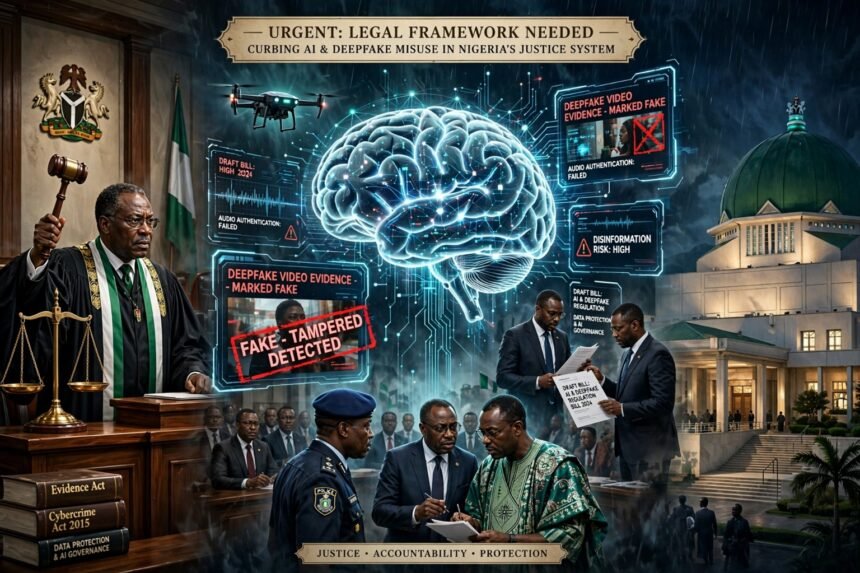
One can also imagine a scenario where some desperate litigants or desperate politicians, who want to win elections at all costs, pay unscrupulous tech experts to develop applications or artificial intelligence tools, such as deepfakes, to generate fake evidence to demonstrate that they won elections but that the Independent National Electoral Commission declared candidates who did not actually win. Such politicians would then file election petitions and frontload these pieces of contrived evidence, which they intend to use in court to prove that they ought to have been declared the winners of the elections.

Similarly, one can imagine unscrupulous law enforcement officers deploying deepfakes to contrive evidence that a person or a suspect they intend to implicate at all costs committed murder, or that he committed forgery of documents which he used to infiltrate a banking system and steal billions of naira.
Therefore, the Judiciary and the National Assembly must begin to network and collaborate to develop a legislative agenda to confront the possibility of unscrupulous individuals, syndicates, or law enforcement agents who intend to use deepfakes and other technologies developed through artificial intelligence to rig the gathering of evidence which they want to deploy during court proceedings to cause judges to admit such fake evidence and arrive at favourable outcomes.
What Must Be Done To Arrest This Trend
To arrest this dangerous trend before it undermines the integrity of our justice system, the following urgent steps must be taken:
1. Urgent Legislative Reform: The National Assembly must amend the Evidence Act, 2011 to make specific provisions for the authentication of electronically generated evidence, particularly AI-generated content. The burden of proving the authenticity and integrity of any digital or video evidence suspected to be a deepfake must be clearly placed on the party seeking to tender it. The Electoral Act, 2022 and the Cybercrimes (Prohibition, Prevention, etc.) Act, 2015 should also be amended to criminalize the creation and deployment of deepfakes to pervert the course of justice or to subvert the electoral process.
2. Judicial Proactivity and Capacity Building: The Judiciary, through the National Judicial Institute, must organize continuous training for judges and magistrates on digital forensics, deepfake detection, and the evaluation of AI-generated evidence. Courts must insist on expert forensic reports and chain-of-custody certification before admitting any contentious audio-visual evidence.
3. Establishment of a Regulatory Framework: Nigeria needs a dedicated Artificial Intelligence Regulatory Authority or an expansion of the mandate of NITDA to license, monitor, and regulate the development and deployment of high-risk AI systems. There must be mandatory watermarking and traceability for all AI-generated content.
4. Investment in Forensic Infrastructure: The Federal Government must invest in state-of-the-art digital forensic laboratories for the Police, EFCC, ICPC and the judiciary, equipped with deepfake detection tools to assist courts in verifying evidence.
Conclusion
If we fail to act now, our courts risk being flooded with sophisticated fabrications, and justice may be delivered on the basis of falsehoods manufactured in the laboratory of artificial intelligence. The integrity of our elections, the credibility of our criminal justice system, and ultimately the rule of law itself are at stake. The time for the legislature and the judiciary to act in concert is now.