By Okoi Obono-Obla
I have read the piece by Chigozie Chimezie titled “The Abandoned property in River state (1967-1979)” circulated on Facebook. With respect, it is a twisted and ahistorical account of a serious legal issue.
The history deserves to be stated correctly.
1. There was no Federal “Abandoned Property Decree of 1979”
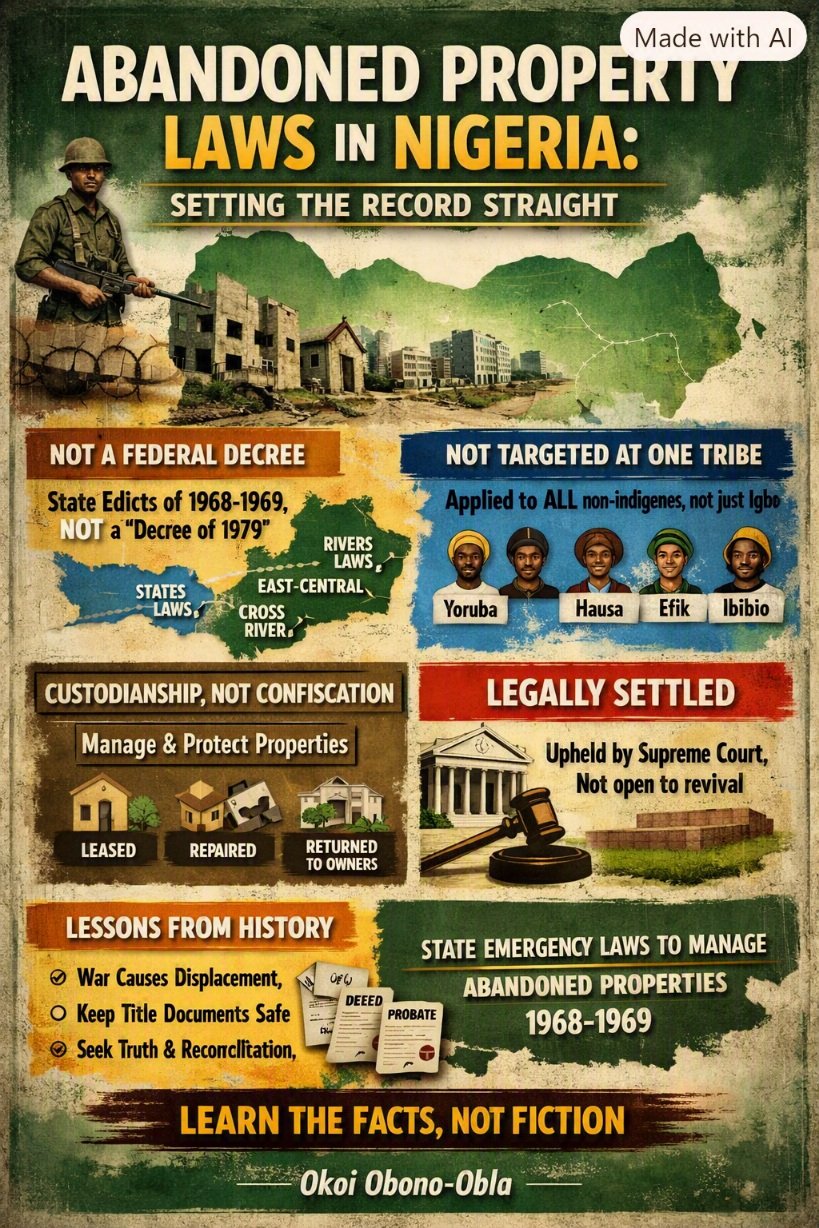
The law Chimezie refers to never existed as a federal law in 1979. The Abandoned Property issue was dealt with by State Edicts and Laws, not a Federal Decree.
The relevant law in Rivers State is the Abandoned Property (Custody and Management) Edict No. 8 of 1969. The Rivers State Government itself has repeatedly described it as such: it “established the Abandoned Property Custody and Management Authority and charged that authority with the responsibility of managing the property of non-indigene left unattended during the Civil War.”
It was not only Rivers State.
Lagos State had its own Administration of Abandoned Properties Law 1969 [Commencement 20th December 1968].
The South-Eastern State (now Cross River and Akwa Ibom) had its own Edict.
The East-Central State also had its own Edict.
A United Nations Observer who visited Lagos, Benin, Port Harcourt, Kano, Kaduna, Jos and Enugu in January 1969 confirmed this: “arrangements varied from state to state. In some, edicts of the Military Governor had been published formally in the State Gazette.” This proves it was a state-by-state emergency management measure, not a federal law targeted at one tribe.
2. The law was not targeted at Igbo people only on its face
Chimezie claims the law was discriminatory and aimed to frustrate a particular tribe.
The Edict does not mention Igbo. It defines abandoned property as:
property… belonging to a person whose hometown or place of origin is not situated in the Rivers State… which has been abandoned by the owner thereof as a result of the civil war… and is at the time of the making of this Edict not in the physical occupation or under the personal control and management of such owner.
In Lagos State, the definition is even wider: any property belonging to persons who moved from one part of Nigeria to another due to the disturbances.
Legally, therefore, it applied to ANY non-indigene who fled — Yoruba, Hausa, Efik, Ibibio, Anang, etc. That South-Eastern State also enacted its own law to deal with properties abandoned in Calabar shows it was not an Igbo-only issue.
That in Port Harcourt the majority of those who fled were Igbo traders and professionals is a matter of demographics, not statutory wording. The effect fell heavily on the Igbo, but the enactment was not a tribal decree. To claim otherwise is to rewrite the statute.
3. The objective was custodianship, not confiscation and sale
Chimezie writes that the law “allowed the government to take over any property that was abandoned… and sell it off to interested buyers.”
That is false.
The laws state that abandoned properties shall “vest in the State and held by the State on trust for the true owners of such properties.”
The functions given to the Committee were:
(a) take possession of any abandoned property;
(b) lease, let or give on hire;
(c) carry out repairs or improvements to prevent deterioration;
(d) not dispose of any immovable property without an order of the High Court.
There was also a clear release procedure:
Where the true owner of any abandoned property returns to the state (whether before or after cessation of hostilities) he may… require the Committee to transfer to him the abandoned property.
Upon application with proof of identity and evidence of title.
If properties were sold to elites without court orders or rents were not accounted for, that is a failure of implementation, not what the Edict itself authorised. And that failure is justiciable — many cases went to court.
4. The matter is legally settled, not open for ethnic blackmail
The Rivers State Attorney-General has stated that “The constitutionality of that law has been tested in several decisions of our court, including that of the Supreme Court and that law is still a subsisting law, and it has never been invalidated by any judgment of the court.”
That is why Government says the issue is “legally closed and cannot be revisited.”
5. The Ikwerre comment is reckless
To say “When Ikwerre people tell you there are not Igbo’s that’s because they are afraid to return all they stole from their Igbo brothers (1966-1970)” is not history, it is incitement. The Ikwerre identity debate predates the war and has nothing to do with the text of Edict No. 8 of 1969, which was made by the Military Government of Rivers State under Commander Alfred Diete-Spiff.
Conclusion
We must learn from history, as Chimezie urges, but we must learn the correct history.
The lessons are:
War leads to displacement and painful property disputes everywhere in the world.
Always preserve title documents — C of O, Deeds, probate letters — in multiple safe places. The release procedure under the Edicts required “evidence of title.”
If we want reconciliation, we must argue law and facts, not twist statutes to fit a tribal narrative.
The Abandoned Property saga was a product of state-level emergency laws made in 1968-1969 across several states to preserve properties in trust. The grievances arising from its implementation should be discussed with honesty, not with a fictional “Abandoned Property Decree of 1979.”