By Okoi Obono-Obla
One Sunday in 1995 or thereabout.
General Sani Abacha was the Military Head of State and Commander-in-Chief of the Armed Forces of the Federal Republic of Nigeria. His regime lasted from 17 November 1993 to 8 June 1998, not 26 November 1993 to 28 June 1998 as earlier stated. 19c5
Constitutionally and legally, part of the Bakassi Peninsula has been transferred to the Republic of Cameroon and Nigeria no longer exercises sovereignty over those areas. However, there is still a part of the Bakassi Peninsula belonging to Nigeria and Nigeria continues to exercise sovereignty over those parts.
Bakassi is still listed in the Constitution of the Federal Republic of Nigeria, 1999, and therefore remains a legal entity.
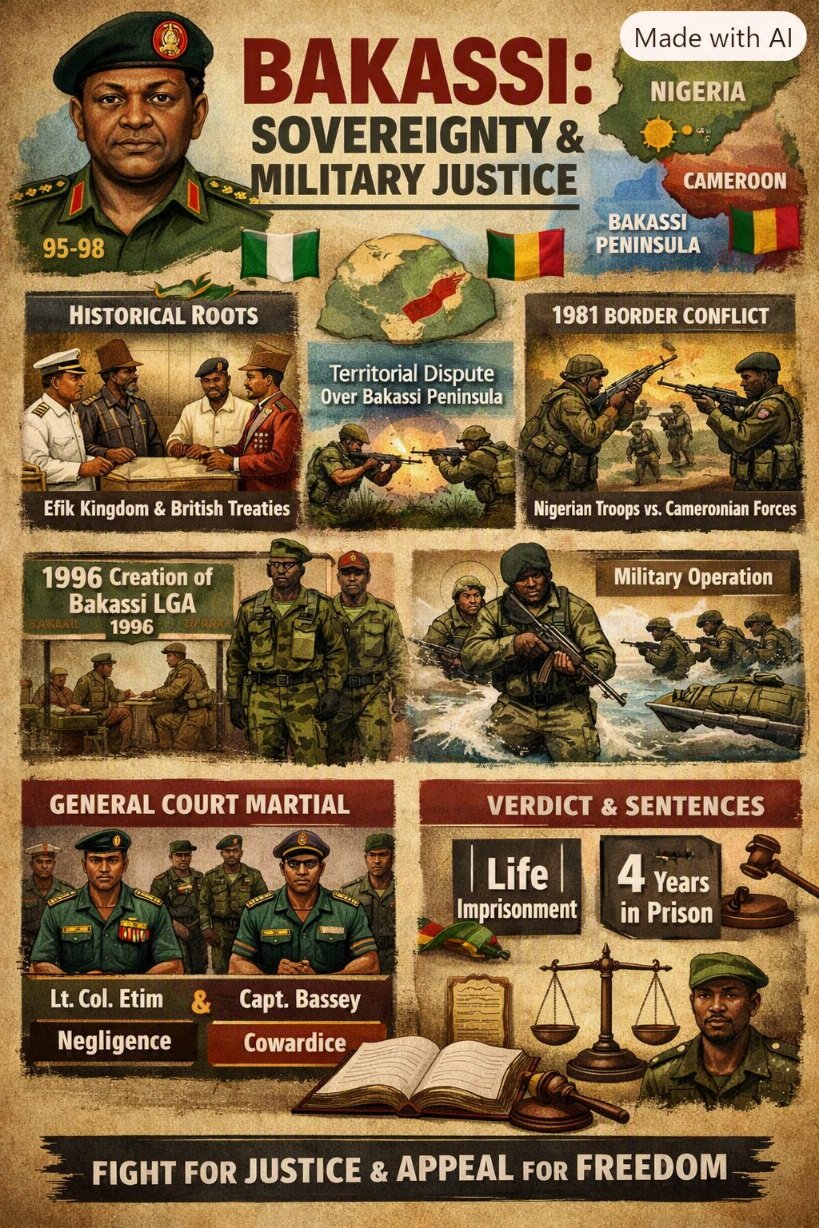
Historically, it must be recalled that the Obong of Calabar had exercised sovereignty over the Peninsula before the advent of European colonialism in the twilight of the 19th century. The territory was part of the domain of the Efik Kings of Old Calabar who entered into Protection Treaties with the British.
It should also be recalled that in 1981, when President Shehu Shagari was in office, Nigeria and Cameroon nearly went to war when Nigerian troops stationed at Ikang on patrol in the sea were ambushed and killed by the Cameroonian military. In that incident on 16 May 1981, five Nigerian soldiers were killed during border clashes, raising tensions to near-war level. 095d
God bless General Sani Abacha who created the Bakassi Local Government Area in 1996 to stem the incursions of the Cameroonian authorities into a territory that successive Nigerian Governments had abandoned and neglected, even though the inhabitants were ethnic Efik, Ijaw, Ibibio and Ekoi.
When the Cameroonians occupied East Atabong Island, General Abacha ordered the deployment of a crack Special Forces unit from their base in the 1st Division of the Nigerian Army, Kaduna, and a Staff Officer from the Armed Forces Command and Staff College, Jaji, Kaduna, Lt. Colonel Etim, was appointed the Commanding Officer. He was familiar with the terrain because he was an Efik man from Calabar South Local Government Area sharing a boundary with the Bakassi Peninsula.
However, the operation to drive out the Cameroonian military, who were dug into trenches in the swampy and water-logged lagoon abutting the Atlantic Ocean, ended in a fiasco. Captain Bassey, who was ordered to carry out intelligence and surveillance of the Cameroonian position to establish whether it was tenable for the Nigerian military to move in and flush out the Cameroonians, bungled his job. This resulted in the subsequent ambush of the advancing Nigerian troops by the Cameroonians. The Nigerian Army lost some troops and a substantial number were taken as prisoners of war.
General Abacha was furious and immediately ordered a military inquiry. The inquiry established a case of dereliction of duty and negligence, and blame was apportioned to Lt. Colonel Etim and Captain Bassey (from Akwa Ibom State).
One Sunday, I was in my office at 98 Marian Road, Calabar, which is within walking distance of the Akim Barracks housing the headquarters of the 13 Amphibious Brigade of the Nigerian Army, when two gentlemen walked in and introduced themselves as soldiers. It sent a cold shiver down my spine and I thought they had come to arrest me. I was a young human rights lawyer seriously involved in the pro-democracy movement, campaigning for the return of the military to the barracks, the restoration of democratic civil rule in Nigeria, and the validation of the annulled election won by businessman Chief M.K.O. Abiola.
My fear was allayed when they said they had come to brief me concerning the defence of two military officers who were to be arraigned before a General Court Martial the next day, and they handed over their charges to me. I was just about five years post-call to the Nigerian Bar – a sort of rookie, but ambitious and adventurous. It was the first time I was to confront the reality of the military justice system.
The next day, I appeared before the General Court Martial convened in the boardroom of the 13 Amphibious Brigade of the Nigerian Army, Akim Barracks, Calabar, chaired by a Brigadier General (a medical doctor). Lt. Colonel Etim and Captain Bassey were marched in by stern-looking military police officers. They were dressed in military fatigues but without their berets.
Lt. Col. Etim was charged with negligence and dereliction of duty, but Captain Bassey was charged with a more serious offence which carries the death penalty – cowardice before the enemy. I had not known that there was such an offence in the military known as cowardice before the enemy.
To cut a long story short, at the end of the trial that lasted about two weeks, I addressed the General Court Martial and raised a technical point of law, especially concerning the case of Captain Bassey, to the effect that the General Court Martial was not properly constituted, hence it did not have jurisdiction to try Captain Bassey and he should therefore be discharged and acquitted. But the General Court Martial ruled that since it was not properly constituted, Captain Bassey would not be sentenced to death but sentenced to life imprisonment. On the other hand, Lt. Col. Etim was sentenced to four years imprisonment and loss of commission as an officer of the Nigerian Army.
After the pronouncement by the President of the Court Martial, military police officers thronged into the court and ordered the two convicts to remove their belts and hand them over, and marched the convicts to be taken to Afokang Prison, Calabar.
I proceeded to file appeals at the Court of Appeal, Enugu. At that time there was no Court of Appeal in Calabar and all appeals emanating from courts in Akwa Ibom and Cross River States were heard in the Court of Appeal, Enugu. However, in 1999, a division of the Court of Appeal was established in Calabar.
The appeals of Lt. Col. Etim and Capt. Bassey respectively were not heard until President Olusegun Obasanjo assumed office in May 1999, and he subsequently granted amnesty to Lt. Col. Etim and Captain Bassey in 2000.