
By Okoi Obono-obla
Abstract
This essay reconstructs the historical trajectory of peoples in the lower and middle Cross River region and the eastern Niger Delta from fragmentary oral sources. It argues that Akpa — as clan identity, ancestral homeland, and diplomatic institution — provides a unifying thread linking Biase, Yakurr, Abanwan-Erei and Ikwerre historiographies. It critically evaluates Daminola Okiah’s Akpa thesis on Ikwerre origins and clarifies the relationship between linguistic classification, genetics, and ethnographic identity.
1. Introduction
In an attempt to reconstruct the historical trajectory of our people from fragmentary sources, and given that our traditional method of preserving the past was anchored in oral tradition, a great deal can be learned about the diverse peoples inhabiting what is now the lower and middle Cross River region and the adjoining Niger Delta.

In our culture, the preservation of history was essentially hinged on oral tradition, through which knowledge of the past was transmitted by means of music, drama, and storytelling by elders who serve as custodians and repositories of collective memory. It is through this process of putting together something out of nothing that the past is recovered. History can therefore be reconstructed through the critical study of cultural music, dance, festivals, language, observation, art and other forms of cultural expression.[1][2]
2. The Bridge: Biase and Yakurr and the Akpa Clan
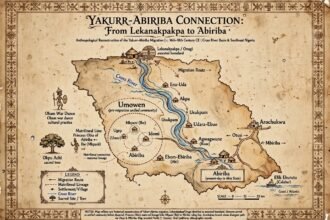
My research has established the historical interconnectedness between Biase and Yakurr Local Government Areas, which naturally serve as the bridge between the lower and middle Cross River regions.[3]
This was illuminated by Dr. Ukam Ekup Edadi, Consultant Physician and Nephrologist at the University of Calabar Teaching Hospital, in response to my earlier essay:
“Onun Ekor is not just an Agwagune word but an Erei word which means the WAR CHIEF… In Abanwan-Erei where I come from, the Ugep man is regarded as our brother. That is why one of our age grades is named UGEP AGE GRADE just like we have Agwagune Age Grade, Efik Age Grade, Biakpan Age Grade… Abanwan has 59 gazetted villages and three clans. One of the clans is called AKPA CLAN because of the historical significance of AKPA to the community.”[4]
From this we discern how ties were forged and sustained through diplomacy, solidarity and unity embedded in institutions such as age grades named after communities with whom they share historical connections, consanguinity and good neighbourliness. The Abanwan-Erei people of Biase and the Yakurr are thus part of the larger Akpa family, whose thread runs through the tapestry of cultures of the Cross River Basin.[5]
3. Extending the Thesis: Daminola Okiah and the Akpa Roots of the Ikwerre
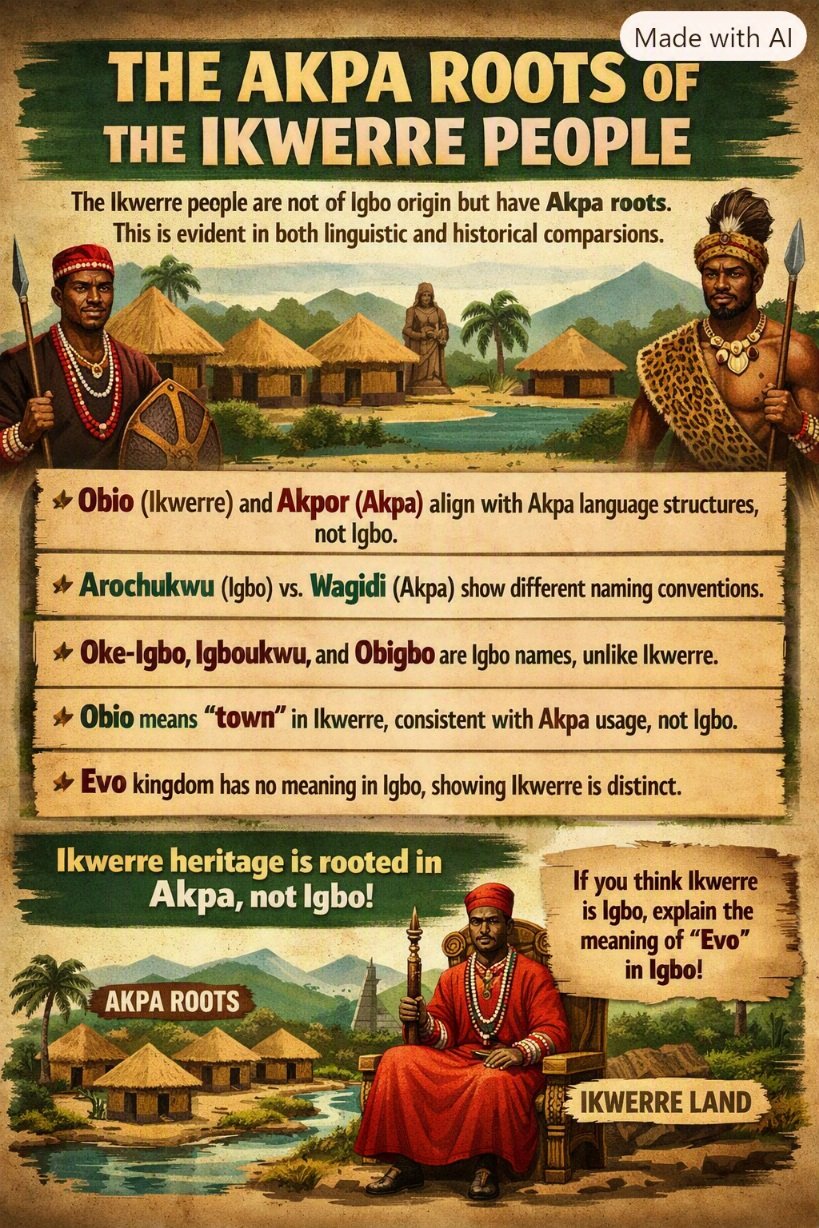
The same Akpa framework has been extended to the contested origins of the Ikwerre people of Rivers State. While colonial reports such as the 1930 Obio clan report claimed Ikwerre were distinct from Igbo and Ekpeye, and later scholars like Aguma (1993) and Wotogbe-Weneka (2011) traced Ikwerre social development, the identity question intensified after the civil war and the discovery of oil.[6]
In this context, Daminola Okiah’s intervention must be acknowledged — an omission noted in recent surveys:
“The Ikwerre people are not of Igbo origin but have Akpa roots… Obio (Ikwerre) and Akpor (Akpa) align with Akpa language structures… Obio means ‘town’ consistent with Akpa usage, not Igbo. The Ikwerre kingdom Evo has no meaning in Igbo, further showing Ikwerre is distinct.”[7]
Okiah’s contribution is historiographically important because it introduces Akwa Akpa — the pre-colonial name for the Calabar-Efik-Ibibio corridor — into the Ikwerre debate, resonating with Yakurr traditions that trace origins to “Akpa” as an ancestral homeland before the collapse of Kwararafa.[8][9]
4. Does Linguistic Similarity or Igboid Classification Prove Ethnic or Genetic Ties?
This is the central theoretical question. Does classifying Ikwerre among Igboid languages change anything, or does it connote genetic or ethnographic ties?
The answer is nuanced.
a) Linguistic classification is not an ethnic certificate. When linguists classify Ikwerre as Igboid, they mean only that Ikwerre and Igbo descend from a common proto-language — Proto-Igboid — spoken perhaps 3,000-4,000 years ago, just as Spanish and Italian descend from Latin. It is a statement about speech, not blood. A language can be adopted, imposed, or retained while identity changes. The Yakurr speak Lokaa, a Bantoid language, but maintain age-grades named after Efik, Agwagune, Umon — as Dr. Edadi showed — because of political alliance, not genetics.[10]
Therefore, Okiah is not wrong to argue that linguistic similarity alone does not prove one is Igbo.
b) But similarity is not meaningless. Languages do not remain mutually intelligible to the degree Ikwerre and Igbo are — an Ikwerre speaker understands Ngwa far more than Efik — without sustained historical interaction: common origin, long-term intermarriage, or prolonged bilingualism and trade. That is ethnographic. It implies ancestors lived, married and worshipped together long enough for speech, Ozo titles, four-market-day calendars, and clan names like Obio and Akpor to co-evolve.
To claim a pure Akpa root, one must explain why that deep Igboid layer exists.
c) Genetics and ethnography complicate, not simplify. Genetic studies in the lower Niger show overwhelming similarity among groups in Rivers, Imo, Abia and Cross River. The genetic distance between an Ikwerre man and an Etche man is far smaller than the political distance claimed. Ethnographically, Ikwerre are heterogeneous, with 27 dialects and multiple origins. Recent scholarship correctly notes Ikwerre identity today is “mainly territorial and political, not genealogical.”[11]
Thus, Akpa should be understood less as an exclusive origin and more as a diplomatic and cultural nexus — a framework for blood brotherhood, age-grade diplomacy, and clan naming that links Biase, Yakurr, Abanwan-Erei and, in Okiah’s extension, Ikwerre.
5. Conclusion
The evidence points to shared ancestry and a long tradition of mutual recognition across the Cross River Basin and the eastern Niger Delta. The preservation of ties through age grades, clan identities (Akpa Clan), and titles like Onun Ekor is not nostalgia but a diplomatic framework for unity. Acknowledging all contributors — including Daminola Okiah — is essential for a complete history. Testing his Akpa hypothesis against systematic sound correspondences and archival evidence on Akwa Akpa migrations remains the next scholarly task.
Footnotes
Vansina, J. Oral Tradition as History (1985).
Wotogbe-Weneka, W. on music, festival and language in Ikwerre historiography.
Obla, O. Yakurr Unity in Diversity (2026).
Edadi, U.E. Personal communication, 2026.
On age-grade diplomacy in Cross River societies.
Obio Clan Report (1930); Aguma (1993); Alagoa & Kiebel (1989).
Okiah, D. The Akpa Roots of the Ikwerre People, Facebook, 2026.
Akwa Akpa as original name of Calabar, Efik-Ibibio histories.
Yakurr ancestral homeland and Akpa, Chat Afrik.
Williamson, K. & Blench, R. Niger-Congo classification: Igboid.
Autochthones and Migrations – The Case of Ikwerre, Academia.edu.[1][2][3][4][5][6][7][8][9][10][11]