by Emmanuel Adegbite
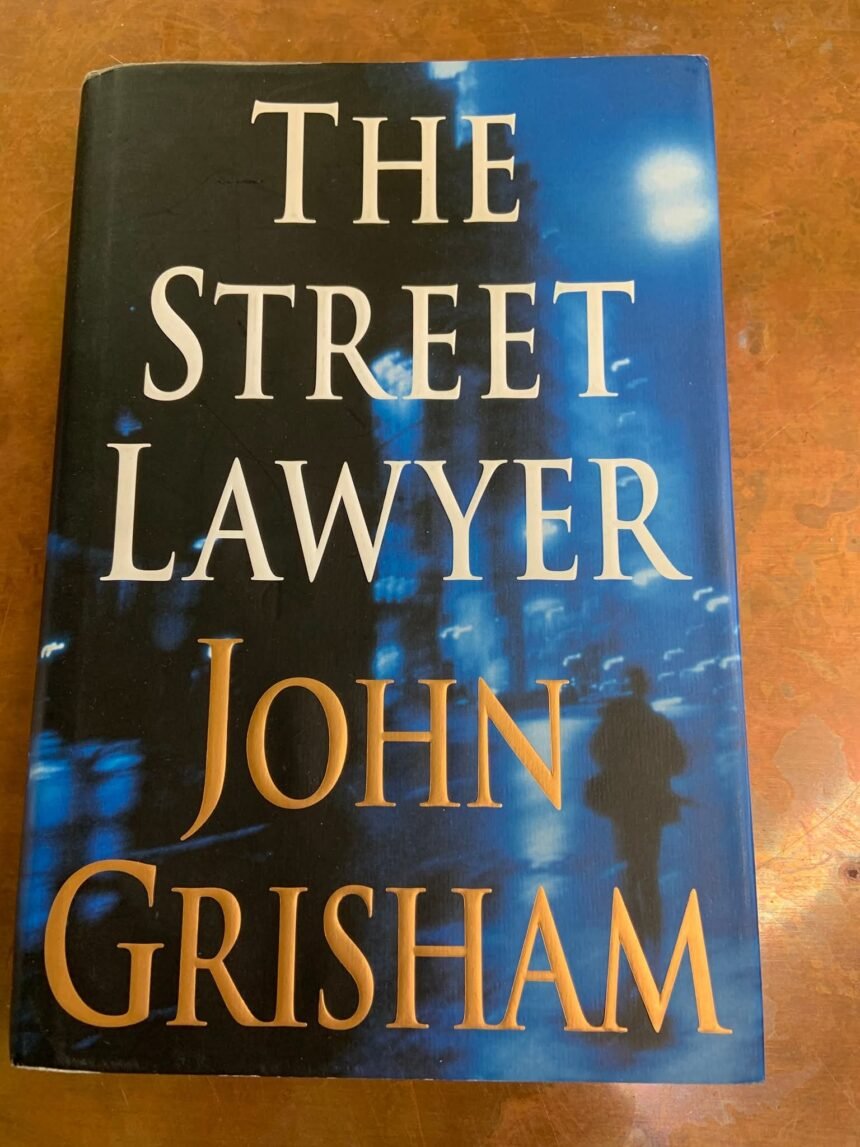
I recently finished John Grisham’s The Street Lawyer, a novel I carried with me for nearly two weeks, reading it in fragments between the press of daily responsibilities. Some books are simply read; others accompany you. The Street Lawyer belonged to the latter category. Even when I was not reading, it remained somewhere in the background of my thoughts, its questions refusing to close with the book, its discomfort lingering long after I had put it down. It is one of those rare novels that does not merely tell a story but quietly rearranges the way one looks at the world. By the time I turned the final page, I had the uncomfortable feeling that Grisham had not really been writing about someone else at all. He had been holding a mirror to the society in which we live and, more unsettlingly, to the compromises through which we learn to live comfortably with the suffering of others.
At first glance, The Street Lawyer appears to be familiar John Grisham territory. There is the prestigious law firm, the ambitious young attorney, the seductive world of corporate power, the machinery of litigation and the intricate relationship between money and the law. Michael Brock is everything that a conventional definition of success celebrates. He is young, intelligent, professionally accomplished and situated within a world where wealth and influence appear almost inevitable. He has entered the kind of career that promises not merely financial security but social prestige and access to power. His future seems mapped out before him. Yet Grisham’s real interest is not in watching Michael climb the ladder of success. It is in asking what happens when a man who has spent his life climbing suddenly looks down and realizes what—and whom—he has left behind.
That realization arrives violently. A desperate homeless man enters Michael’s office, disrupting the polished security of the corporate environment in which he has become comfortable. The encounter is frightening, unpredictable and deeply unsettling, but its consequences extend far beyond the immediate incident. The homeless man does not merely interrupt Michael’s working day; he interrupts his worldview. He forces him into an encounter with a reality that professional success had allowed him to keep at a safe distance. What begins as an intrusion gradually becomes an awakening, peeling away the layers of ambition, comfort and institutional privilege through which Michael has learned to understand his place in the world.

This is where The Street Lawyer becomes considerably more than a legal thriller. Beneath the courtroom drama and corporate manoeuvring is a profound examination of privilege and moral blindness. Grisham is interested in the distance between knowing that suffering exists and actually allowing that knowledge to affect one’s life. Most societies are aware that poverty exists. We see it on television, encounter it on the streets and hear politicians discuss it in speeches. Yet awareness does not necessarily produce compassion, and proximity does not necessarily produce responsibility. There is a strange psychological mechanism by which human beings can become accustomed to suffering. What should shock us eventually becomes scenery. What should provoke outrage becomes routine. What should demand action becomes somebody else’s problem.
The poor are particularly vulnerable to this kind of social invisibility because poverty is so often reduced to statistics. We speak of unemployment figures, poverty rates, housing deficits and economic indicators as though the people represented by those numbers disappear once they have been converted into data. But poverty is not an abstraction to the person experiencing it. It is hunger, exposure, humiliation, uncertainty and the constant struggle to preserve dignity in circumstances that seem determined to strip it away. Grisham’s great strength in The Street Lawyer is his refusal to allow homelessness to remain an abstract social problem. He gives poverty faces, voices, histories and human complexity. He reminds the reader that the person sleeping on the pavement is not merely a social inconvenience but a human being whose circumstances have not erased his capacity to dream, suffer, love, fear and hope.
That insight makes the novel remarkably portable across geographical and cultural boundaries. One does not need to walk the streets of Washington, D.C., to understand the contradictions Grisham presents. The same moral landscape can be found in Lagos, Abuja and countless other cities across Africa and the developing world, where spectacular wealth and devastating poverty frequently exist within uncomfortable proximity. Skyscrapers rise beside informal settlements. Luxury vehicles pass children begging at traffic intersections. Expensive estates can exist only a short distance from communities struggling for adequate housing, healthcare, electricity, water and employment. We build monuments to prosperity while millions remain excluded from the prosperity those monuments are supposed to represent.
This contradiction is not peculiar to Nigeria or even to developing countries. It is one of the enduring contradictions of modern civilization. We have become extraordinarily efficient at producing wealth, but considerably less successful at ensuring that the benefits of that wealth are experienced with dignity by everyone. We celebrate economic growth, technological advancement and urban development, yet we rarely pause to ask what those achievements mean to the person who cannot afford a meal, a home, medical treatment or legal representation. Progress becomes easy to celebrate when we measure it from the top. It becomes much more complicated when we measure it from the bottom.
Reading The Street Lawyer in fragments between my own responsibilities made these questions strangely personal. The interruptions in my reading meant that Michael’s questions had time to follow me into ordinary life. What is the meaning of justice if it remains inaccessible to those who need it most? What is the value of professional success if it requires us to become indifferent to the suffering around us? What does it say about a society when wealth and influence determine not only the quality of one’s life but the likelihood of being heard? And perhaps the most uncomfortable question of all: what does it say about us when we can witness suffering repeatedly without allowing it to disturb the architecture of our own comfort?
Most people do not become indifferent because they consciously decide to become cruel. That is what makes the problem so difficult. Indifference often develops quietly, through routine, exhaustion, distraction and self-preservation. We become busy. We become comfortable. We learn to prioritize our own problems. Eventually, the suffering of strangers becomes background noise. The beggar at the traffic light becomes part of the morning commute. The homeless family becomes a familiar sight. The unemployed graduate becomes another statistic. The abandoned child becomes another tragic story on social media. We see these things, but seeing does not necessarily mean recognizing. Recognition requires something deeper: the willingness to admit that another person’s suffering places a moral demand upon us.
Michael Brock’s transformation is therefore significant because it represents more than a change of career or personal philosophy. It represents a change in what he is willing to see. His professional privilege, which once existed primarily as a vehicle for personal advancement, begins to acquire another meaning. He discovers that education, legal knowledge, financial resources, professional connections and institutional access can be used either to reinforce existing hierarchies or to challenge them. Privilege is not simply what one possesses. It is also a question of what one chooses to do with what one possesses.
This is one of the novel’s most enduring challenges. We live in societies that teach people to pursue success relentlessly. From childhood, we are encouraged to acquire qualifications, secure prestigious careers, accumulate wealth, purchase property, build influence and climb as high as possible. But we are rarely encouraged to ask what our success is ultimately for. We celebrate the person who escapes poverty, but we seldom ask what responsibility accompanies that escape. We admire wealth without asking whether wealth has created any obligation toward those who remain excluded from it. We praise power without asking what power is supposed to accomplish.
Perhaps The Street Lawyer offers an uncomfortable answer: success becomes morally meaningful when it enlarges our capacity to serve rather than merely our ability to accumulate. Education should not only distinguish us from those who have had fewer opportunities; it should equip us to create opportunities for others. Wealth should not merely insulate us from hardship; it should increase our ability to alleviate hardship. Influence should not simply make our voices louder; it should help amplify the voices of those who have been denied the privilege of being heard.
This is particularly important when we consider the relationship between law and justice. A society may possess courts, constitutions, statutes and legal institutions and still remain profoundly unjust. The existence of law does not automatically guarantee justice. Justice becomes meaningful only when ordinary people can realistically access it. A legal system that is theoretically available to everyone but practically accessible only to those who can afford it may satisfy the requirements of procedure while failing the demands of morality. The law can exist on paper while justice remains absent in practice.
Grisham understands this tension and uses the legal profession as a lens through which to examine it. The law firm in the novel represents more than a workplace. It becomes a symbol of institutional power and of the distance between those who possess resources and those who desperately need them. Michael’s journey forces him to confront the uncomfortable reality that legal expertise can be used to defend almost anything when money is available, while those without money may struggle even to make their grievances visible. In that sense, The Street Lawyer asks whether justice can truly be called justice when access to it is determined by economic circumstance.
The novel also challenges the convenient assumption that poverty is simply the consequence of personal failure. It is tempting for comfortable societies to imagine that people are poor because they made poor decisions, failed to work hard enough or lacked sufficient ambition. Such explanations are attractive because they absolve everyone else of responsibility. If poverty is entirely the individual’s fault, then society has no obligation beyond sympathy, and sometimes not even that. But human lives are shaped by circumstances far more complicated than individual choice. Economic structures, family circumstances, education, health, housing, discrimination, employment opportunities, public policy and sheer misfortune can all influence where a person eventually finds himself. To recognize this is not to deny personal responsibility. It is to acknowledge that human beings do not make their choices in a vacuum.
Perhaps this is why the novel remains uncomfortable after the final page. It does not permit the reader to remain safely outside the problem. It asks us to consider not only what governments should do, or what charities should do, or what lawyers should do, but what ordinary individuals are prepared to do when confronted with suffering. The question is deceptively simple: will we continue walking?
There is a peculiar convenience in believing that suffering becomes less morally demanding when it is far away. The suffering of strangers is easier to ignore than the suffering of people we know. The suffering of another neighbourhood is easier to dismiss than that of our neighbour. The suffering of the poor is especially easy to rationalize because poverty has frequently been treated as a measure of personal worth. But The Street Lawyer disrupts that comfortable distance. It reminds us that circumstances can change, that dignity is not the property of the wealthy, and that the difference between security and vulnerability can sometimes be far narrower than those living in comfort are willing to admit.
When I finally closed the book, I did not feel comforted. I felt confronted. Perhaps that is the appropriate response to a novel such as this. Some books entertain us; some educate us; others interrogate us. The Street Lawyer belongs to the last category. Its power does not lie simply in telling us that homelessness exists. We already know that. Its power lies in making indifference more difficult to defend. It asks us to look again at the people society has trained us to overlook and to question the moral assumptions that allow us to walk past them without consequence.
The homeless person is not merely the person on the pavement. The poor are not simply those who failed to become rich. The marginalized are not an unfortunate footnote to civilization. They are part of the same human story. Their dignity is connected to ours, their suffering exposes the limits of our claims to justice, and their exclusion forces us to confront the uncomfortable distance between the society we claim to be and the society we actually inhabit.
Ultimately, The Street Lawyer is not simply about law. It is about conscience. It is about what happens when a person who has spent years pursuing success suddenly realizes that there are human beings beyond the walls of his privilege. It is about the possibility that professional achievement without moral responsibility can become another form of emptiness. It is about the uncomfortable relationship between wealth and obligation, between justice and accessibility, between seeing suffering and responding to it.
Perhaps, then, the true measure of a civilization is not the height of its skyscrapers, the sophistication of its legal institutions, the size of its economy or the wealth of its most successful citizens. Perhaps we should measure it by what happens to the person who has nothing. By whether the vulnerable can retain their dignity. By whether justice remains meaningful when money is absent. By whether those who possess power remember those who possess none. And, above all, by whether we are still capable of being disturbed by another person’s suffering.
John Grisham begins The Street Lawyer with a lawyer surrounded by privilege and ends with a man forced to confront his conscience. Between those two points lies the novel’s deepest lesson: privilege becomes meaningful only when it is accompanied by responsibility, and justice becomes human only when compassion refuses to remain an abstraction. The book may have been written about Washington, about lawyers and about homelessness, but its moral argument travels much farther. It reaches our cities, our institutions, our professions and our private lives. It reaches Lagos and Abuja. It reaches every place where prosperity exists beside deprivation and where people have become accustomed to looking away.
And perhaps that is the question The Street Lawyer ultimately leaves behind—not whether we have seen suffering, because we have, but whether we have allowed ourselves to truly see it. Because once privilege gives us the ability to look away, the choice to look becomes an ethical act. And once we finally see, we must decide what kind of people we are prepared to become.