By Okoi Obono-Obla
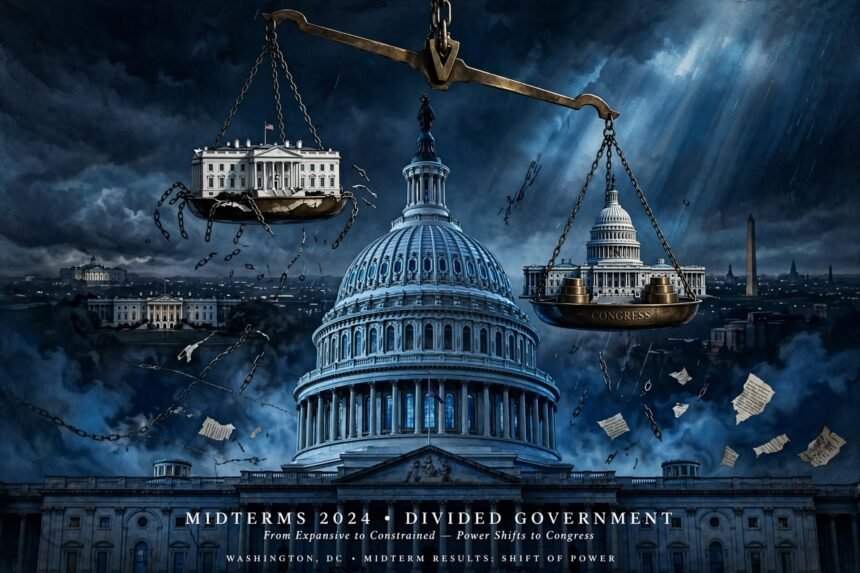
The 2026 midterms mark a structural break in Trump’s second term. From January 2025 to January 2027, Trump operated with a Republican House and a 53-seat Republican Senate – what critics described as an imperial and overbearing presidency where executive orders, tariff emergency powers, mass deportation operations, and sweeping agency rewrites were backed by a compliant Congress.
With Democrats taking both chambers on January 3, 2027, that model ends. The final two years will be defined by constraint, not expansion.
I. Domestic Agenda: The Legislative Presidency Is Over

1. The big legislative projects are dead.
The extension of the Trump tax cuts, national voting restrictions, federal immigration codification, and the full repeal of Biden-era climate provisions all required a House majority and 51 Senate votes. Those votes are gone. The House Democratic majority will not bring them to the floor. The Senate Democratic majority under a Democratic leader will control the calendar and kill any such bill in committee.
2. The power of the purse flips.
Every domestic priority of the second term needs money. ICE operations, detention facilities, border wall construction, DOJ reorganization, and deregulation enforcement need appropriations. Democrats now chair House and Senate Appropriations. They can:
Refuse to fund signature initiatives unless paired with their own demands on ACA subsidies, Medicaid, education and housing
Force repeated shutdown confrontations where the President must sign a Democratic spending bill or shut down government
Use the debt ceiling in summer 2027 as maximum leverage
This is the classic mechanism that turns a majestic presidency into a negotiating presidency.
3. Oversight becomes the main product of Congress.
Under Republican chairs, oversight of the executive was minimal. Under Democratic chairs:
House Oversight, Judiciary, Homeland Security, and Ways and Means, and Senate Judiciary will have subpoena power
Expect continuous hearings on January 6th accountability, executive use of emergency powers, conflicts of interest, tax returns, DOJ political interference, and administration of deportation programs
This creates a permanent legal and public relations battle that absorbs White House time, staff, and political capital
II. Foreign Policy Agenda: President Still Powerful, But On a Shorter Leash
The President remains the primary actor abroad, but Congress controls the checkbook.
1. Ukraine, NATO, and traditional alliances: A Democratic Congress is ideologically predisposed to fund Ukraine, maintain NATO funding, and support traditional security commitments. They can attach Ukraine aid to must-pass bills that Trump must sign, limiting his ability to pressure Kyiv into a settlement.
2. Tariffs and trade war: Trump built his second-term trade policy on IEEPA emergency powers to bypass Congress. Congress cannot simply vote tariffs away, but a Democratic House can pass bills to reclaim tariff authority, hold high-profile hearings with affected businesses and farmers ahead of the 2028 presidential election, and refuse to pass any trade deal implementing legislation Trump negotiates.
3. Sanctions and military action: Any new military authorization, major arms sale, or sanctions relief for Russia, Iran, or Syria will need Democratic buy-in. Expect tighter restrictions on unilateral action.
III. Is Trump Now a Lame Duck?
In the classic definition, a lame duck is a president who cannot get Congress to do what he wants. By that standard, from January 2027, Trump becomes a lame duck on legislation:
He cannot pass a major law without Democratic consent
He cannot confirm judges or cabinet replacements without Democratic consent in the Senate
He can be impeached in the House, even if conviction in the Senate remains mathematically impossible without 67 votes
But he is not powerless. The American presidency after Watergate was designed to be resilient in divided government:
The veto: He can veto every Democratic bill, and Democrats do not have 290 House votes and 67 Senate votes to override. That means Democratic legislative priorities also become lame.
Executive power: As long as his actions are justified under existing statutes, he can still drive immigration enforcement, regulatory rollbacks, DOJ priorities, and foreign negotiations through executive orders.
The bully pulpit: He remains the Republican frontrunner for defining the 2028 field.
The transition is therefore from a supercilious, overbearing, imperial presidency where Congress amplified presidential will, to a besieged presidency where Congress investigates presidential will and the courts arbitrate between them.
The last two years will not be about building a legacy through laws. They will be about defending the 2025-2026 legacy through vetoes, executive orders, and court fights, while the real legislative action moves to 2028.