by Ibrahim Bunu
How Religion, Democracy, Elite Competition and Constitutional Ambiguity Rewired Northern Nigerian Politics
Introduction: The Question Nigeria Still Has Not Answered
When northern Nigerian states began expanding the application of Sharia after the restoration of civilian rule in 1999, the country was confronted with a question much larger than whether Muslims should be permitted to practice Islamic law.

The deeper question was:
What happens when religious identity becomes an instrument of political power inside a deeply divided federation?
That question remains relevant more than two decades later.
The Sharia expansion that began in Zamfara in 1999 was simultaneously religious, political, constitutional, social, and institutional. Reducing it to any single explanation produces bias.
It is inaccurate to say that cynical politicians manipulated ordinary Muslims. Many Muslims genuinely wanted Sharia because they associated it with moral renewal, justice, faster dispute resolution, resistance to corruption, and restoration of an Islamic identity that they believed had been weakened by colonial and postcolonial legal systems.
But it would be equally naïve to pretend that politicians did not recognize the enormous electoral value of that demand.
They did.
And once politicians discovered that religious identity could generate legitimacy faster than roads, schools, hospitals or employment programs, Nigerian politics entered a new phase.
That is the real story.
1. First, Get the History Right
The commonly repeated story that “12 northern governors adopted Sharia between October 1999 and April 2001” is broadly correct in substance but too neat in chronology.
The decisive starting point was Zamfara State, where Governor Ahmad Sani Yerima’s government enacted the Sharia Establishment Law on 27 October 1999. The new system became operational in January 2000. (Landmark University Repository)
Zamfara became the political and symbolic catalyst.
Other states subsequently followed.
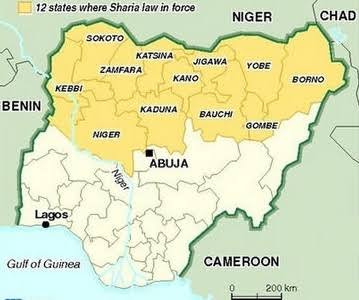
By 2002, Human Rights Watch identified twelve states that had introduced some form of Sharia into their criminal legislation:
* Bauchi
* Borno
* Gombe
* Jigawa
* Kaduna
* Kano
* Katsina
* Kebbi
* Niger
* Sokoto
* Yobe
* Zamfara
(Human Rights Watch)
This distinction matters because Sharia was not suddenly invented in northern Nigeria in 1999.
Islamic law had a much longer history in northern Nigeria.
The major change after 1999 was the expansion of Sharia from primarily personal and family law matters into criminal and public law domains.
That was the shock.
1. Sharia Did Not Arrive in an Empty Political Space
To understand 1999, one must go backward.
Northern Nigeria had experienced Islamic political and legal institutions long before British colonial rule. The Sokoto Caliphate had developed systems of administration, taxation, scholarship and adjudication based substantially on Islamic principles.
British colonialism did not destroy those institutions.
Instead, through indirect rule, colonial authorities incorporated elements of existing northern political structures into the colonial state.
After independence, however, Nigeria gradually developed a complex legal order combining:
* English-derived law;
* customary law;
* Islamic personal law;
* constitutional law;
* statutory law.
Sharia courts already existed within the Nigerian legal framework.
The constitutional architecture of the Fourth Republic itself recognized Sharia Courts of Appeal and gave them jurisdiction in Islamic personal-law matters. Sections 275–279 of the 1999 Constitution contain provisions concerning State Sharia Courts of Appeal and their jurisdiction. (Nigeria Law Reports)
Therefore, the argument cannot honestly be:
“Sharia was unconstitutional because Nigeria had never permitted Islamic law.”
That is historically and legally inaccurate.
The real constitutional controversy concerned how far state governments could extend Sharia beyond the personal-law jurisdiction already contemplated by the Constitution, particularly into criminal law.
That is a much harder question.
1. Then Came Democracy
The political environment changed dramatically in May 1999.
After years of military rule, Nigeria returned to civilian government under President Olusegun Obasanjo.
And this produced an important psychological and political transformation.
For decades, military governments had concentrated enormous power at the federal level.
Northern political elites had historically enjoyed considerable influence within that structure.
Now the political equation changed.
A southern Christian had become president.
Northern governors suddenly had something they had not possessed to the same degree under military rule:
a new democratic political arena in which they needed to build legitimacy among their own populations.
This is where the Sharia story becomes politically interesting.
The question was no longer simply:
“What does Islam require?”
It also became:
“What political language can mobilize our electorate?”
And Sharia was an extraordinarily powerful language.
1. The Critical Mistake: Assuming Everything Was a Conspiracy
Here is where serious analysis must resist ideological temptation.
There is evidence that political elites benefited enormously from Sharia.
But that does not prove that politicians manufactured the demand for Sharia.
Human Rights Watch documented several reasons why ordinary Muslims supported the movement.
Many people were frustrated with:
* corruption;
* slow courts;
* ineffective policing;
* rising crime;
* social inequality;
* political corruption;
* the perception that Western-derived institutions had failed them.
Sharia was therefore attractive to many Muslims not merely because it was religious.
It was also understood as a promise of justice.
HRW specifically reported that some people viewed Sharia as an alternative to inefficient and corrupt police and courts because they expected it to be faster, simpler and less corrupt. (Human Rights Watch)
This distinction is crucial.
The political elite did not necessarily manufacture the demand.
They discovered how to capture, channel and institutionalize it.
That is a much more sophisticated explanation.
1. The Political Genius of Sharia
From the perspective of political strategy, Sharia possessed something conventional development programmes lacked:
Emotional immediacy.
A governor promising:
“I will improve primary healthcare.”
must wait for hospitals to be built.
A governor promising:
“I will create 50,000 jobs.”
must eventually produce employment.
But a governor declaring:
“We are returning society to the path of Sharia.”
can generate immediate symbolic legitimacy.
The political product is instantaneous.
It creates an identity.
It establishes a moral narrative.
It defines insiders and outsiders.
It tells citizens:
“We are different.”
And politicians understand that identity is often more powerful than policy.
1. The Zamfara Effect
Governor Ahmad Sani Yerima became the most visible political face of the movement.
Zamfara was not one of Nigeria’s wealthiest states.
It had serious developmental challenges.
Yet suddenly the governor was at the centre of a national political conversation.
That demonstrates something important about political branding.
A governor who could not immediately transform his state’s economic structure could nevertheless transform the political conversation around his government.
Sharia became the headline.
The governor became its champion.
And other governors saw what was happening.
Human Rights Watch described the subsequent process bluntly: other governors capitalized on the mood generated in Zamfara and introduced their own Sharia legislation. (Human Rights Watch)
That is political diffusion.
One state demonstrates the electoral potential.
Other political actors imitate it.
1. Why Did the Other Governors Follow?
There was no single reason.
There were several overlapping incentives.
First: Religious legitimacy
A governor who embraced Sharia could present himself as a defender of Islam.
Second: Electoral competition
Democracy created direct competition for popular support.
Third: Elite rivalry
No northern governor wanted to appear less committed to Islam than another governor.
This produced a form of political escalation:
If Governor A supports Sharia, Governor B cannot easily afford to appear less Islamic.
Fourth: Federal-regional tension
The presidency was controlled by a southern Christian.
This gave religious politics an additional layer of regional meaning.
Fifth: Public frustration
Citizens wanted justice and moral reform.
Politicians could present Sharia as the solution.
Sixth: Institutional expansion
Sharia created new commissions, courts and enforcement institutions.
That meant new positions, new appointments and new bureaucratic networks.
The result was a system in which religion and patronage could reinforce one another.
1. The Patronage Question
This is one of the most important parts of the story.
Once Sharia became an administrative project, it required institutions.
These included:
* Sharia courts;
* Sharia commissions;
* Hisbah organizations;
* Zakat institutions;
* religious education structures;
* Islamic legal bureaucracies.
This created something politicians understand very well:
institutional real estate.
Institutions require:
* budgets;
* personnel;
* appointments;
* offices;
* vehicles;
* contracts;
* administrative authority.
Therefore, an ideological movement could become a bureaucratic ecosystem.
That does not automatically mean that every institution was created for corruption.
That accusation would require evidence on a case-by-case basis.
But politically, the creation of institutions inevitably created new channels of state power and patronage.
That is the structural point.
1. Hisbah: Religious Enforcement Meets State Power
Hisbah became one of the most visible institutional consequences.
The idea itself is deeply rooted in Islamic concepts concerning the promotion of good and prevention of wrongdoing.
But when governments institutionalize such concepts, a difficult question emerges:
Who watches the people who are watching the people?
That is not an anti-Islamic question.
It is a constitutional question.
It applies equally to:
* religious police;
* conventional police;
* morality agencies;
* intelligence agencies;
* vigilante organizations;
* anti-corruption agencies.
Any institution with coercive authority requires:
clear legal limits + professional training + accountability + judicial oversight.
Human Rights Watch raised concerns about the training and legal knowledge of many Hisbah members, including reports that many lacked adequate formal education and training in law enforcement procedures. (Wikipedia)
The problem therefore was not simply that Hisbah existed.
The deeper issue was:
What happens when moral authority becomes coercive authority without sufficiently
strong institutional safeguards?
1. The Constitutional Contradiction
This is where Nigeria’s constitutional architecture becomes fascinating.
Section 10 of the 1999 Constitution provides that:
“The Government of the Federation or of a State shall not adopt any religion as State Religion.”
At the same time, the Constitution explicitly provides for Sharia Courts of Appeal.
That created an obvious constitutional tension.
The Constitution therefore simultaneously:
recognizes Islamic legal institutions
while
prohibiting the adoption of an official state religion.
The constitutional debate was consequently not as simple as:
“Sharia is legal.”
or:
“Sharia is illegal.”
The real question was:
How far may a state use Islamic law as part of its public legal system without effectively adopting Islam as a state religion or violating constitutional rights?
That question was never cleanly resolved through a definitive constitutional judgment on the entire post-1999 Sharia system.
The U.S. State Department’s contemporary reporting noted precisely this ambiguity: the Constitution prohibited an official state religion but also allowed states to use Islamic customary law and courts, while some states interpreted constitutional language as permitting expansion into criminal matters. (Refworld)
1. Obasanjo’s Dilemma
President Obasanjo initially considered the expanded Sharia provisions unconstitutional.
He publicly argued that Nigeria’s Constitution prohibited a state religion. (Christianity Today)
But there was a problem.
Enforcing constitutional supremacy could ignite a national religious confrontation.
The president faced a choice:
Option A: aggressively challenge the states.
Potential consequences:
* northern political resistance;
* religious mobilization;
* accusations of anti-Islamic policy;
* possible escalation of violence.
Option B: tolerate the situation.
Potential consequences:
* constitutional ambiguity;
* minority anxiety;
* legal duality;
* erosion of federal authority.
Nigeria largely chose the second path.
The Federal Government did not legally annul the state laws, despite the president’s stated constitutional objections. (Refworld)
This was not necessarily cowardice.
It was political risk management.
But political risk management can produce institutional weakness.
1. The Federal Government’s Greatest Mistake
The deeper failure was not necessarily that Abuja did not immediately abolish Sharia criminal codes.
The deeper failure was:
Nigeria never decisively established the constitutional boundaries.
A federation survives on rules.
If the rules are unclear, political actors test them.
If nobody enforces the boundaries, the test becomes precedent.
That is what happened.
The Sharia controversy became an example of Nigerian constitutional ambiguity:
The Constitution said one thing about state religion, while another set of constitutional provisions created space for Islamic courts, and political reality allowed states to expand that space.
That ambiguity survived.
And unresolved constitutional ambiguity is not neutrality.
It is deferred conflict.
1. Kaduna: When Legal Politics Became Physical Violence
The most devastating demonstration came in Kaduna.
The Kaduna State government’s decision to move toward Sharia generated fierce opposition.
On February 21, 2000, a Christian protest concerning the proposed introduction of Sharia was followed by clashes between Muslims and Christians.
The violence escalated catastrophically.
Human Rights Watch reported that a Kaduna judicial commission found at least 1,295 people killed in the February violence, with additional deaths occurring in May. HRW noted that the total number of deaths may have exceeded 2,000. (Human Rights Watch)
This was not an abstract constitutional argument anymore.
People died.
Homes were destroyed.
Businesses were destroyed.
Communities were traumatized.
And Kaduna demonstrated a brutal truth:
In a deeply divided society, political use of religious identity can turn institutional disagreement into existential conflict.
1. But Even Kaduna Should Not Be Simplified
There is another important correction.
It would be intellectually dishonest to say:
“Sharia caused all Kaduna violence.”
The underlying conflict was more complicated.
Kaduna already had:
* ethnic tensions;
* political competition;
* economic grievances;
* religious polarization;
* historical disputes;
* disputes over political representation.
Human Rights Watch later described Kaduna’s conflicts as involving political and ethnic dimensions as well as religious ones. (Human Rights Watch)
Therefore:
Sharia was the immediate political trigger and symbol in 2000, but it operated within an already combustible political environment.
That distinction matters.
1. The Minority Problem
Here is where democratic majoritarianism reaches its limit.
Suppose 90 percent of a state’s population supports a particular religious legal system.
Does the majority automatically possess the right to impose every consequence of that system on the remaining 10 percent?
Democracy says:
majority rule.
Constitutional democracy adds:
majority rule subject to fundamental rights.
That second principle is indispensable.
A minority does not lose constitutional protection simply because it is a minority.
That is why the Sharia debate was never merely about whether Muslims had the right to practise Islam.
They unquestionably have religious freedom.
The harder question was:
How much coercive state power can legitimately be derived from one religion in a constitutionally plural society?
That is the real issue.
1. Non-Muslims and the Important Nuance
The post-1999 Sharia systems generally stated that their criminal provisions applied to Muslims rather than forcing Christians to accept Islamic criminal law.
That is an important fact and should not be erased for political convenience. Contemporary reporting recognized this distinction. (The Guardian Nigeria)
But formal non-application did not eliminate all constitutional concerns.
Why?
Because citizens live in the same state.
They share:
* roads;
* schools;
* markets;
* police institutions;
* public budgets;
* government offices;
* political institutions.
A state cannot completely separate its religious and secular populations into two airtight legal universes.
Therefore, even if a Christian is formally outside Sharia criminal jurisdiction, the expansion of religiously informed state institutions can still affect:
* public policy;
* social norms;
* employment;
* education;
* policing;
* public space;
* minority security.
That is why minority rights remained a central issue.
1. Women: The Most Complicated Story
The effect of Sharia on women cannot honestly be reduced to either:
“Sharia liberated women.”
or:
“Sharia oppressed every woman.”
Reality was more complicated.
Some women welcomed aspects of the system, particularly where they believed it offered:
* quicker dispute resolution;
* clearer family-law procedures;
* protection against certain forms of abuse;
* moral order;
* religious legitimacy.
Others experienced restrictions concerning:
* mobility;
* dress;
* public behaviour;
* employment;
* social interaction.
The U.S. State Department reported restrictions on women’s movement in parts of northern Nigeria and concerns about implementation of religious rules in public life. (Refworld)
The proper analytical question therefore is not:
“Is Sharia good or bad for women?”
It is:
Which interpretation of Sharia, implemented by which institution, under which safeguards, with what rights of appeal, and with what consequences for women who disagree?
That is a much more serious question.
1. The Great Promise: Justice
The greatest selling point of political Sharia was not punishment.
It was justice.
That distinction is essential.
Many ordinary Muslims were not demanding Sharia because they wanted amputations or public flogging.
They wanted:
* corrupt officials punished;
* thieves deterred;
* courts to work;
* leaders to fear God;
* social morality restored;
* wealth distributed more fairly;
* public officials to become accountable.
This is why the movement attracted genuine enthusiasm.
The tragedy was that politicians could promise divine justice while still operating ordinary human patronage systems.
That contradiction eventually produced disillusionment.
Academic literature has documented the emergence of the term “political Sharia” to describe perceptions that implementation had become politicized and had failed to deliver the sweeping social transformation many supporters expected. (Cambridge University Press)
1. The Governance Test
Here lies the hardest question.
If a government claims that Sharia will produce:
* justice,
* prosperity,
* morality,
* security,
* accountability,
then eventually citizens are entitled to ask:
Where are the results?
Religion cannot become a substitute for governance.
A state still needs:
* functioning schools;
* hospitals;
* roads;
* electricity;
* clean water;
* jobs;
* agricultural productivity;
* competent police;
* effective courts;
* transparent budgets;
* accountable politicians.
A government cannot build legitimacy indefinitely by declaring itself morally superior.
Eventually:
roads must work.
schools must work.
hospitals must work.
security must work.
That is the ultimate test of political leadership.
1. The Dangerous Political Formula
The most dangerous political formula emerging from the episode was:
Identity + fear + religion + patronage = political insulation.
Once citizens are persuaded that criticism of a government equals criticism of their religion, accountability becomes difficult.
Imagine a governor whose education policy fails.
Ordinarily, citizens ask:
“Why did you fail?”
But if the governor successfully converts the argument into:
“They are attacking our religion.”
the policy question disappears.
That is political insulation.
And it is not unique to religion.
The same mechanism can operate through:
* ethnicity;
* region;
* language;
* nationalism;
* tribe;
* class;
* ideology.
Whenever identity becomes stronger than performance, politicians become harder to hold accountable.
1. The Most Important Lesson: Never Confuse the People With the Political Class
It would be profoundly unfair to conclude:
“Northern Muslims wanted Sharia because they were backward.”
That is intellectual laziness.
Millions of Muslims had sincere religious convictions.
Many believed secular institutions had failed them.
Many wanted a moral alternative.
Many saw Sharia as part of their cultural and religious identity.
The problem begins when political elites discover that sincere religious sentiment can be converted into political capital.
Therefore the proper distinction is:
Faith is not the enemy.
Political exploitation of faith is the danger.
That distinction protects both religious freedom and democratic accountability.
1. What Actually Changed After 1999?
The Sharia wave produced at least five major structural changes.
1. It strengthened religious identity as an electoral instrument
Politicians learned that religion could be used to differentiate themselves.
1. It expanded legal pluralism
Nigeria increasingly operated with overlapping:
* secular;
* customary;
* Islamic
legal institutions.
1. It exposed constitutional ambiguity
The Constitution’s provisions regarding religion and Sharia were never satisfactorily reconciled through a definitive national settlement.
1. It institutionalized religious bureaucracies
Hisbah, Zakat commissions and other bodies became part of state governance in various forms.
1. It changed the language of political legitimacy
Politicians could increasingly compete over who was the stronger defender of religious identity.
That legacy remains important.
1. Did Sharia Cause Northern Nigeria’s Later Security Crisis?
This is where analysis must be disciplined.
It is tempting to construct a straight line:
Sharia → Islamism → Boko Haram → insurgency.
That is too simplistic.
The causes of Boko Haram and subsequent insecurity are much broader.
They include:
* political exclusion;
* economic deprivation;
* weak institutions;
* corruption;
* unemployment;
* religious extremism;
* radical preaching;
* state violence;
* regional instability;
* the collapse of security institutions;
* the influence of transnational jihadist movements.
Therefore, one cannot responsibly claim that the 1999 Sharia experiment caused Boko Haram.
But one can make a more defensible argument:
The Sharia episode helped normalize a political environment in which religion became increasingly intertwined with state legitimacy and public authority.
That is different from saying it caused terrorism.
The distinction is essential.
1. The Political Economy of Identity
There is an even deeper lesson here.
Governance is expensive.
Identity politics is cheap.
Building a modern hospital requires:
* land;
* architects;
* engineers;
* procurement;
* doctors;
* nurses;
* equipment;
* maintenance;
* electricity;
* recurrent funding.
Building an identity narrative requires:
* speeches;
* symbolism;
* religious language;
* public ceremonies;
* institutional declarations.
This creates a temptation for politicians everywhere:
When delivering material transformation is difficult, deliver symbolic transformation instead.
And symbolic transformation can be politically powerful.
This is why the lesson of Sharia extends beyond religion.
1. The Northern Political Class Was Not Monolithic
Another correction is necessary.
There was never one unified “northern elite.”
Northern Nigeria contains:
* competing political parties;
* traditional rulers;
* Islamic scholars;
* Christian communities;
* business interests;
* military veterans;
* civil servants;
* academics;
* farmers;
* labour unions;
* youth groups;
* women;
* ethnic minorities;
* different Islamic traditions.
They did not all want the same thing.
Some governors embraced Sharia enthusiastically.
Some politicians were more cautious.
Some Muslims supported it.
Others criticized its implementation.
Some Christian leaders opposed it.
Others focused on negotiated coexistence.
Therefore, talking about “the North” as though it were a single political organism produces bad analysis.
1. The Democratic Argument for Sharia Must Be Taken Seriously
A fair analysis must give the strongest argument to its opponents.
The democratic defence is straightforward:
If the overwhelming majority of citizens in a state want their elected government to organize aspects of public life according to Islamic principles, why should Abuja prevent them?
That argument cannot simply be dismissed.
Democracy involves self-government.
Religious freedom includes the right to practise one’s religion.
And the Nigerian Constitution itself recognizes Islamic legal institutions.
Therefore, there is a legitimate democratic case for allowing Muslims access to Sharia institutions.
But that argument has a boundary.
Majority preference cannot erase constitutional rights.
A Muslim majority cannot constitutionally acquire unlimited power over a Christian minority.
A Christian majority cannot constitutionally acquire unlimited power over a Muslim minority either.
That is the essence of constitutional democracy.
1. The Counterargument to the Counterargument
The defenders of Sharia could respond:
“But Christians are not compelled to use Sharia courts.”
That is significant.
But the constitutional question does not end there.
A government can violate neutrality without forcing every citizen to become a member of a religion.
The state may create an environment in which one religion receives institutional privilege.
That is why Section 10 exists.
The constitutional principle is therefore bigger than court jurisdiction.
It concerns:
the relationship between government and religion.
1. Nigeria’s Real Failure Was Not Religious
Nigeria’s deepest failure was institutional.
The country attempted to combine:
religious freedom
with
religiously influenced state institutions
inside a federation with:
weak constitutional enforcement
and:
highly competitive identity politics.
That is an unstable combination unless strong institutions exist.
The problem was therefore not simply Islam.
Nor Christianity.
Nor the North.
Nor the South.
The problem was a political system that repeatedly allowed identity to outrun institutions.
1. What Nigeria Should Have Done
A more mature response in 1999–2001 would not necessarily have been to ban Sharia.
It would have been to establish clear constitutional rules.
Nigeria needed to answer five questions.
Question 1
What exact Sharia jurisdiction does the Constitution permit?
Question 2
Which citizens may voluntarily submit to Sharia courts?
Question 3
What happens when a Sharia judgment conflicts with fundamental rights?
Question 4
Who supervises Hisbah and other religious enforcement bodies?
Question 5
Can public money be used to privilege religious institutions, and under what conditions?
Those questions should have been answered transparently.
Instead, Nigeria largely muddled through.
1. The Lesson for 2027 and Beyond
The most important warning is not:
“Sharia will return.”
The more important warning is:
Identity politics always returns when institutions fail to deliver.
If citizens are frustrated with:
* unemployment;
* insecurity;
* corruption;
* poverty;
* inequality;
* political exclusion;
politicians will search for emotionally powerful narratives.
Religion is one.
Ethnicity is another.
Regionalism is another.
Indigene-settler politics is another.
Nationalism is another.
The mechanism is always similar:
Find an identity.
Define an enemy.
Claim to represent the group.
Convert collective anxiety into political loyalty.
Make criticism of the leader look like betrayal of the group.
That is the political technology Nigeria must learn to recognize.
1. The Hard Truth
The most uncomfortable conclusion is this:
The Sharia movement was neither purely grassroots nor purely elite-engineered.
It was both.
There was genuine religious demand.
There was genuine frustration with corrupt secular institutions.
There was genuine desire for moral reform.
And there was also political opportunism.
Politicians did not invent every grievance.
But they learned how to organize those grievances into political legitimacy.
That is the distinction between social demand and political exploitation.
1. What the Episode Reveals About Nigerian Federalism
The Sharia controversy exposed a fundamental weakness in Nigeria’s federal system:
Nigeria often negotiates constitutional questions politically instead of resolving them institutionally.
When an issue becomes too politically dangerous, leaders compromise.
The immediate crisis disappears.
The constitutional problem remains.
Twenty years later, another generation inherits it.
This is why Nigeria repeatedly experiences the same structural problems:
* constitutional ambiguity;
* federal-state disputes;
* resource-control disputes;
* religious disputes;
* electoral disputes;
* judicial uncertainty;
* centre-periphery tensions.
The country frequently manages crises.
It does not always resolve their underlying architecture.
1. The Bigger Historical Pattern
The Sharia episode should therefore be placed inside a larger Nigerian pattern.
Nigeria has repeatedly used identity to compensate for weak institutions.
When institutions fail:
ethnicity becomes security.
When government fails:
religion becomes legitimacy.
When economic opportunity fails:
patronage becomes survival.
When justice fails:
communal loyalty becomes protection.
And when citizens lose confidence in the state:
identity becomes the state.
That is the real danger.
Because once citizens begin trusting their religious or ethnic group more than the constitutional order, the federation becomes fragile.
1. Final Verdict
The 1999–2001 Sharia wave should not be remembered simply as:
“Northern Muslims demanded Sharia.”
That is incomplete.
Nor should it be remembered simply as:
“Northern politicians used religion for political gain.”
That is also incomplete.
The fuller historical judgment is more uncomfortable:
A genuine religious and social movement collided with democratic competition, elite incentives, constitutional ambiguity, institutional weakness and Nigeria’s unresolved identity politics.
That collision produced the Sharia experiment.
And the experiment produced consequences that went far beyond religious law.
It transformed political incentives.
It created new state institutions.
It exposed the limits of Nigerian federalism.
It intensified Muslim-Christian mistrust in some places.
It demonstrated the dangers of politicized religious identity.
It also revealed the legitimate grievances that made religious reform politically attractive in the first place.
That is why the episode still matters.
THE ULTIMATE LESSON
Nigeria should never fear religion.
Nigeria should fear the weaponization of religion.
Nigeria should never fear Muslim citizens demanding justice.
Nigeria should fear politicians who turn religious loyalty into immunity from accountability.
Nigeria should never fear constitutional diversity.
Nigeria should fear constitutional ambiguity that allows political actors to determine the rules according to convenience.
And Nigeria should never confuse democracy with simple majority rule.
A democracy is not merely where the majority gets what it wants.
A constitutional democracy is where the majority gets to govern without destroying the rights of the minority.
That is the line Nigeria must learn to defend.
Because once religion becomes a shield against accountability, politics becomes theology.
Once ethnicity becomes a shield against accountability, politics becomes tribalism.
Once region becomes a shield against accountability, politics becomes sectionalism.
And once identity becomes more powerful than citizenship, the republic begins to fracture.
The deepest lesson of the Sharia shock, therefore, is not about Islam.
It is about power.
Who controls it.
How they acquire it.
How they legitimize it.
How they protect themselves from accountability.
And, most importantly:
Whether the Nigerian state belongs equally to every citizen—or whether citizenship becomes conditional on which identity happens to control the government at a particular moment.
That is the question the Sharia controversy raised in 1999.
More than two decades later, Nigeria still has not completely answered it.