By Otunba (Dr) Abdulfalil Abayomi Odunowo
Every year on May 1st, the world pauses to celebrate International Workers’ Day a sacred reminder of the dignity of labour, the sweat that builds nations, and the social contract that binds workers, employers, and the state.
In Nigeria, however, this day has morphed into a day of painful reckoning. It lays bare a heartbreaking truth: millions of our fathers, mothers, brothers, and sisters wake up each morning, toil honestly from dawn to dusk, yet return home unable to feed their children, pay rent, or sleep without the gnawing fear of tomorrow. Their wage no longer sustains life it merely prolongs suffering.
The ₦70,000 Illusion

Nigeria’s national minimum wage stands at ₦70,000 per month, a figure enacted in 2024 that many states are still struggling or refusing to fully implement. On paper, it satisfies the law. In reality, it fails the most basic test of humanity: Can a worker and their family live with dignity on this amount?
The answer, confirmed by relentless 2025–2026 data and the daily cries of Nigerian workers, is a resounding No.
Food prices have skyrocketed. A bag of rice that once offered hope now mocks the average pocket. Transport fares have doubled or tripled in cities like Abuja, Lagos, and Port Harcourt. Rent has become an unbearable monthly crucifixion. Healthcare? A luxury many can no longer afford without choosing between medicine and meals.
Inflation, driven by food and energy costs, continues to erode whatever nominal gains the 2024 wage increase provided. What was hailed as a 133% raise from ₦30,000 has been largely swallowed by persistent high inflation, leaving real purchasing power dangerously low.
The Brutal Arithmetic of Survival
Let us speak plainly, with facts, not feelings alone though the feelings are raw and justified.
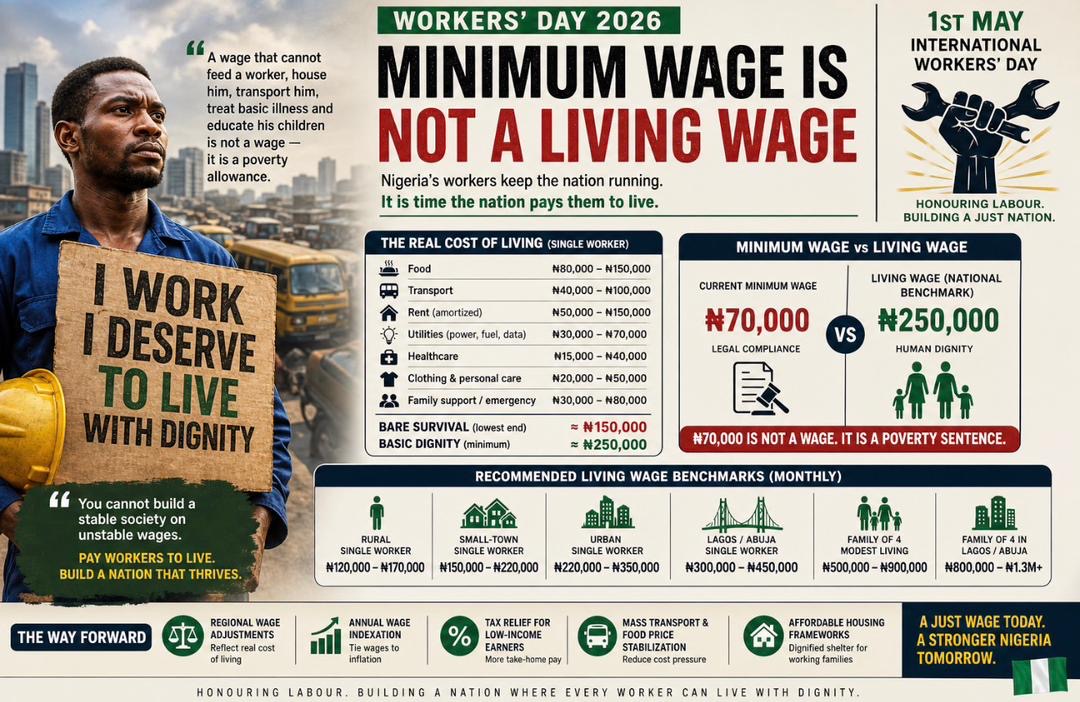
For a single worker in major urban centres today, a modest survival budget looks like this (based on 2026 cost-of-living realities):
• Food: ₦80,000 – ₦150,000+ (a single modest meal for a family can consume a shocking portion of the wage)
• Transport: ₦40,000 – ₦100,000 (daily commuting in chaotic traffic has become a financial and emotional drain)
• Rent (amortized): ₦50,000 – ₦200,000+ (one-bedroom apartments in decent areas of Lagos or Abuja often exceed ₦150,000–₦300,000 monthly)
• Utilities (power, fuel, data): ₦30,000 – ₦70,000 (with erratic electricity forcing reliance on expensive generators)
• Healthcare and miscellaneous: ₦15,000 – ₦50,000
Even at the lowest estimates, bare survival demands ₦150,000–₦250,000 monthly. Basic human dignity the ability to eat decently, house one’s family safely, educate children, and seek medical care without panic requires ₦300,000–₦450,000 in major cities.
The ₦70,000 minimum wage does not reach even half of the bare minimum. It is not a wage. It is a poverty sentence, quietly condemning hardworking Nigerians to debt, anxiety, multiple survival hustles, and quiet despair.
Minimum Wage vs Living Wage: A Dangerous Confusion
Nigeria has fallen into a tragic policy trap: we confuse the legal minimum with the moral and economic living wage.
• A minimum wage is meant to prevent outright exploitation.
• A living wage is what restores human dignity, fuels productivity, and stabilises society.
One is written in statutes. The other is written in the tear-stained faces of workers who skip meals so their children can eat, who walk long distances to save transport fare, who lie awake at night wondering how to pay school fees.
When a nation pays below a living wage, it does not save money it accumulates social dynamite: rising petty crime born of desperation, collapsing productivity as workers battle exhaustion and worry, accelerated brain drain as our brightest flee to countries that value labour, broken families, and the dangerous growth of informal survival economies that weaken formal growth.
You cannot build a prosperous, stable Nigeria on the broken backs and shattered hopes of underpaid workers.
A New, Realistic Benchmark
If we are truly serious about rebuilding the middle class and honouring the dignity of labour, we must align policy with painful reality:
• ₦250,000 as a national baseline living wage.
• ₦350,000 – ₦450,000 for high-cost urban centres like Lagos, Abuja, and Port Harcourt.
Anything less is not “gradual reform.” It is deliberate delay and delay, in the face of such suffering, is injustice.
The Moral Question We Cannot Evade
This Workers’ Day confronts us with a piercing question:
What is the true value of Nigerian labour?
Is it a cold figure frozen in outdated law books, or is it measured by a worker’s ability to live without daily humiliation to feed their family, keep a roof over their heads, and dream of a better tomorrow for their children?
When a worker cannot afford decent food, cannot reliably reach their place of work, cannot care for a sick child without selling possessions, and cannot save even a kobo for the future, then our economy is not functioning. It is extracting life from its own people.
The Intelligent Way Forward
This is not a simplistic cry for higher wages alone. It is a call for courageous, coordinated reform anchored in reality:
1. Regional and sectoral wage adjustments that recognise the vast differences between urban and rural costs of living.
2. Annual indexation of wages to inflation, so workers are not perpetually playing catch-up with an economy in constant crisis.
3. Targeted tax relief and exemptions for low-income earners.
4. Aggressive policies on mass affordable transport, food price stabilisation, and genuine investment in public infrastructure.
5. Affordable housing schemes deliberately tied to worker income levels.
Wages do not exist in a vacuum. They must be part of a holistic economic architecture that values productivity, dignity, and long-term stability.
Beyond Empty Celebration
On this International Workers’ Day 2026, as the Nigeria Labour Congress and workers in defaulting states take to the streets in protest against non-implementation and unbearable hardship, Nigeria must move beyond ritual speeches, red carpets, and empty parades.
The greatest honour we can give our workers is not eloquent rhetoric it is policy courage, structural justice, and economic honesty.
A nation that consistently underpays its workers is not merely failing its people. It is undermining its own future, mortgaging its stability, and betraying the very labour that sustains it.
The time for asking Nigerian workers to “endure” and “sacrifice” is over. The time has come to pay them what allows them to truly live.
Otunba (Dr) Abdulfalil Abayomi Odunowo
For a just, productive, and dignified Nigerian workforce