By Otunba (Dr) Abdulfalil Abayomi Odunowo
A common line in Nigeria’s public debate is that petrol isn’t expensive because its nominal price per litre still looks lower than in Europe or North America. That claim is factually true on paper, but it’s misleading. It ignores purchasing power, the structure of the economy, and fuel’s daily role in survival.
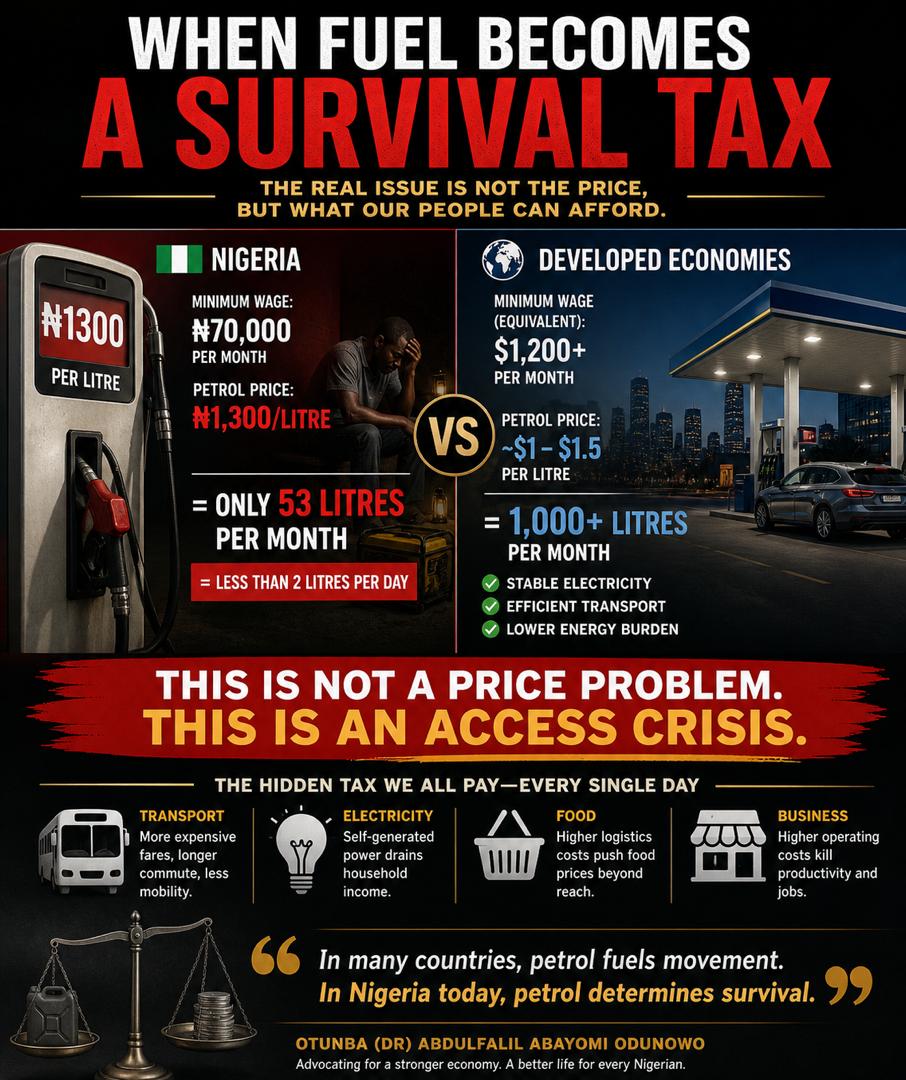
The real measure of affordability is simple: how many litres of petrol a minimum-wage worker can buy with a month’s pay, alongside the wider cost-of-living burden.
Affordability in Context
Nigeria’s national minimum wage is ₦70,000 per month. With average petrol prices fluctuating between ₦1,050 and ₦1,300+ per litre in early 2026 (reaching ₦1,288 in March per NBS data, and higher in some areas recently), a minimum-wage earner can afford roughly 50–65 litres a month.

That works out to under 2 litres a day to cover transport, business operations, food supply chains, and self-generated electricity.
Comparisons with advanced economies show the gap clearly. Data on minimum-wage purchasing power shows a US or UK minimum-wage worker can usually afford 1,000–1,500 litres per month, roughly 20 times more energy access.
Critics may point to nominal prices or absolute figures, noting Nigeria’s pump price (around $0.88–$0.90 per litre) sits below global averages or prices in the US/UK. Still, that argument misses the point: in developed nations, energy costs mainly support transport on stable grids, while Nigeria’s fuel carries a far heavier load. Purchasing power parity and proportional burden reveal the real constraint on Nigerian households and businesses.
Structural Distortion: Fuel’s Triple Burden
In most advanced economies, petrol is mainly transport fuel. Reliable electricity powers homes and industries. Nigeria is fundamentally different:
• Electricity substitute: Chronic grid unreliability forces widespread generator use. Nigeria ranks among the world’s largest markets for backup generators, with off-grid solutions (often petrol- or diesel-powered) supplying a massive share of actual consumption — estimates suggest backup generation rivals or exceeds grid output in many areas.
• SME and livelihood backbone: Small businesses, transporters, and agricultural chains depend heavily on fuel.
• Multiplier on essentials: Fuel costs cascade into higher transport fares, food prices, goods, and services.
Fuel price increases therefore create exponential effects, not linear ones. Post-2023 subsidy removal studies confirm sharp rises in transportation costs (often 200%+), operational expenses for SMEs, and overall inflation, with food insecurity and poverty metrics worsening for many.
Even people who don’t buy fuel directly still pay this “survival tax” through higher living costs.
Limitations of Wage-Only Responses
Calls for higher wages address the symptom, not the root cause. In an energy-constrained economy, wage hikes often feed cost-push inflation, wiping out real gains. Lasting relief requires lowering the cost of energy and essentials, not endless nominal adjustments.
Priority Reforms
Nigeria must pursue targeted, measurable interventions:
1. Electricity Stabilization: Aggressively reduce generator dependence through grid reliability, investment in generation, transmission, and distribution. This single step would bring the biggest immediate drop in household and business energy costs.
2. Local Refining and Transparent Supply Chains: Operational domestic refineries must deliver real efficiency and price benefits. That requires transparency in costs, competition, and anti-corruption safeguards; local production alone does not guarantee affordability without proper market dynamics.
3. Mass Transit and Logistics Efficiency: Expand reliable public transport (buses, rail) to reduce individual fuel demand and ease economy-wide pressure.
4. Macroeconomic Stability: Tame exchange rate volatility and inflation. Fuel pricing remains tightly linked to FX swings; stability is the foundation for predictable energy costs.
These aren’t abstract ideals. They’re practical necessities, backed by the lived economics of subsidy removal and persistent infrastructure gaps.
Urgent Call to Government and Leaders
Nigeria’s leaders at federal, state, and local levels must confront this crisis with urgency and clarity. The turn of fuel into a survival tax undermines productivity, deepens poverty, stifles small enterprises, and threatens social cohesion. Three years after subsidy removal, the promised dividends in infrastructure, palliatives, and diversified energy have still not materialized at the scale ordinary citizens need.
The government should treat energy access as a national emergency. Prioritize verifiable improvements in power supply, transparent refining outcomes, mass transit rollout, and macro stability. Short-term palliatives must go hand in hand with structural fixes, or real incomes and economic viability will keep eroding.
This is no longer a debate about nominal pump prices versus London or New York. It is about whether Nigeria’s workforce can access the basic energy required for daily productivity, dignity, and participation in the economy.
In many nations, petrol powers movement. In Nigeria today, it increasingly determines survival. Leaders owe citizens courageous action, not comforting narratives, to restore affordability, productivity, and hope. The time for decisive intervention is now.
Signed
Otunba (Dr) Abdulfalil Abayomi Odunowo
National President
SpeakUp Collectives Nigeria (SCN)