By Okoi Obono-Obla
The original name of present-day Calabar was Akwa Akpa, in the Efik language.
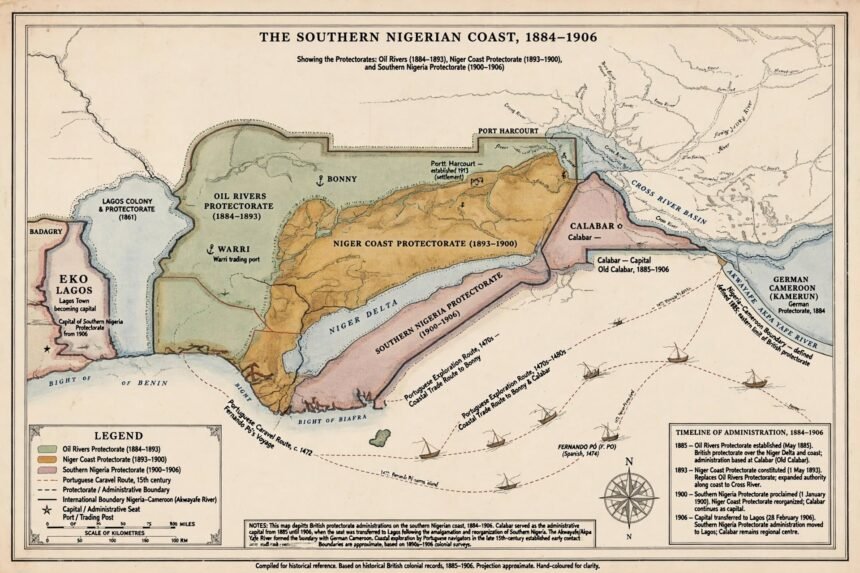
It was the Portuguese who later changed it to Calabar. The Portuguese were the earliest Europeans to arrive on the West African coast, beginning their voyages in the 15th century — from about 1472 — establishing early trading contacts in Lagos, the Warri area, and the Calabar coast.
Lagos itself was originally Eko by the Awori people. The Portuguese renamed it Lagos, after the town of Lagos in southern Portugal — Lagos meaning “lakes.”

The more complete indigenous history, however, shows that Calabar was not founded by one group alone.
Calabar has been the homeland of the Qua (Akin), Efut and Efik. Research on intergroup relations in Calabar notes that before colonialism, the Akin (Qua) dwelled in the interior while the Efik occupied the coastal plains of the Calabar River, and the Efut inhabited the forest and enclaves to the south of Old Calabar.
Historical sources trace the Qua people as the first settlers in Calabar — Southern-most section of the Ejagham people that had expanded from the Mamfe district of Cameroon through the Ikom area. Ejagham Qua tradition records that it was founded by Prince Ikang Eta and his father Ndidem Eta Nyak Ntison, with settlement as early as the wider first millennium, bringing Ejagham traditional practices such as Ekpe (Egbo) which later spread to neighbouring civilizations. The city of Calabar is home to the Efik, the Efut, and the Qua-Ejagham peoples who inhabited the city as early as the beginning of the fifteenth century, with archaeological terracottas suggesting occupation dating back to the fifth century CE.
Together with related coastal peoples such as the Balondo (Efut) — seafaring peoples with roots in Cameroon and the Old Calabar area — these three principal groups, plus the Efik who later founded Creek Town, Duke Town and Old Town and developed Old Calabar into a major trading centre from the 17th to 19th century, have collectively lived in the region, harmoniously blending their cultures and traditions into a rich tapestry which is one of the richest heritages on the African continent.
This heritage is imprinted on the map itself. The Akpa Yafe River, also known as the Akwayafe / Akpakorum River, which empties into the Gulf of Guinea, now forms a portion of the land and maritime boundary between Nigeria and Cameroon. Also known as “Akpa Yafé”, it forms a natural boundary by the eastern flanks of Bakassi and Akpabuyo. The Akpa tradition remains replete throughout the Cross River Basin, which straddles both countries.
Calabar as Colonial Capital, 1885-1906
It was on this multi-ethnic foundation that British administration was layered. After the chiefs of Duke Town accepted British protection in 1884, the town served as capital of the Oil Rivers Protectorate (1885–1893), then the Niger Coast Protectorate (1893–1900), and then Southern Nigeria (1900–1906).
Specifically: the Oil Rivers Protectorate was formally established in 1885 with Calabar as capital. It was renamed Niger Coast Protectorate on 12 May 1893. On 1 January 1900 it merged with the chartered territories of the Royal Niger Company to form the Southern Nigeria Protectorate, with Calabar still as capital. In February 1906, the Colony of Lagos was merged with Southern Nigeria, and Lagos, with its larger port, was chosen as the new headquarters — the capital of the Southern Nigeria Protectorate was moved from Calabar to Lagos.
From Akwa Akpa to Calabar, from Eko to Lagos, and from the Cross River to the Akwayafe — the story is not just one of Portuguese renaming, but of Qua-Ejagham, Efik, Efut and Balondo peoples creating one of Africa’s most enduring cultural mosaics.