

By Okoi Obono-Obla
Presently, Ugep Urban in Yakurr Local Government Area of Cross River State is made up of five towns or traditional quarters, namely Ijom, Ijiman, Ikpakapit, Bikobiko and Ketabebe. Ketabebe is the youngest of these towns, an offshoot of Ijom that started to develop from the early 1960s to its present status.
About 150 years ago, the area now known as Bikobiko was inhabited by those whom the Yakurr people called the Benobase — literally, children of God — the Aro.
After Umor (Ugep) was founded around 1617 AD, following the first wave of migration from Umowen in Akpa or Lẹkanakpakpa near Lake Ejagham in the present Manyu Division of the South West Region of the Republic of Cameroon, Ukpawen (Ijiman), Ijom and Ikpakapit sprang up. According to the migratory history documented by the Yakurr historian Dr. Otu Abam Ubi (1978, 1986), Ugep and Idomi were founded around 1660 as part of that first phase of settlement.

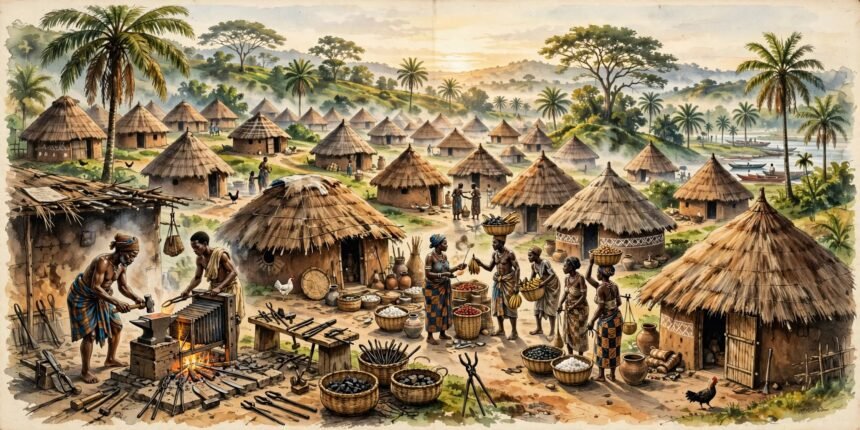
The Benobase or Aro were then living in a trading settlement in Letekom (the blacksmiths’ compound). This fits the well-known pattern of the Aro Confederacy, which established trading and smithing colonies across Southeastern Nigeria at the height of its power in the 18th and 19th centuries.
Then something happened that fundamentally changed the course of history and made the people of Ugep take a decisive decision to expel them.
In about 1835, there was a dispute between an Ugep man named Imon Okan and an Aro trader over a debt. Both agreed to submit their grievance to the oracle known in Lokaa as Obase Ubulukpabi — properly known as Ibini Ukpabi, also called Long Juju by the British — at the headquarters of the Aro Confederacy in Arochukwu. At that time, the oracle performed police and judicial functions across the Confederacy.
When the Aro man and Imon Okan agreed to settle their dispute, they traveled to Arochukwu with their witnesses. The mystery of Obase Ubulukpabi sent a cold chill down the spines of disputants who went there for adjudication, because of the belief that the oracle devoured some of those who came before it. When a party of, say, ten people or fewer traveled to consult the oracle, a smaller number would eventually return home — the rest were believed to have been eaten.
Imon Okan never returned to Ugep. It was presumed that he had been eaten by the oracle, and his people performed his funeral rites as customary. Surprisingly, after four harvest seasons (four years), Imon Okan resurfaced in Ugep and told his people that he had not been eaten but had been sold into the trans-Atlantic slave trade — a trade that was still carried on clandestinely from the Bight of Biafra at that time — and that he escaped when he was about to be shipped to the Americas.
The story told by Imon Okan incensed the Ugep people, because Yakurr people never practiced selling their own people into slavery. The structure of Yakurr social organization makes such a practice highly improbable. As a double-unilineal society, everyone in Yakurr belongs to both his patriclan and matriclan concurrently, so for anyone to be sold into slavery, there would have to be a consensus between both clans, which would be difficult to forge. The oracle, which was widely accused by historians of converting disputants into slaves for sale through coastal allies like Calabar and Bonny, lost all credibility in Ugep.
The dialectical consequence was the destruction of trust between the Benobase and Ugep. The people of Ugep, who would typically hit back if deliberately hurt, schemed vengeance against the Aro living among them.
The Council of Yabol, which comprises the Obol Lopon, the heads of the various matriclans and Yabol Yepon, met and took a decisive decision to expel the Aro from Letekom. They directed the Onun Eko (commander-in-chief) to mobilize able-bodied young men from the various Yekpon in Ugep to carry out the operation.
The operation took place on the morning of Koka (market day). Ugep troops attacked in the early hours, burning the houses of the Aro, and those who came out of their burning houses were bludgeoned to death while hundreds fled into the bushes. According to Dr. Otu Abam Ubi, during the operation there were cries of “Biko, biko” — the Igbo word for “please, please” — from the Benobase. It is from that cry of mercy that the name Bikobiko is said to have been derived.
After the attack, the people of Ikpakapit town, under whose jurisdiction the settlement of the Benobase fell, sent some of its people to establish a permanent settlement there. That settlement is today Bikobiko Town of Ugep Urban.