By Okoi Obono-Obla
Ebonyi State now has an APC Governor, just like Imo and Enugu States. Unlike in 2023, when Ebonyi and Imo were the only South-Eastern states with APC Governors, we are going into the 2027 presidential polls with three APC Governors. The game-changer is Enugu, where Governor Peter Mbah defected from the PDP to the APC on October 14, 2025, with his entire cabinet and 23 of 24 State Assembly members. Anyone who thinks this new tripod of APC Governors will not impact the outcome of the presidential polls in the South-East geopolitical zone is merely joking.
Governors are powerful political levers and controllers of the nexus of power. They are great instruments for mobilizing the local populace. Ebonyi State is somewhat a rural state with a less sophisticated population of farmers who will not be teleguided by what takes place on social media but will depend on what the local political leader at the ward level tells them.
The electorate will also be swayed by what the traditional ruler at his community level tells him. These traditional rulers are somewhat public servants, under the payroll of government, and will definitely play the role the Governor wants them to play. Then the Local Government Chairman and councillors are power brokers at the base. At that level, the people fear and hold the government in awe, and sometimes they perceive any exercise of free will without government imprimatur as tantamount to fighting the government — and you fight the government at your own peril.

The rural population does not really bother about the cost of petrol or the floating of the Naira. Those are issues that bother urban dwellers. You will be surprised that these rural dwellers totally depend on what local leaders tell them about government and what to do, even during voting. Personally, in my community, which is fairly literate by all standards, local people come to me on election day before polling opens to ask me who they should vote for, or even at the polling station they will not hesitate to ask how they should vote.
Therefore, those who dismiss the power of local leaders — Chairmen and councillors of Local Government Areas, traditional and community leaders, and the Governor — in a rural state like Ebonyi are missing the point. These factors, more than identity and religious politics, will determine how Ebonyi votes, because Ebonyi is not too sucked into the identity politics that defines the politics of the South-East.
The Nigeria Democratic Congress (NDC) that now presents Peter Obi from Anambra State is not structurally solid in Ebonyi. To put it in context, Obi contested in 2023 under Labour Party, joined the African Democratic Congress (ADC) on December 31, 2025, and moved to the NDC on May 2, 2026, where he was ratified as its presidential candidate on May 29, 2026. The NDC lacks the props of power to pose any challenge to the APC incumbency both at the State and Federal levels, where the former Governor and present Minister of Works, Senator David Umahi — a consummate grassroots politician and the acknowledged generalissimo of Ebonyi politics — holds sway. There is also the tension between Ebonyi, seen as a fringe state, and the centre of South-East politics, which may alienate voters from using identity politics to decide the presidential election.
2027 is a different ball game. The dynamics of 2023 will not determine 2027 because a lot of water has passed under the bridge. The Federal Government’s massive investment in road infrastructure in Ebonyi — the Abakaliki-Afikpo Federal Highway, the Ndibe Bridge over the Cross River linking Ebonyi to Cross River State up to Calabar — the creation of the South East Development Commission (SEDC), which was signed into law by President Bola Tinubu in July 2024, and the deep respect Ebonyians have for their son David Umahi, are the new determining factors.
PERMUTING THE OUTCOME IN EBONYI STATE
When these factors are permuted, this is how Ebonyi will stand:
1. Presidential Election: APC 65-75%
APC will win Ebonyi clearly. The structure of Governor, LGA Chairmen, ward leaders and traditional rulers will deliver the wards. NDC will come a distant second with 15-25% concentrated in urban Abakaliki and Afikpo, because it has no ward structure and no sitting councillor or traditional ruler. PDP will be reduced to less than 10%.
2. Governorship Election: APC Retains Power by Landslide
Incumbency has never been defeated in Ebonyi since 1999. Governor Francis Nwifuru, backed by Umahi, controlling all 13 LGAs and the State Assembly, will win a second term. Opposition will struggle to even field a statewide candidate.
3. National Assembly:
Senate (3 Seats): APC 3 – 0. Ebonyi North, Central and South will all go to APC. In 2023 APC won 2 and PDP 1; in 2027 the Umahi factor and federal projects will deliver a sweep, with Ebonyi South as the strongest zone.
House of Representatives (6 Seats): APC 5-6, NDC 0-1. APC will take Abakaliki/Izzi, Ebonyi/Ohaukwu, Ezza North/Ishielu, Afikpo North/South, Ohaozara/Onicha/Ivo. Ezza South/Ikwo is the only potential contest.
4. State House of Assembly (24 Seats): APC 22-24.
This is where LGA Chairmen matter most. PDP and NDC will not have polling unit agents in many hinterlands of Izzi, Ikwo, Ezza and Ohaukwu. The Assembly will remain an APC family affair.
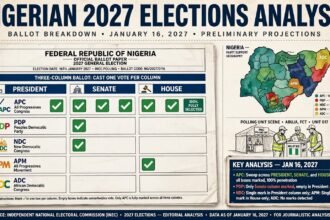
| Election | APC | NDC | PDP |
| — | — | — | — |
| Presidential | Dominant | Distant 2nd | Marginal |
| Governorship | Winner | 2nd | Marginal |
| Senate | 3 | 0 | 0 |
| Reps | 5-6 | 0-1 | 0 |
| State Assembly | 22-24 | 0-2 | 0 |
Conclusion
In 2023, Ebonyi voted partly on emotion. In 2027, Ebonyi will vote on structure, patronage and proximity to power. While Anambra and parts of Enugu may still be swayed by identity politics, rural Ebonyi will follow its traditional rulers, its ward leaders, its LGA Chairmen and its Governor. With three APC Governors now in the South-East, with the SEDC as proof of connecting to the centre, and with David Umahi as a son at the federal table with visible roads and bridges to show, Ebonyi will emerge as the most solid APC state in the South-East. Those who ignore the power of local political levers in a rural state do so at their own peril.