by Ademola Rabiu
My Ẹ̀gbọ́n, an elder brother, a writer whose pen I respect, recently described Alhaji Atiku Abubakar as “a complicated and conflicted character,” a “deceptive and disloyal individual” who covets the seat of his elders and betters.
It was a generous reading. The truth is smaller, uglier, and far less interesting than “complicated.”
His Excellency Atiku Abubakar, with all due respect, is not a riddle wrapped in an enigma. He is not a man of hidden depths, tortured by competing loyalties. He is, quite simply, egoistic and self centered – a man whose entire political existence rests on one unshakable conviction: that money is the only currency of power, and that loyalty is a commodity to be bought, sold, and discarded like any other.

Let us strip away the mystique. And let us strip away the vehicle he now rides in, which is not a political party in any sense that word deserves.
The Megalomaniac with No Mind
A complicated man has depths. A perfidious man has only appetites.
Alhaji Abubakar is a megalomaniac of the most banal kind – so consumed by his own reflection that he cannot conceive of a Nigeria that does not revolve around his ambition. His self-esteem is not merely excessive. It is baseless.
Our former No. 2 lacks, frankly speaking, the intellectual furniture to grapple with the complexities of governance, the educational grounding to understand political economy, and the ideological compass to navigate the moral questions of leadership.
What Alhaji possesses in abundance is the vulgar certainty of the nouveau riche: that every door opens with cash, every conscience has a price, and every principle is negotiable.
He aspires to lead 200 million souls, and he has never once demonstrated the curiosity to understand them. He does not study Nigeria. He studies his own reflection.
Twenty-Five Years, Six Parties, Zero Convictions
Can anyone – anyone – associate a single coherent ideology or political principle with Atiku Abubakar?
His defenders scramble and come up empty. On fuel subsidy, he supported removal in 2023 and vows to restore it in 2027 – a position described by the APC’s National Vice Chairman (South-East), Dr. Ijeomah Arodiogbu, as evidence of “an unstable character and a lack of consistent ideology.” Political analyst Ajomale stated flatly that “Atiku doesn’t have any political ideology” and “is not a politician Nigerians can trust,” citing his serial defections across parties over 25 years. The News observed that his name “has become synonymous with raw ambition, political desperation, and a relentless quest for power that has often trampled over principle, loyalty, and national interest” – a man whose “only abiding ideology is self-promotion.”
Even the Presidency has described his career as “a study in relentless ambition unmoored from ideological grounding.”
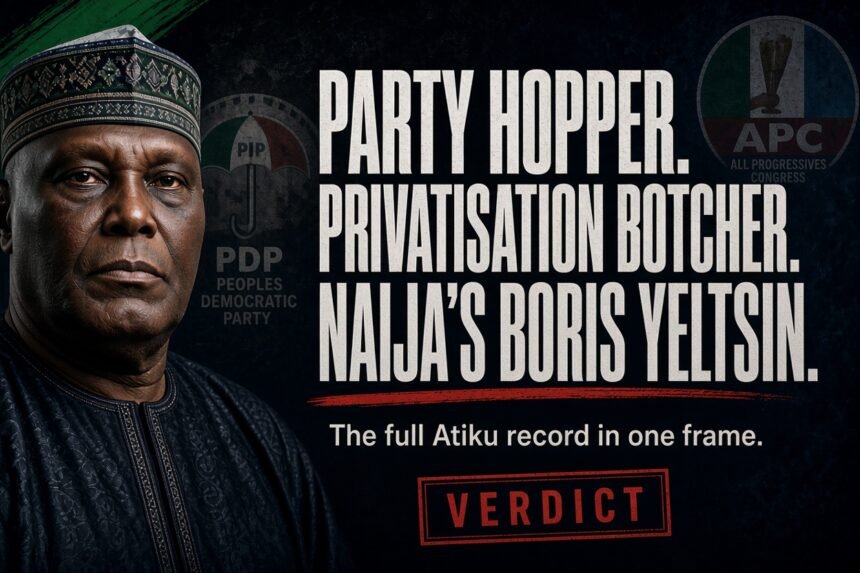
Twenty-five years. Six political parties. Not one conviction he has not abandoned. Not one principle he has not traded. Not one promise he has not broken. This is not a political career. It is a kleptocracy in motion.
The Man Who Changed His Ideological Wardrobe
Vice President Kashim Shettima, speaking at the inauguration of the APC Presidential Campaign Council in Abuja, put it in terms that cut to the bone.
He called the current political season “a masterclass in cinematic comedy.” He noted that Atiku, “who had worn the toga of capitalism with pride throughout his political career, now sounded like the legitimate offspring of Vladimir Lenin”. And then he asked the questions that Atiku’s new costume cannot answer: “Who pays? Who benefits? And which competing priorities must surrender their funding? A change of ideological wardrobe cannot balance a national budget.”
He has no ideology. He has a tailor. And he changes his suit to match whatever crowd he is addressing. One season he is a capitalist. The next he is a born-again leftist. The only constant is the ambition. The only conviction is the craving.
There is No There There
To borrow from Gertrude Stein’s famous line about Oakland: there is no there there.
Our dear Alhaji is not complex, deep, or fascinating – not a riddle to be solved, certainly – because when you strip away the ambition, the money, and the noise, there is nothing meaningful underneath. He is all shell, all performance, a transaction in human form. A political participant with no ideological core, no intellectual depth, no moral centre, no settled principle, no inner substance. What you see is ambition and appetite – and when you look beneath it, there is nothing else there.
The Man Who Joked About Selling Nigeria’s Lifeblood
Consider the NNPC. On television, before the 2019 election, Atiku declared – with the fervour of a man who had finally found his true religion – “I am committed to privatising NNPC, I said it. I swear. Even if they are going to kill me, I will do it. I am not going to enrich members of my family, but my friends. Are my friends not entitled to be enriched?”
His aide later called it “a joke taken too far.”
A joke. The national oil company – the backbone of Nigeria’s economy, the patrimony of 200 million people – was, to Atiku, a punchline. A wink to a room of business elites that the feeding trough would remain open.
Imagine a man standing before the nation and promising to sell its lifeblood to his friends – then, when challenged, calling it humour. Imagine the arrogance. Imagine the contempt. Imagine the sheer disdain for every Nigerian who has queued for fuel, watched a livelihood evaporate, or wondered if tomorrow would be better. To Atiku, we are not citizens. We are spectators to his acquisition.
Where Does He Belongs? Definitely Not on a Ballot
In South Korea, a politician who said such a thing would not be campaigning for president. He would be in a prison cell, answering for corruption.
In Nigeria, he is fêted, platformed, and packaged as a statesman.
Shame on the party that platforms him. Shame on the enablers who nod along. Shame on anyone who pretends this is normal.
The Political Tourist Who Calls Dubai Home
And what of his patriotism?
A politician who, after every electoral defeat, retreats to Dubai – where, in the words of activist Omoyele Sowore, he “resides permanently” – only to return four years later, hat in hand, for another round of electoral adventurism. Sowore put it plainly: “The moment the election is over, Atiku will go back to Dubai, which is where he stays permanently, and you won’t see them again.”
This is not a leader. This is a seasonal migrant, a political tourist who treats Nigeria as a stage for his ego and Dubai as his sanctuary. As one commentator noted, while he “pretends to be concerned about the security of Nigeria,” he was “happy sojourning in Dubai for years, including under Buhari, while security got considerably worse in his region of origin and he said/did nothing.” Minister Festus Keyamo asked the question every patriotic Nigerian should ask: if Atiku loved Nigeria so much, why did he not sell off his Dubai assets and relocate to Abuja when the UAE visa ban was announced?
The answer is as obvious as it is damning: because Nigeria is not his home. It is his project.
He does not bleed when Nigeria bleeds. He does not mourn when Nigeria mourns. He packs his bags, boards his jet, and waits for the storm to pass – leaving behind the very people he claims to serve. This is not leadership. This is parasitism.
The Khalifa Who Trusts Soothsayers Over All
And then there is the marabout problem.
It is a well-worn tale – told in whispers, and increasingly in print – that Abubakar Atiku, who permits his acolytes to address him as “Khalifa,” surrounds himself with hooded imams and otherworldly men whenever crucial decisions must be taken. It is said he regards a marabout more highly than a Harvard professor of Economics. In election season, the stories multiply: marabouts from Nigeria, from the Sahel, from West Africa, even from as far as Arabia, crouching in his camp, crooning prophecies of a crown that is his destiny, telling him the presidency is written for him and that even he cannot help it. They elevate him to the status of a deity, and he – a man of colossal ego – laps it up. The Presidency itself has described him as a man “under the spell of marabouts,” racing against time in pursuit of “the prophecy of his marabouts.”
A man who believes he can buy the presidency with money also believes he can conjure it with incantations.
And here is the deepest tragedy: a man who would be President of Nigeria – a nation of Muslims, Christians, traditionalists, and those of no faith at all – has outsourced his judgment to soothsayers. He seeks the counsel of the occult over the counsel of his own conscience. He trusts the whisper of a stranger over the will of the people.
What kind of leader does not trust himself? What kind of man does not trust his God? A pious Muslim does not traffic in fortune-telling. A pious Muslim submits to the Qadar, to Allah, AW, not to the puppetry of marabouts. This is not a private matter, if true. It is a public scandal – a violation of the very faith he wears like a garment of convenience.
The real Khalifah is a scholar of the Qur’an, and I honour him. But the diviner who borrows the name to sell the future is another matter. The Qur’an teaches that the unseen belongs to Allah AW alone, and the Prophet, peace be upon him, warned that whoever consults a diviner has his prayers refused for forty nights.
A man who parades piety on Fridays and then goes shopping for prophecies about the presidency should not ask the believers of Nigeria to trust him with their destiny.
You cannot ask the Almighty for votes in the mosque and ask a diviner for the date of your coronation.
The Man Who Found Refuge in Another Man’s House
And here is the deepest wound of all – a wound that Shettima reopened with surgical precision.
“In 2022, I reminded this nation that former Vice President Atiku Abubakar’s presidential bid in 2007 found refuge in the political house President Bola Ahmed Tinubu had built,” Shettima said. “That generosity became part off our political history.” The Vice President did not stop there. He reminded the nation that the same man who now cannot bring himself to address Tinubu by his title once depended on Tinubu’s generosity to keep his political career alive.
This is not a man who built his own house. He is a man who has lived in other people’s houses, eaten at other people’s tables, and then spat on the floor on his way out. He has been a guest in every party he has joined, a tenant in every political structure he has occupied. And now he wants to be landlord of the entire country.
He Is No Abraham Lincoln – He Is a Serial Tenant
Shettima drew the contrast that every Nigerian should carry into the voting booth.
“You can call him Bola. If you like, you can call him Adekunle. But the truth is that he is the president and commander-in-chief of the Armed Forces of the Federal Republic of Nigeria,” Shettima said, refusing to return Atiku’s disrespect in kind. “I will not follow suit with Lawal and call him Kachalla. No. But believe me, Atiku Abubakar, who has contested for the presidency of this country for the eighth time, is no Abraham Lincoln. He is more of Odinga Odinga.”
Eight times. Eight attempts at the same office. Not because he has a vision the nation is waiting for, but because he believes the office belongs to him by right. He is not a statesman seeking to serve. He is a claimant demanding his inheritance. And a man who has been rejected eight times by the Nigerian people should ask himself a simple question: is it them, or is it me?
The NDC Is Not a Party. It Is a Lifeboat
And now, our dear Kachalla has a new vehicle – the ADC.
We are told it is a political party. We should be precise: it is a fire brigade, an electoral vehicle, assembled in a hurry, for one purpose – to carry one man to one office. Whatever name it flies this season, whatever letterhead it prints, it is not a party in any sense that word has ever meant in Nigeria.
Ask it a simple question. Name your ward chairman. Name your councillor. Name the LGAs where you have offices, membership registers, dues-paying members, and a footprint older than the ambition it was built to serve.
There is no answer, because there is nothing there.
A political party is a covenant with a community. It has a history, a structure, a base, a programme, a discipline, and a memory. It argues with itself. It holds conventions where power genuinely changes hands. It loses elections and survives, because it exists for something larger than any single man.
What we are being sold is a shell company. A lifeboat. A chieftaincy title with a logo. ADC has no ideology because it was not built on ideas – it was built on one man’s timetable. It has no grassroots because it was never planted; it was announced. It has no future because it was never designed to outlive its passenger.
This is the oldest trick in our politics: dress ambition in the borrowed robes of a party, and hope the crowd mistakes the costume for a movement. But a crowd is not a party. A convoy is not a party. A WhatsApp group with a letterhead is not a party.
And here is the question every Nigerian should ask of this vehicle and its passenger: If he could not build a party in twenty-five years – if he could only rent one, then abandon it, then rent another – what makes anyone believe he can build a nation?
If a man cannot keep faith with a party, he will not keep faith with a country. If he cannot be loyal to a structure he helped erect, he will not be loyal to a constitution he swears to uphold. The character of a leader is revealed in what he does with power he already has – not in what he promises with power he does not.
Frustration Is Not a Strategy
Let me be brutally clear, because honesty demands it: this is not a defence of every action or inaction of the PBAT administration. If you are not completely satisfied with some of its missteps, you are entitled to your frustration. You are entitled to demand more. You are entitled to be impatient.
But it is a no-no – and a joke taken too far – to let that frustration drift into the slightest consideration of Atiku or Peter Obi as alternatives.
They are not credible alternatives.They are not alternatives at all. They are a road to the reversal of gains and progress. Atiku is a transactional megalomaniac; Obi is a motion without movement, a mythomaniac, a man whose governance in Anambra was a study in abandoned projects and broken promises. To imagine either as a remedy is to mistake a different poison for a cure. They are not the change we seek. They are the chaos we must avoid.
Discontent with the present is not a licence to embrace the past. Frustration is not a strategy. And a nation that keeps returning to the same broken men, the same hollow promises, the same perfidious ambitions, will keep getting the same broken results. We cannot keep drinking poison and praying for health.
Ambition Is Not a Qualification – It Is a Warning
So let us say it plainly, without the flattery of “complicated.”
Alhaji Atiku Abubakar is not conflicted. He is not a tragic figure. He is not a mystery to be unravelled. He is conflicted – a transaction in human form, a walking balance sheet of grievances and appetites, a man who believes he can buy the presidency the way he bought his friends, the way he bought silence, the way he bought the remnants of Nigeria’s patrimony.
But money cannot buy patriotism. It cannot buy integrity. It cannot buy the love of a people who have seen through the masquerade. It cannot buy history, which will remember the men who sold the family silver and called it reform.
Nigeria is not for sale. Not to Atiku, not to his friends, not to any man who treats this country as a pit stop on the road to Dubai.
The coming election is not a contest between personalities. It is a referendum on whether we will continue to be governed by men who see us as customers to be bought and sold – or whether we will finally demand something better: leaders who stay, who serve, who understand that power is a trust, not a transaction.
Alhaji Atiku Abubakar has no ideology. He has no programme. He has no patriotism. He has only ambition.
And ambition alone is not a qualification for the highest office in the land. It is a warning.
Let us heed it. Let us not be seduced again. Let us not let the promise of a new vehicle blind us to the old, rotten driver. Nigeria deserves better. Nigeria must demand better. And Nigeria must, at last, become better – starting with the men we refuse to put in power.
– A Patriot Tired of Transactional Politics