
By Okoi Obono-Obla
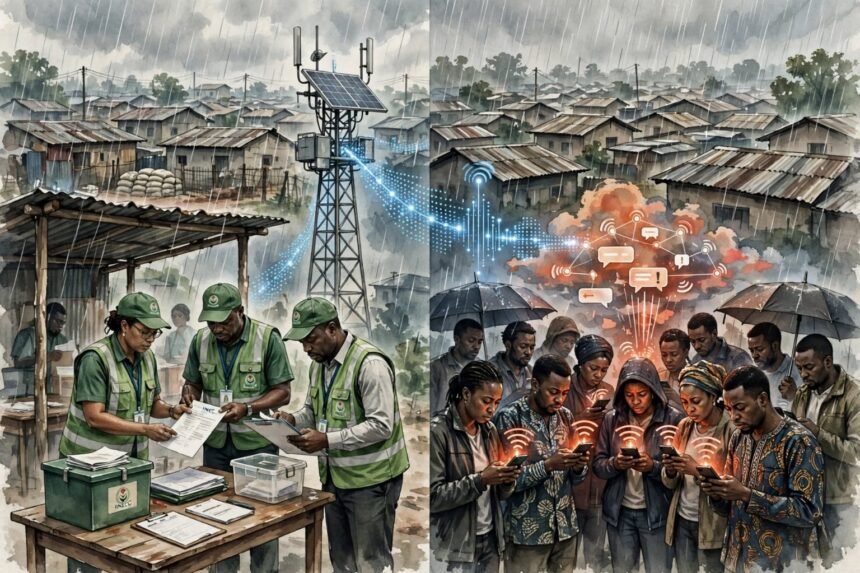
On Thursday last week, Mr Peter Obi, presidential candidate of the National Democratic Congress (NDC) for the 2027 election, told Arise TV that his team will establish a system to independently transmit polling unit results to its situation room in 2027.
“We will have even a dual transmission so that as it’s going to the proper designated INEC portal, it’s also being transmitted where the people can see it,” he said. He clarified: “All we are saying is that this time around, we will make sure that in every polling unit, we must have a system that transmits to our own situation room the correct results.”
The statement caused alarm. It should not have, legally. Politically, it should teach us a lesson.
What is the normal practice?
Since 1999, the Nigerian electoral process has always contemplated that polling agents of candidates are furnished with duplicate copies of Form EC8A after counting and announcement at the polling unit. Those copies are transmitted or conveyed to ward, local government, state and national collation centres — not as official results, but as party records for verification.
Every serious party does this. It is called Parallel Vote Tabulation. It is not illegal. It is a safeguard.
What does the Electoral Act 2026 say?
The Electoral Act 2026 strengthens what was previously an administrative practice:
Section 47 gives statutory recognition to BVAS.
Section 60(3) gives statutory recognition to IReV and mandatorily requires electronic transmission of Form EC8A to the portal.
Section 60(6) creates criminal liability for any presiding officer who wilfully frustrates that transmission.
Section 74 and Section 125 stiffen penalties. A returning or collation officer who intentionally collates or announces a false result now faces not less than 10 years imprisonment without option of fine. Any person who announces or publishes a false result knowing it to be false commits an offence.
The law remains: only INEC can collate and declare. A candidate can compile for verification; he cannot compile and declare as official.
Why the alarm over Obi then?
The alarm is not legal; it is political and contextual.
First, language. The phrase “dual transmission” in the context of Section 60(3) which now makes transmission to IReV mandatory by law, was easily misconstrued as intention to create a parallel IReV and to declare a parallel result. That would be an offence under Section 125.
Second, history. The failure of IReV in 2023 made party collation central to election petitions. Any talk of independent compilation is now read as preparation to dispute 2027.
Third, INEC’s monopoly. INEC must constantly remind Nigerians that only it can declare, lest supporters confuse a party situation room figure for the official result.
The real danger: Misinformation and volatility
Here lies my concern, and why I think politicians must fine-tune their language.
We are in an era of 30-second clips, of X, Facebook, Threads and WhatsApp broadcasts. When a leader says “we will compile our results,” the full context is lost. Gullible supporters hear “our candidate will declare his own result.” In a country as volatile as ours, with deep distrust and history of post-election violence, that loose phrasing can make youths take the law into their hands at collation centres.
Social media has made fake news travel faster than Section 60(3) can transmit EC8A. We also now have “fake laws” — citizens quoting repealed provisions or inventing provisions that do not exist in the 2026 Act.
A leader must be precise. There is a world of difference between:
“We will have dual transmission and compile our own results” — which sounds like usurpation of INEC; and
“Our agents shall, as permitted by law, obtain duplicate copies of EC8A at polling units and transmit same to our situation room for verification against IReV as published by INEC” — which is lawful and responsible.
The first incites; the second educates.
What a candidate can and cannot do
Under the Electoral Act 2026, a candidate can:
Deploy agents to all 176,846 polling units.
Collect duplicate EC8A.
Transmit same to his situation room.
Verify against IReV.
Use discrepancies to file a petition under Section 138.
A candidate cannot:
Collate and declare the official result.
Publish his compiled figure as the official result.
Instruct supporters to treat his situation room as the authentic collation centre.
Peter Obi’s suggestion, as clarified, falls within what a candidate can do. But he caused the alarm because he raised a normal administrative practice as a political innovation, using language that the street can misread.
In 2027, the election will be won not just by BVAS and IReV, but by responsible communication. Politicians must not play to the gallery and send wrong signals to their gullible supporters to take the law into their hands. When chaos erupts from such careless use of language, everyone will be affected.
As my people say, when it rains, it does not fall on one man’s roof alone — including those who never prayed for rain in the first place.