By Otunba (Dr.) Abdulfalil Abayomi Odunowo
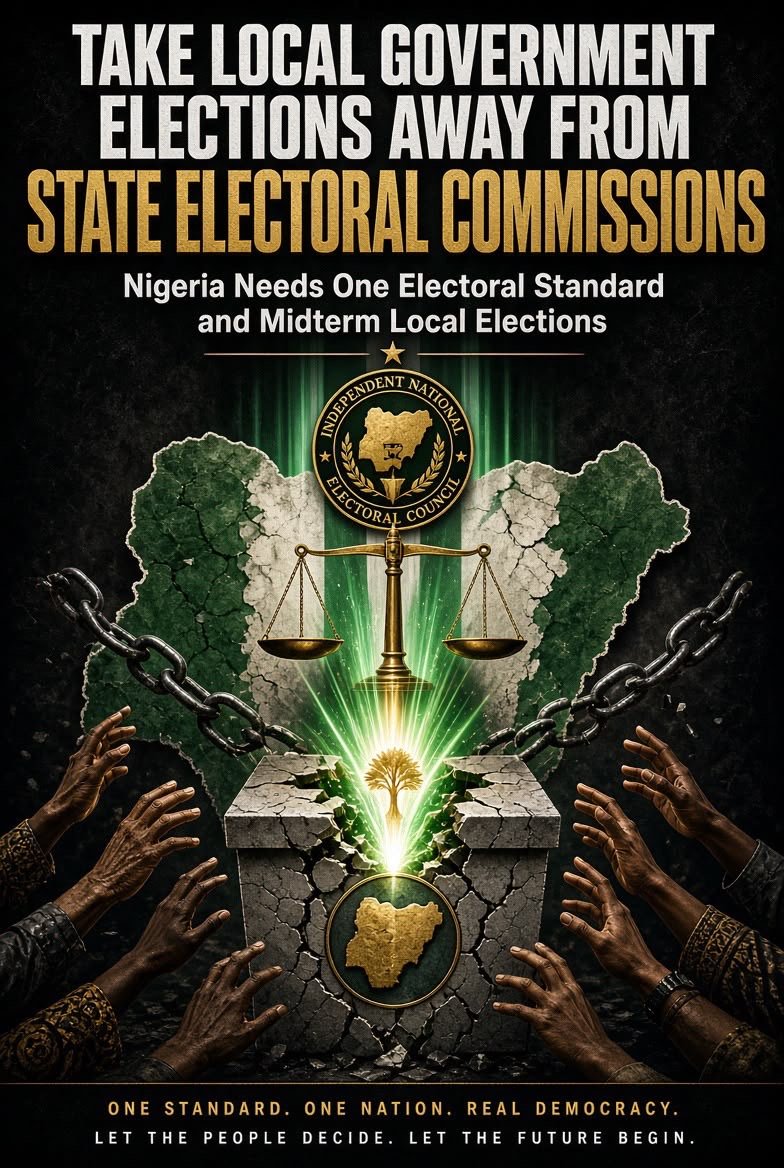
Nigeria Needs One Electoral Standard and Midterm Local Elections
Twenty-seven years into the Fourth Republic, Nigeria must confront an uncomfortable truth: local government elections rarely feel like genuine contests. The party that controls a state almost invariably sweeps every chairmanship and nearly every councillorship seat. This is not an APC or PDP problem. It is a structural one.
In Lagos (2025), the ruling APC took all 20 chairmanships and 375 of 376 councillorships. In Ondo, APC won every seat. In Osun, under PDP control, PDP took all 30 chairmanships and 332 councillorships. In Gombe, APC repeated the pattern. Clean sweeps are theoretically possible in free elections. When they become the routine outcome across states controlled by different parties, confidence collapses.
Democracy requires more than the ritual of voting. It requires a reasonable chance that votes can change leadership. Local government is the tier closest to daily life roads, markets, sanitation, primary healthcare. Yet it is the tier where many Nigerians least believe their votes matter. When results appear preordained, opposition parties under-invest, capable candidates stay away, and voters stay home. Elections become administrative ceremonies.
Three reforms are required.
First, transfer responsibility for local government elections from State Independent Electoral Commissions to the Independent National Electoral Commission. One country should have one voters’ register, one set of minimum standards, and one independent body conducting public elections. INEC is imperfect and needs continuous reform. But state commissions that depend on state structures repeatedly deliver near-total victories for the party in power. Recent INEC-conducted by-elections have returned winners from APC, PDP, APGA and NNPP. Nigerians deserve the same institutional standard whether electing a president or a councillor.
Second, establish a uniform four-year tenure for all elected local government councils. The mandate must belong to the electorate, not to the convenience of state governments. Financial autonomy without electoral autonomy is incomplete. A chairman who receives allocations directly but owes political survival to the state establishment is not fully accountable to the people. True autonomy requires financial independence, administrative responsibility and electoral legitimacy.
Third, hold local elections nationwide two years after the general elections. Presidential, National Assembly, governorship and State Assembly contests would remain on their cycle. Two years later, Nigerians would elect chairmen and councillors. Local races would no longer be swallowed by higher-level politics. Candidates would be forced to answer community questions: Who will fix the roads? Who understands the markets? Who can improve sanitation and primary healthcare? The midterm poll would also give citizens a democratic verdict on performance halfway through a national tenure, creating continuous accountability rather than four-year bursts of attention.
These changes require constitutional amendment. They must not be crafted to favour any party. The test is simple: would we accept the present system if our own party were in opposition? A credible framework protects government and opposition alike.
Nigeria’s democracy will not be completed from Abuja downward. It must be secured from the 176,000 polling unit upward. After 27 years of civilian rule, we should be mature enough to insist that the same standards that determine who occupies Aso Rock also determine who occupies the local government secretariat. Let the people choose their chairmen and councillors. Give them a secure four-year mandate under one independent electoral authority. And two years after every general election, let Nigerians return to the ballot box and deliver their midterm verdict.
Democracy begins in the ward.
Signed
Otunba (Dr) Abdulfalil Abayomi Odunowo
National Chairman AATSG
ASIWAJU AHMED TINUBU SUPPORT GROUP
Saturday 12th September 2026.