


By Okoi Obono-Obla
My American friend, Jillian, who lives in Virginia, shared with me a thought-provoking and heartbreaking story published in the New York Times edition of 26th May, 2026, titled “They Started I.V.F. Now Split. Who Gets Custody of the Embryos?”
When I remarked, “What a pathetic story!” she responded:
“I thought the situation itself was interesting, but I also thought the lawyer in you would find the legal issues to be interesting as well.”
She was absolutely right. What appeared at first as a pathetic human story quickly revealed itself as a profound legal problem that both American and Nigerian law are struggling to resolve. Who owns a frozen embryo when love ends?
I. The Question
An American couple or partners start I.V.F. Embryos are created and cryopreserved. Suddenly, the man sues for divorce, stating he is no longer interested in the relationship, and they eventually split. Who gets custody of the embryos?
This modern problem is now common. With over 400,000 frozen embryos in storage in the United States and a rapidly expanding IVF sector in Nigeria, courts on both sides of the Atlantic are being asked to decide what family law never contemplated: the disposition of a frozen embryo.
The phrase “custody of embryos” itself is misleading. In no jurisdiction are embryos treated as children for custody purposes. The correct legal question is disposition – who has the right to decide whether the embryos are implanted, destroyed, donated to research, or donated to another couple?
II. The American Position
There is no federal law in the United States governing the fate of embryos on divorce. The law has been developed by state courts since 1992, beginning with Davis v Davis, 842 S.W.2d 588 [Tenn. 1992].
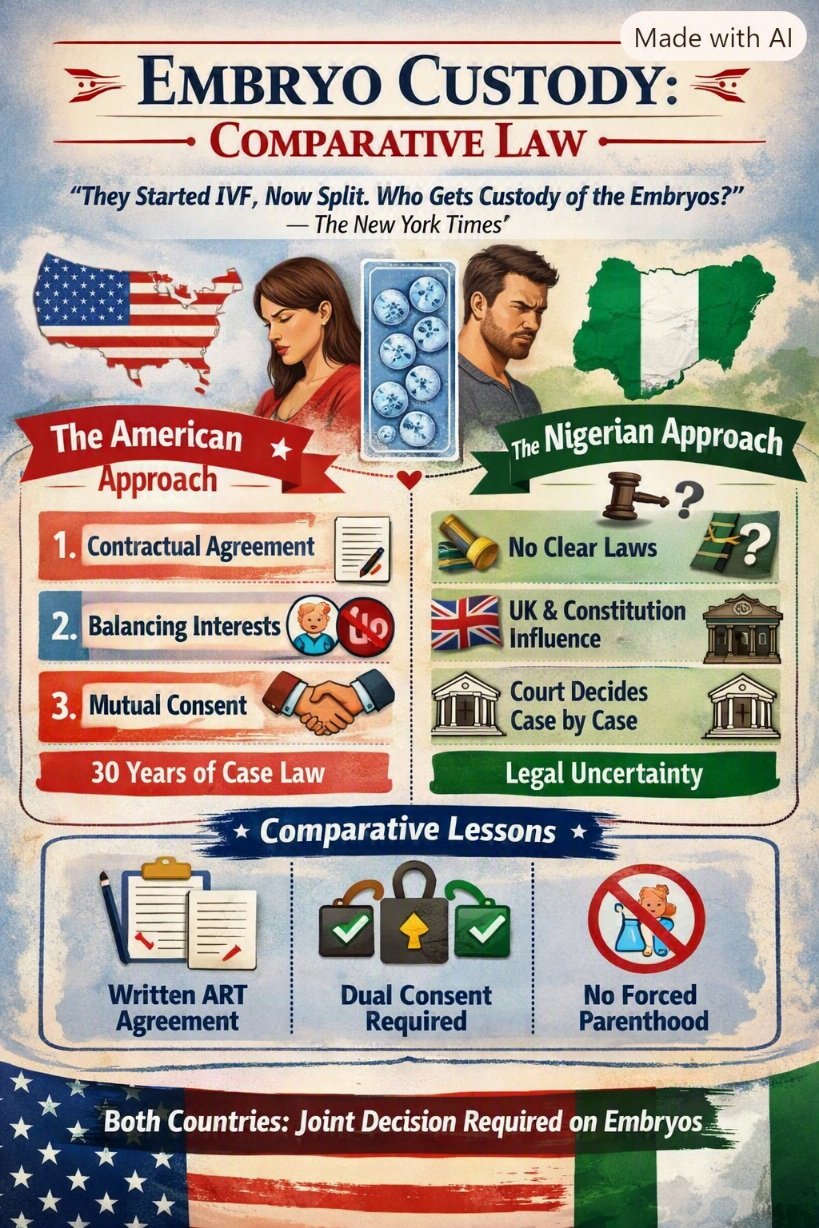
American courts have developed a three-tier hierarchy:
1. The Contractual Approach
When a couple begins IVF, the clinic requires them to sign a disposition agreement or informed consent form. It contains options for divorce, death, non-payment of storage, or disagreement. Where that agreement is clear, voluntarily signed, and unambiguous, most courts enforce it as an expression of the parties’ intent.
2. The Balancing Test
If there is no contract, or the contract is ambiguous, courts balance the competing interests: (a) The right to procreate of the party who wants to use the embryos, particularly if these are their last chance to have a biological child; and (b) The right NOT to procreate of the party who wants to avoid genetic parenthood. In almost all reported decisions, the right not to procreate prevails.
3. Contemporaneous Mutual Consent
A minority of courts hold that without a clear agreement, no use of the embryos can occur without the present, mutual and contemporaneous consent of both gamete providers.
The result in America is this: divorce alone does not transfer the embryos to the other party. If the husband withdraws consent, the wife generally cannot implant the embryos to create a child with his sperm.
III. The Nigerian Position
Nigeria presents a stark contrast – not because the law is settled differently, but because it is largely unsettled.
a. No Statutory Framework
In Nigeria’s rapidly expanding fertility sector, Assisted Reproductive Technology has advanced at remarkable speed, but the law has not. The National Health Act 2014 does not have any provision for surrogacy through assisted reproductive technology.
Legal research in Nigeria has specifically found a lack of comprehensive legislation on the ownership, storage duration and disposition of cryopreserved embryos particularly in cases of divorce, death, or partner disagreements, and that presently there is no law governing the practice of ART in Nigeria. Most ART centres in Nigeria operate based on the UK’s Human Fertilisation and Embryology Authority [HFEA] guidelines.
b. How a Nigerian Court Would Decide
Because there is no statute, a Nigerian High Court would proceed on three sources:
i. Contract: The clinic consent form is treated as a contract.
ii. English Persuasive Authority: Nigerian courts rely on the UK Human Fertilisation and Embryology Act 2008 and Evans v Amicus Healthcare Ltd, which holds that either party may withdraw consent at any time before implantation.
iii. Constitutional Principles: Section 37 of the 1999 Constitution guarantees private and family life. A court would be reluctant to force a man to become a genetic father after divorce against his will.
The likely practical order in Nigeria today is: If there is a clear disposition agreement – enforce it. If there is none, require current mutual consent for any use. If one party objects, restrain the clinic from implanting and order the embryos to remain frozen.
IV. Merging the Two Positions – A Comparative Lesson
Both systems agree on the starting point: embryos are not children. Both prefer contract. Both protect the right not to be made a parent against your will.
The difference is certainty. In America, there are now over 30 years of reported cases and a clear hierarchy: Contract > Balancing > Mutual Consent. In Nigeria, the same hierarchy exists only by practice, not by law.
For Nigerian couples, the American experience – and the story Jillian shared – is instructive:
1. Do not rely on the clinic tick-box form alone. Couples should execute a separate ART Agreement drafted by a lawyer, with independent legal advice.
2. The agreement must specifically provide for: what happens on divorce, judicial separation, or breakdown of an unmarried relationship; whether consent can be withdrawn and when; who pays storage and for how long; and what happens on death.
3. Clinics must maintain a strict no-transfer without dual consent rule until Nigeria enacts a comprehensive law.
V. Conclusion
The man who walks away from the relationship does not automatically lose his interest in the embryos, and the woman who remains does not automatically gain an exclusive right to them. In both America and Nigeria, the law starts from joint interest and demands joint decision-making.
In America, that principle is now codified in case law. In Nigeria, it remains a matter of contract and persuasive foreign law. Until the National Assembly passes a comprehensive Assisted Reproduction Act, Nigerian couples remain vulnerable to precisely the type of painful dispute that the New York Times so poignantly captured, and which Jillian correctly thought any lawyer would find legally interesting.