By Chief Akinwumi Akinfenwa
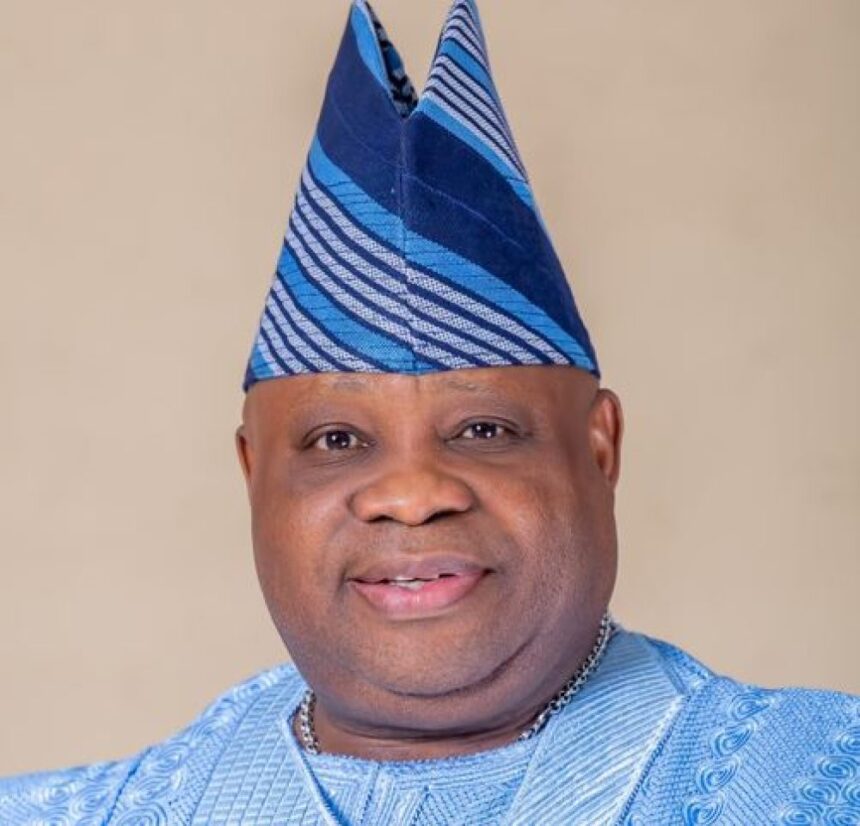
*The lessons, signals and strategic implications of Governor Ademola Adeleke’s re-election*
The 15 August 2026 Osun State governorship election has produced far more than a second-term victory for Governor Ademola Adeleke. It has generated a political laboratory from which Nigerian political parties, incumbents, opposition strategists, campaign managers, pollsters and, importantly, the electorate can extract several powerful lessons.
The Independent National Electoral Commission (INEC) declared Ademola Adeleke of the Accord Party winner with 511,067 votes, against 444,815 votes for APC candidate Bola Oyebamiji, giving Adeleke a substantial 66,252-vote margin. ADC candidate Najeem Salaam finished a distant third with 17,180 votes. Adeleke won 19 of Osun’s 30 LGAs, while Oyebamiji won 11.
The result is especially significant because Adeleke did not contest on the platform on which he won in 2022. He won his first term as a PDP candidate with 403,371 votes against Gboyega Oyetola’s 375,027, but returned for 2026 under Accord, after leaving the PDP.
That fact alone makes Osun 2026 worthy of very serious political study.
*1. The first lesson: THE ELECTORATE, NOT THE PARTY LOGO, IS THE ULTIMATE POLITICAL ASSET*
Perhaps the most important message from Osun is that a candidate can become bigger than the political platform on which he contests.
Adeleke’s movement from PDP to Accord did not prevent him from securing 511,067 votes—more than 107,000 votes above his 2022 winning total.
That is remarkable.
It demonstrates that, under the right circumstances, voters can transfer their loyalty from a traditional party structure to a candidate personally.
In strategic terms:
Party structure may provide the vehicle, but candidate credibility, voter identification and grassroots relationships determine whether the vehicle moves.
This should concern Nigeria’s major parties.
The PDP, in particular, should study the election very carefully. It is extraordinary that the incumbent governor could abandon the platform on which he originally won the governorship and subsequently win re-election under another party.
That suggests that personal political capital can sometimes survive the collapse or abandonment of party capital.
*2. INCUMBENCY IS NOT AUTOMATICALLY A DISADVANTAGE—BUT PERFORMANCE MUST BE CONVERTED INTO VOTES*
For many years, Nigerian opposition strategists have relied heavily on the assumption that voters naturally want to punish incumbents.
Osun 2026 demonstrates the limitation of that theory.
Adeleke successfully transformed incumbency into an electoral asset.
His campaign placed considerable emphasis on infrastructure, workers’ welfare, healthcare, education, agriculture and other government interventions. His administration had also repeatedly publicised claims concerning debt repayment and infrastructure improvements.
The strategic lesson is straightforward:
Incumbency becomes an asset when government visibility is converted into voter experience.
A governor cannot merely say:
“I have performed.”
The question is:
“What can the voter point to and say: I personally benefited from this government?”
That distinction is critical.
*3. THE ELECTION WAS A REFERENDUM ON ADELEKE—BUT NOT AN ABSOLUTE ENDORSEMENT OF HIS GOVERNMENT*
This is where political analysis must avoid triumphalism.
Adeleke received 511,067 votes, representing about 50.8% of valid votes, while Oyebamiji received about 44.2%.
Therefore, while Adeleke won convincingly, approximately half of the valid votes went elsewhere.
This means the election should not be interpreted as a unanimous endorsement.
Rather, it represents a strong electoral mandate within a competitive political environment.
For the returning governor, the strategic implication is profound:
The first four years created sufficient electoral confidence to secure another four years; the second term must now convert electoral confidence into institutional legacy.
The honeymoon is effectively over.
*4. THE APC’S NATIONAL STRUCTURE DID NOT TRANSLATE AUTOMATICALLY INTO LOCAL ELECTORAL DOMINANCE*
This is arguably the most consequential lesson for Nigeria’s ruling party.
The APC entered the contest with considerable national political influence and access to federal power.
Yet it lost.
This reinforces an important principle:
Federal power is not the same thing as electoral power.
Political parties frequently confuse:
number of governors;
number of ministers;
federal appointments;
National Assembly members;
financial resources;
campaign rallies;
political endorsements
with actual voter commitment.
Osun demonstrated that these are different variables.
The voter ultimately enters the polling booth alone.
The APC candidate nevertheless performed strongly, securing 444,815 votes and winning 11 LGAs.
So the correct conclusion is not that APC is politically irrelevant in Osun.
Quite the opposite.
The party remains a formidable force and controls substantial electoral territory.
But it failed to overcome Adeleke’s aggregate advantage.
*5. LOCAL GOVERNMENT SPREAD MATTERS—BUT MARGIN MATTERS EVEN MORE*
One of the fascinating statistical lessons from Osun is that electoral geography matters enormously.
Adeleke won 19 LGAs, while APC won 11.
But an election is ultimately determined by votes, not merely by the number of LGAs won.
A party can win fewer LGAs but dominate them massively.
Therefore, campaign strategists should track at least four indicators simultaneously:
1. LGA win/loss
2. Polling-unit performance
3. Vote margin
4. Turnout
A modern campaign dashboard should never simply say:
“We won 19 LGAs.”
It should say:
“Where did we win, by how much, with what turnout, among which voter segments, and at what mobilisation cost?”
That is the difference between political storytelling and political analytics.
*6. TURNOUT REMAINS NIGERIA’S GREAT DEMOCRATIC PROBLEM*
Osun had 2,339,233 registered voters, with about 1.906 million PVCs collected. Yet only 1,005,800 votes were cast.
That means roughly 43% of registered voters participated.
This is one of the most important statistics in the election.
Consider the implication.
Adeleke’s 511,067 votes were enough to secure the governorship, but they represented only around one-fifth of registered voters.
This means that Nigerian political victories can still be produced by relatively small proportions of the total electorate.
For political strategists, the conclusion is unmistakable:
The battle is increasingly not only about persuading voters; it is about identifying supporters and physically getting them to the polling unit.
Mobilisation is becoming as important as persuasion.
*7. THE REAL CAMPAIGN BEGINS LONG BEFORE THE CAMPAIGN PERIOD*
Adeleke’s victory also reinforces an old but often ignored political truth:
Grassroots political relationships cannot be manufactured in six weeks.
The winning campaign had years to develop:
name recognition;
personal identity;
local political networks;
government visibility;
constituency relationships;
voter familiarity.
The APC had to overcome all of that within a relatively compressed electoral cycle.
Therefore, parties planning for 2027—and especially 2027 presidential, National Assembly and state-level contests—should already be conducting constituency-level political mapping.
You cannot build political capital on election eve.
*8. THE “THIRD FORCE” PROBLEM REMAINS REAL*
ADC candidate Najeem Salaam secured 17,180 votes, placing third.
That is not insignificant in a three-way political contest, but it was nowhere near enough to fundamentally alter the Adeleke–APC duel.
The lesson for emerging parties is uncomfortable:
A political party can possess ideological appeal without possessing sufficient electoral machinery.
The emerging political forces therefore need:
credible candidates;
ward structures;
polling-unit agents;
voter databases;
funding;
communication infrastructure;
coalition management;
disciplined leadership;
election-day logistics.
Without those, third-force politics can become primarily symbolic.
*9. THE PDP’S ABSENCE IS ITSELF A POLITICAL STORY*
Perhaps one of the strangest aspects of Osun 2026 is that the PDP—the party that won the governorship in 2022—did not produce a candidate in the 2026 contest.
Adeleke, who had won under the PDP, contested under Accord.
This represents a profound organisational warning.
A political party can possess historical strength and still lose its political relevance if it fails to retain its strongest political asset.
The PDP should therefore treat Osun as a case study in organisational self-destruction through internal fragmentation.
*10. POLITICAL BRANDING CAN DEFEAT TRADITIONAL PARTY BRANDING*
Adeleke’s political persona has become a brand.
The dancing, informal communication style, populist presentation and highly personalised political image have repeatedly attracted attention.
Critics often dismissed the style as unserious.
But politics is not a graduate seminar.
Political communication is about emotional connection as much as policy communication.
The lesson is not that politicians should dance.
The lesson is:
A politician who can become emotionally identifiable to ordinary voters possesses an enormous communication advantage.
A candidate does not necessarily have to look presidential to win a governorship.
He has to look electable to the electorate.
*11. SOCIAL MEDIA AND POPULAR CULTURE HAVE BECOME POLITICAL INFRASTRUCTURE*
The political influence of celebrity culture should not be underestimated.
Davido’s involvement in Adeleke’s campaign illustrates the increasingly blurred boundary between entertainment, family identity, popular culture and politics.
This should be taken seriously by campaign managers.
The contemporary political ecosystem is no longer:
TV + radio + newspapers + rallies.
It is now:
TV + radio + newspapers + WhatsApp + Facebook + TikTok + Instagram + X + influencers + celebrities + community networks + traditional institutions.
But there is an important caveat:
Visibility is not the same thing as votes.
Digital popularity must ultimately be converted into physical mobilisation.
*12. VOTE BUYING REMAINS ONE OF THE BIGGEST THREATS TO DEMOCRATIC LEGITIMACY*
This is one area where Osun’s election should give every Nigerian democrat serious concern.
The EU-SDGN Election Observation Hub reported 323 electoral offences and irregularities in 726 observed polling units by midday.
These included:
103 cases of vote trading
12 cases of multiple voting
28 cases of inducement of polling/security officials
38 cases of campaigning at polling units
14 cases of voter impersonation
31 cases of obstruction
85 cases involving exposure of ballot papers.
These figures must be understood in context: they were observations from sampled polling units, not a claim that all 3,763 polling units experienced the same problems.
Nevertheless, the scale is disturbing.
It demonstrates that Nigeria’s electoral problem is no longer simply:
“Who counted the votes?”
It is increasingly:
“What happened before the voter cast the vote?”
*13. THE PVC HAS BECOME A POLITICAL COMMODITY—AND THAT IS DANGEROUS*
Reports of voter inducement and alleged attempts to obtain or control voters’ cards expose a dangerous evolution.
When politicians begin to treat voters as economic transactions rather than citizens, democracy becomes a marketplace.
The danger is that poorer citizens can be pushed into selling their immediate voting decision for temporary financial relief.
This is not simply a moral issue.
It distorts:
political accountability;
policy choices;
democratic competition;
legitimacy of elected governments.
Political parties must therefore invest far more in voter education.
*14. BVAS HAS NOT ELIMINATED ELECTORAL MANIPULATION—IT HAS MERELY CHANGED THE BATTLEFIELD*
BVAS remains an important electoral technology.
However, observers reported BVAS malfunctions and delays in accreditation at some locations.
This reveals a critical technological lesson:
Technology does not automatically create electoral integrity.
It requires:
reliable hardware;
adequate network infrastructure;
trained officials;
contingency arrangements;
transparent troubleshooting;
effective technical support.
Technology can reduce certain forms of fraud while creating new operational vulnerabilities.
*15. RESULT TRANSPARENCY IS NOW AS IMPORTANT AS VOTING ITSELF*
Another significant development was the extensive use of INEC’s IReV platform for result uploads.
By Sunday morning, reports indicated that approximately 98.35% of polling-unit results had been uploaded.
This represents an important evolution in Nigerian electoral transparency.
The strategic implication is enormous:
Political parties now need their own parallel result-monitoring systems.
Every serious campaign should have:
trained polling-unit agents;
result photography protocols;
encrypted transmission;
central results databases;
collation monitoring;
statistical anomaly detection.
The days when a party could depend exclusively on what it hears at the collation centre should be over.
*16. THE ELECTION WAS RELATIVELY CALM—BUT “PEACEFUL” SHOULD NOT MEAN “PERFECT”*
Security authorities and observers generally described the election environment as relatively calm compared with the fears preceding it.
But observers still recorded security incidents, including reports of thuggery, attacks on election officials and intimidation.
The lesson is important:
Nigeria must stop measuring electoral success only by whether people were killed.
A credible election requires more than the absence of large-scale violence.
It requires:
free participation;
freedom from intimidation;
transparent procedures;
equal opportunity;
credible counting;
protection of observers;
protection of journalists;
accessibility for persons with disabilities;
confidence in results.
*17. OSUN HAS PRODUCED A MAJOR WARNING FOR 2027*
The biggest strategic implication may actually lie outside Osun.
Nigeria is now moving toward the 2027 general elections.
Osun demonstrates that:
Candidate quality matters.
Internal party cohesion matters.
Grassroots structure matters.
Incumbency matters—but only when accompanied by perceived performance.
National political power does not guarantee local victory.
Voter mobilisation matters enormously.
Election-day logistics can determine outcomes.
Third-party candidates can affect margins even without winning.
Digital influence must be converted into physical votes.
Vote buying remains a major threat.
*18. THE NEW POLITICAL FORMULA IS NOT “PARTY + MONEY + STRUCTURE”*
The Osun election suggests a more sophisticated formula:
Candidate + Performance + Personal Brand + Grassroots Structure + Coalition + Data + Election-Day Mobilisation + Trust
Money remains important.
Structure remains important.
But money without trust can become waste.
Structure without a popular candidate can become machinery without fuel.
A popular candidate without election-day organisation can lose.
Social-media popularity without physical mobilisation can become vanity metrics.
*19. THE MOST IMPORTANT LESSON FOR OPPOSITION PARTIES*
Opposition parties must stop assuming that anti-incumbency is a campaign strategy.
It is not.
“APC is bad.”
“Government has failed.”
“People are suffering.”
These may be valid political messages, but they are not sufficient campaign strategies.
The opposition must answer three questions:
Why should voters reject the incumbent?
Why should voters choose us?
What specifically will change in the first 100 days?
Osun demonstrates that attacking an incumbent is considerably easier than replacing one.
*20. THE MOST IMPORTANT LESSON FOR INCUMBENTS*
Conversely, incumbents should not interpret re-election as permission to relax.
Adeleke has secured another term, but his 511,067 votes were not 511,067 unconditional endorsements of everything his administration has done.
They represent a mandate with expectations.
The next four years will determine whether his 2026 victory becomes:
a political comeback,
or
the foundation of a genuine developmental legacy.
*21. THE MOST IMPORTANT LESSON FOR POLITICAL CONSULTANTS*
Political consultants should abandon generic statewide campaign strategies.
The future belongs to micro-targeted political management.
Campaigns must know:
every ward;
every polling unit;
voter population;
previous election results;
turnout;
demographic tendencies;
historical margins;
party strength;
candidate strength;
influential community leaders;
likely swing areas;
weak polling units;
supporter mobilisation requirements.
The campaign headquarters should be able to answer at 11 a.m. on election day:
“Where are our votes, where are they not coming out, and what can legally be done to improve turnout?”
That is modern electoral strategy.
*22. THE BIGGEST WINNER MAY ACTUALLY BE THE POWER OF PERSONAL POLITICAL CAPITAL*
The most remarkable Osun statistic is not even 511,067.
It is this:
Adeleke won the governorship in 2022 as PDP candidate and has now won re-election in 2026 as Accord candidate.
That is an extraordinary demonstration of political personalisation.
The electorate essentially followed the politician across party boundaries.
That should send a powerful message to every Nigerian political party:
Do not build political parties around temporary officeholders alone. Build institutions capable of surviving the departure of individual politicians.
Otherwise, the politician becomes the party.
And when the politician leaves, the party discovers that much of its supposed structure was actually personal loyalty.
*23. FINAL VERDICT: WHAT OSUN 2026 REALLY TELLS US*
The Osun election should not simply be remembered as:
“Adeleke defeated APC.”
That interpretation is too shallow.
The deeper story is that Nigerian politics is rapidly transitioning from traditional party-dominated politics toward candidate-centred, performance-sensitive, data-driven and highly personalised electoral competition.
The numbers tell a compelling story:
Indicator 2026 Osun
Registered voters – 2,339,233
PVCs collected – 1,906,390
Votes cast – 1,005,800
Valid votes – 985,079
Rejected ballots – 20,721
Adeleke/Accord – 511,067
Oyebamiji/APC – 444,815
Adeleke’s win margin – 66,252
ADC/Najeem Salaam – 17,180
Adeleke LGAs – 19/30
APC LGAs – 11/30
Polling units – 3,763
Registered-voter turnout – 43%
And therein lies the central lesson:
In contemporary Nigerian politics, the party that understands the voter at polling-unit level—and can translate candidate popularity, governance performance, grassroots relationships and election-day mobilisation into actual ballots—will increasingly outperform the party that merely possesses the biggest political machinery.
Osun has therefore delivered a victory for Adeleke, a warning to APC, an existential lesson for PDP, a reality check for emerging parties, and a strategic textbook for anyone preparing for Nigeria’s 2027 elections.
The election has also demonstrated something even more fundamental:
The Nigerian voter is not as predictable as political elites imagine.
Voters can reject a governing party, embrace an incumbent, abandon a traditional party, support a smaller party, respond to performance, respond to personality, resist political intimidation—and still surprise virtually everyone.
*©️ Chief Akinwumi Akinfenwa*
*07062986613 for Calls/SMS*
*09091700203 for WhatsApp*