


By Okoi Obono-Obla
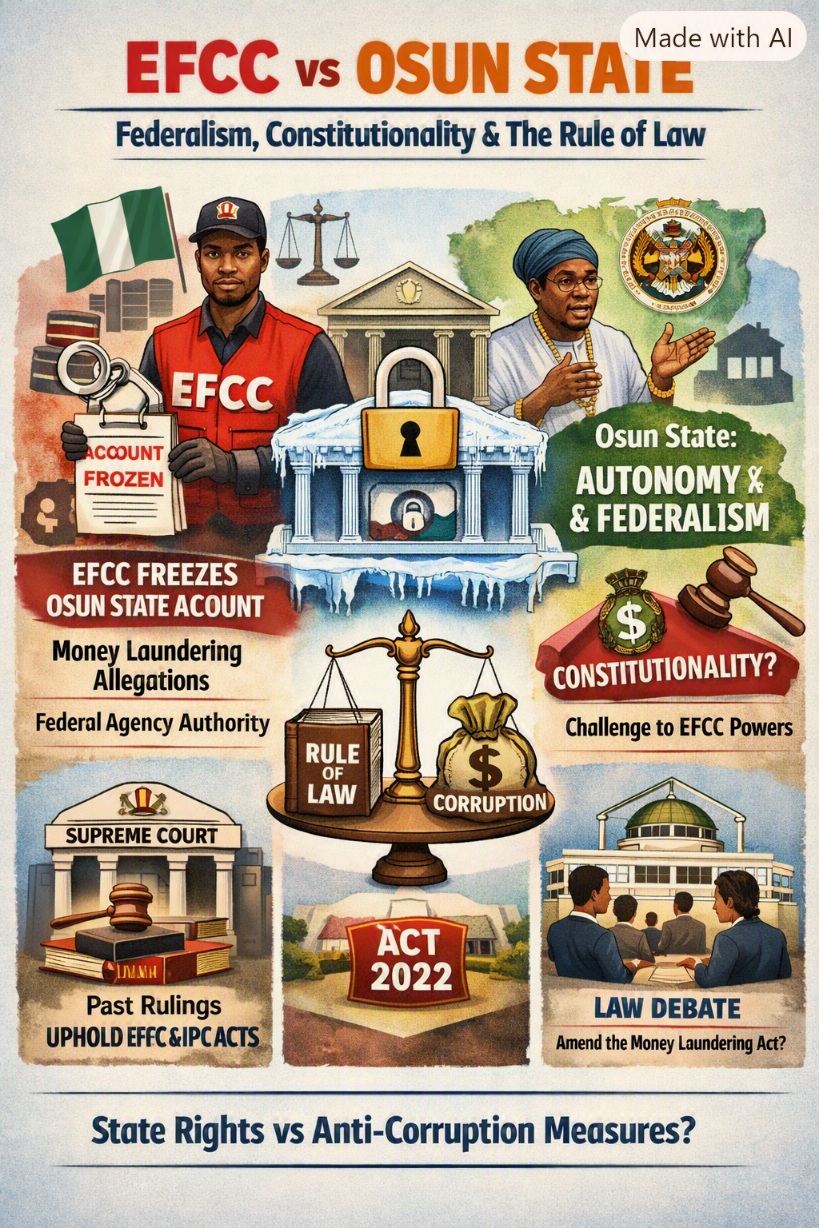
The freezing of one of the accounts of Osun State by the EFCC on 5th August, 2026, on the ground of suspicious activities bordering on money laundering, has triggered a debate on the powers of the EFCC — a Federal Government agency — to freeze accounts belonging to a State, a tier of government that is supposedly independent and autonomous. The argument being canvassed in some quarters is that this action constitutes an infringement on the principle of federalism embedded in the Constitution of the Federal Republic of Nigeria, 1999, and is therefore unconstitutional.
The law, however, is there and it must be applied.
Such concerns should be addressed to the appropriate quarters — the National Assembly — for a review of the Money Laundering (Prevention and Prohibition) Act, 2022, under which the EFCC purportedly acted. Alternatively, the Osun State Government should challenge the power of the EFCC to place a post-no-debit order on one of its accounts, in order to invite a judicial interpretation of the provisions of the Act upon which the EFCC hinged its action. This is how the law evolves.

It will be recalled that when the EFCC and ICPC Acts were passed and the two Commissions took steps to operationalize them, there were vigorous and strenuous challenges filed by a number of States against their constitutionality, on the ground that federal agencies cannot be financial watchdogs over State Governments.
The Supreme Court, however, consistently upheld the constitutionality of both laws and the Commissions established thereunder.
The locus classicus on the ICPC is Attorney-General of Ondo State v. Attorney-General of the Federation & 35 Ors (2002) 9 NWLR (Pt. 772) 222, where the Supreme Court upheld the Corrupt Practices and Other Related Offences Act, 2000, holding that the National Assembly has powers under Section 15(5) and Item 60(a) of the Exclusive Legislative List to enact laws for the abolition of corrupt practices.
The same principle was re-affirmed in respect of the EFCC in the recent decision in Attorney-General of Abia State & 15 Ors v. Attorney-General of the Federation, SC/CV/178/2023. In its unanimous judgment delivered on 15th November, 2024, a seven-man panel of the Supreme Court led by Hon. Justice Uwani Abba-Aji dismissed the suit filed by 16 States challenging the legality of the Acts establishing the EFCC, ICPC and NFIU. The apex Court held that the States were completely wrong to contend that the EFCC was illegally established, and that the EFCC Act, being a convention domesticated and not a treaty under Section 12 of the Constitution, does not require ratification by the Houses of Assembly of the States.
Conclusion
The contest between the autonomy of States in a federal system and the overriding need to combat corruption and money laundering is not new. While the freezing of a State account may raise legitimate concerns about federalism, the law as it stands today empowers the EFCC to act where there is reasonable suspicion of money laundering, even against a State. Until the National Assembly amends the Money Laundering (Prevention and Prohibition) Act, 2022, or the Supreme Court pronounces otherwise in a specific challenge by Osun State, the action of the EFCC remains within the contemplation of the law.