By Okoi Obono-Obla
No People is Pure: Migration, the Slave Trade, and the Peopling of the Niger Delta
I have always maintained that no tribe, ethnic group, community, or nation can lay claim to purity or homogeneity. The history of humanity is, from time immemorial, a history of migration driven by wars, conflicts, persecution, conquest, natural disasters, and climatic change. These movements have led to the interlocking, admixture, and miscegenation of peoples from different places through interbreeding, and from such unions new groups, ethnicities, and communities have emerged.
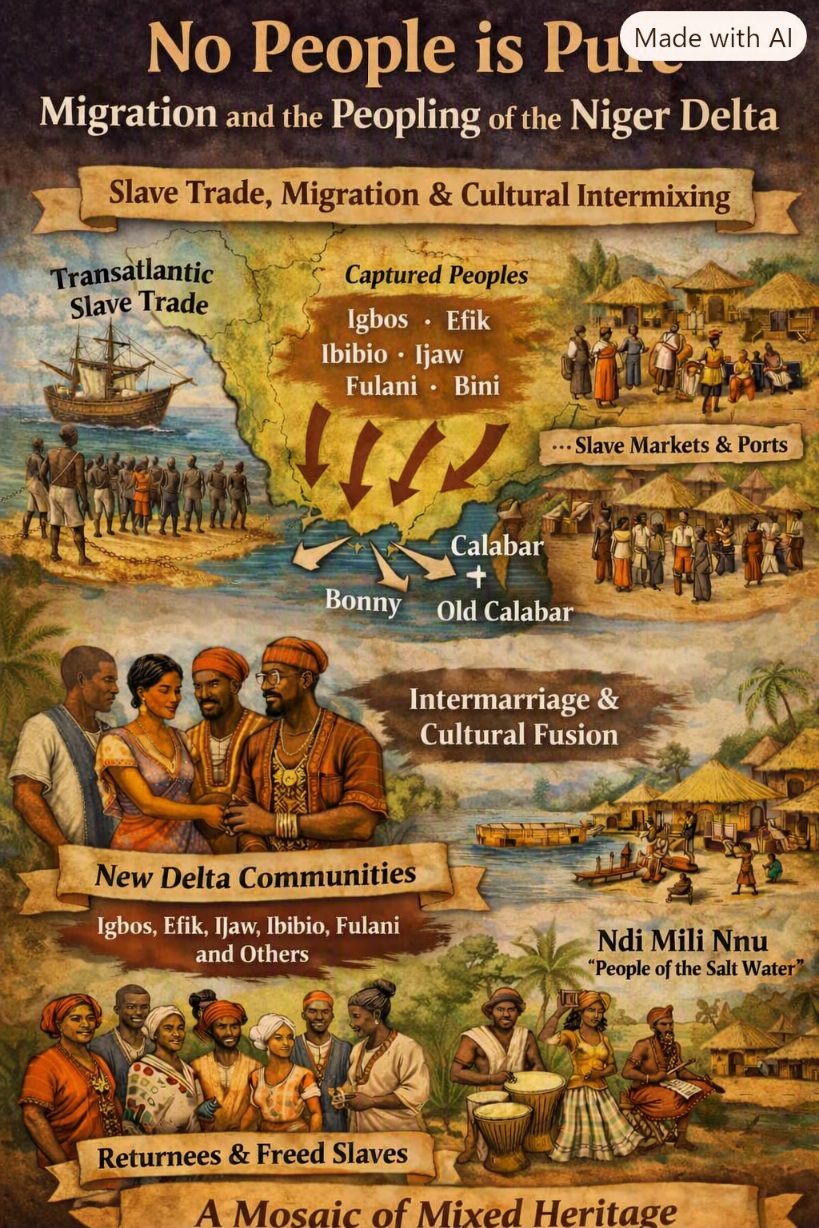
The Transatlantic Slave Trade was one such incident. It resulted in people from different ethnicities in Africa being enslaved and moved to holding centres such as Calabar, Ikot Abasi, and other ports in the present-day Niger Delta region of Nigeria. Although the trade was abolished in the United Kingdom by an Act of Parliament in 1807, slavery itself did not end in West Africa until the 1860s. People who had already been captured, as well as those liberated from slave ships intercepted by the British Navy during enforcement of the ban, were kept in major ports like Calabar. They eventually became part of the population of these ports as they settled and intermarried among themselves and with local women.
Professor Kenneth Onwuka Dike vividly captured this reality in his seminal work, Trade and Politics in the Niger Delta, 1830-1885: An Introduction to the Economic and Political History of Nigeria (1966), which was based on his doctoral thesis at Oxford University:
In West Africa, equalling the trade of all West Africa put together. Delta ascendancy in this traffic dated from the closing years of the seventeenth century. Between 1786 and 1800 Captain John Adams carried out a scientific research into the West African trade and people. In 1822 he wrote: “This place is the wholesale market for slaves, as not fewer than 20,000 are annually sold here; 16,000 of whom are members of one nation, called Heebo [the Ibos]…” These figures have been borne out by other witnesses. Macgregor Laird put the Delta export slave trade between 1827-34 ‘at the lowest calculation’ as 200,000 slaves.² This over-population explains the great preponderance of the same tribe in the Delta itself, even in areas like Old Calabar and the Cameroons not dominated by the Ibo interior. In 1853, when Creek Town was the leading trading community of Old Calabar, Ibos formed more than half the population.³ “The King of New Calabar… and Pepple King of Bonny, were both of Ibo descent, of which also are the mass of the natives.”⁴ This was confirmed by Dr. W. B. Baikie after an interview with King William Dappa Pepple at Fernando Po in 1854.⁵ Impressed by this Ibo ubiquity, Dr. J. A. B. Horton, a West African writing in 1868, declared that Iboland ‘is separated from the sea only by petty tribes [the Delta communities], all of which trace their origin from the great race’.⁶ The mistake of ascribing Ibo origins to all the Delta peoples was common among nineteenth-century writers.[Bonny]
Ekoi, Ibibios, Efik, and even the northern Nigerian tribes were represented. The following contemporary statement on the composition of Old Calabar’s population was true of almost any Delta state: ‘We have amongst us [in Old Calabar] captives of the slave raids of the Tibari, as the Fulatos or Fellani are called here. Thus about 13 different tribes are represented in our population.’⁷ To sum up, it is broadly true to say that owing to their numerical superiority and consequent land hunger the Ibo migrants (enforced or voluntary) formed the bulk of the Delta population during the nineteenth century. They bequeathed their language to most of the city-states—to Bonny, Okrika, Opobo, and to a certain extent influenced the language and institutions of Old and New Calabar. But the population which evolved out of this mingling of peoples was neither Benin nor Efik, Ibo nor Ibibio. They were a people apart, the product of the clashing cultures of the tribal hinterland and of the Atlantic community to both of which they belonged. The tribal Ibos called them Ndi Mili Nnu (People of the Salt Water).[Fulani]
Conclusion:
What Dike’s account makes clear is that the Niger Delta, like much of Nigeria and Africa, is not the product of a single, pure lineage but of centuries of forced and voluntary migration, conquest, and commercial encounter. The presence of Igbo, Ibibio, Efik, Ekoi, Ijaw, Bini, Sobo, Itsekiri, Fulani and even liberated returnees in the same estuaries proves that identity in this region was forged through admixture. To claim ethnic purity in such a context is therefore historically untenable. We are all, in essence, a people of mixed origins — shaped by movement, and made stronger by it.
Footnotes and References
John Adams, Remarks on the Country Extending from Cape Palmas to the River Congo (London, 1823), p. 38.
Parliamentary Papers, 1842, XI, Pt. I, Appendix and Index, No. 7 – Report by Macgregor Laird.
Church Missionary Intelligencer (London, 1853), Vol. XIV, p. 255; cf. Hugh Goldie, Efik Dictionary (Edinburgh, 1874), p. 355.
Hugh Crow, Memoirs of the Late Captain Hugh Crow of Liverpool (London, 1830), p. 197.
W. B. Baikie, Narrative of an Exploring Voyage up the Rivers Kwora and Binue (London, 1856), p. 355.
J. A. B. Horton, West African Countries and Peoples (London, 1868), p. 171.
Hugh Goldie, Calabar and Its Mission (Edinburgh, 1890), p. 18.
K. O. Dike, Trade and Politics in the Niger Delta, 1830-1885: An Introduction to the Economic and Political History of Nigeria (Oxford: Clarendon Press, 1956).