
By Okoi Obono-Obla
Every political contradiction needs a place where it can be seen clearly. For the so-called Rainbow Coalition, that place is Cross River State.
Cross River is not a side example. It is the perfect example. Because in Cross River, the Coalition has put its contradiction on a poster for all to see, and its own supporters have put the refutation in writing.
The Poster That Gives It Away
The poster for the Rainbow Coalition event of 28 November 2026 is remarkably honest.
On it stand together: President Bola Ahmed Tinubu, the presidential candidate of the All Progressives Congress, APC; a PDP presidential candidate; the Minister of the Federal Capital Territory, Abuja; a PDP governorship candidate; a PDP Central District senatorial candidate; and a PDP House of Representatives candidate for Abi/Yakurr Federal Constituency.
The message is unmistakable: in Cross River, PDP candidates support Tinubu for President, while opposing APC candidates for Governor, Senate and House of Representatives.
That is the Rainbow Coalition in one image. And that image is a contradiction.
Tinubu is not merely a member of the APC. He is its presidential candidate. He is the embodiment of the party, its government, and its record. To support Tinubu is to support the APC. To oppose APC candidates is to oppose the APC.
You cannot do both and claim to be coherent.
The Coalition asks the voter to believe that hardship stops at the National Assembly and the Government House, but does not reach Aso Rock. It asks the voter to believe that the man at the top is innocent, while his party below him is guilty. It asks the voter to reject APC because of its record, and then to vote for the man who heads that record.
That is not strategy. That is confusion.
The PDP Campaign in Cross River Says the Opposite
What makes Cross River the perfect example is that the contradiction is not merely exposed by critics. It is exposed by the PDP’s own campaigners in Cross River.
In Cross River Central Senatorial District — Ikom, Etung, Boki, Obubra, Yakurr and Abi — a PDP supporter campaigning for one of the candidates for a seat in the National Assembly has told voters, in plain language:
“The only way to vote out this hardship called APC is to vote PDP from top to bottom.”
“Do not vote for any candidate wearing APC in any form. A vote for APC is a vote for more hunger, more hardship, more suffering.”
“January 2027 is not just an election, it is a rescue mission.”
The message lists the grievances: fuel that was N87 now over N1,400; a bag of rice that was N8,000 now over N100,000; farmers who can no longer farm, students who can no longer go to school, traders who can no longer trade.
Whether you accept every figure or not, the argument is clear: APC is hardship, and hardship must be voted out.
But if APC is hardship, then Tinubu is hardship. If Tinubu must be rejected, he cannot be supported. If Tinubu must be supported, then APC cannot be condemned as hardship.
“Top to bottom” means what it says. Top is the Presidency. Bottom is Senate, House of Representatives, Governorship, State Assembly.
The Rainbow Coalition says the opposite: Tinubu at the top, PDP below.
You cannot have both.
Either the PDP campaign in Central is wrong, or the Rainbow Coalition is wrong. They cannot both be right.
This is why Cross River matters. The Coalition claims to speak for PDP interests in the State, while the actual PDP campaign on the ground is telling voters: PDP top to bottom, no APC in any form.
A coalition that must contradict its own party to explain itself is not a coalition. It is a convenience.
The Elections Make the Contradiction Worse
The timetable makes the absurdity even clearer.
The Presidential and National Assembly elections will hold on 16 January 2027. The Governorship and State Assembly elections will hold on 6 February 2027.
On 16 January, the Rainbow Coalition wants the Cross River voter to vote APC for President and PDP for National Assembly.
On 6 February, it wants the same voter to vote PDP for Governor and State Assembly.
What government will that produce? A President who must work with a National Assembly elected to oppose his party? A Governor who must work with a President elected to oppose his party?
In Cross River, the contradiction is not abstract. It is concrete. It is on the ballot in Central Senatorial District, in Abi/Yakurr Federal Constituency, and in the governorship contest itself.
The voter in Ikom is told: reject APC. The voter in Yakurr is told: reject APC. The voter in Abi is told: reject APC. And then all of them are told: but support the head of APC.
No voter can hold that logic together. Either the APC government has failed, in which case its presidential candidate has failed. Or the APC government has succeeded, in which case there is no need to “vote out hardship.”
A Party Cannot Be Against Itself
There is a deeper point, and Cross River illustrates it perfectly.
A political party is not a costume you wear in one election and remove in another. It is a platform, a programme, a government, and a record.
The APC Constitution, in Articles 11 and 12, deals with the organs of the party and the discipline expected of members. The logic of party discipline is universal: a member who works against the party’s candidate, or who supports the candidate of a rival party, engages in anti-party activity.
The Rainbow Coalition turns that logic upside down. It asks PDP members to support the APC presidential candidate while opposing APC candidates for other offices. It asks APC supporters, by implication, to accept that their presidential candidate can be separated from their party.
But a presidential candidate cannot be separated from his party. His nomination is the party’s nomination. His victory is the party’s victory. His government is the party’s government.
To support Tinubu while opposing APC is to pretend that the head can be cut off from the body and still live.
In Cross River, that pretence is visible in the very names on the poster. The PDP governorship candidate, the PDP Central senatorial candidate, the PDP Abi/Yakurr candidate — all are presented as allies of Tinubu, and all are presented as opponents of APC.
Who, then, are they opposing? If they are opposing APC, they are opposing Tinubu. If they are supporting Tinubu, they are supporting APC.
They cannot do both.
Why Cross River Exposes the Rainbow
Cross River is the perfect example for three reasons.
First, the poster is explicit. It does not hide the contradiction. It displays it. Tinubu and PDP candidates, together, as if there were nothing strange about the combination.
Second, the PDP grassroots is explicit. In Central, the PDP campaign is not whispering. It is shouting: vote PDP top to bottom, no APC in any form. The Coalition cannot claim that it represents PDP opinion in Cross River when PDP opinion in Cross River says the opposite.
Third, the stakes are explicit. Cross River voters are being asked to decide, in January and February 2027, whether they want an APC government or a PDP government. They cannot be asked to want both at the same time.
That is why the Rainbow cannot hide its colours in Cross River. The colours are on the poster. The contradiction is in the campaign messages. The confusion is on the ballot.
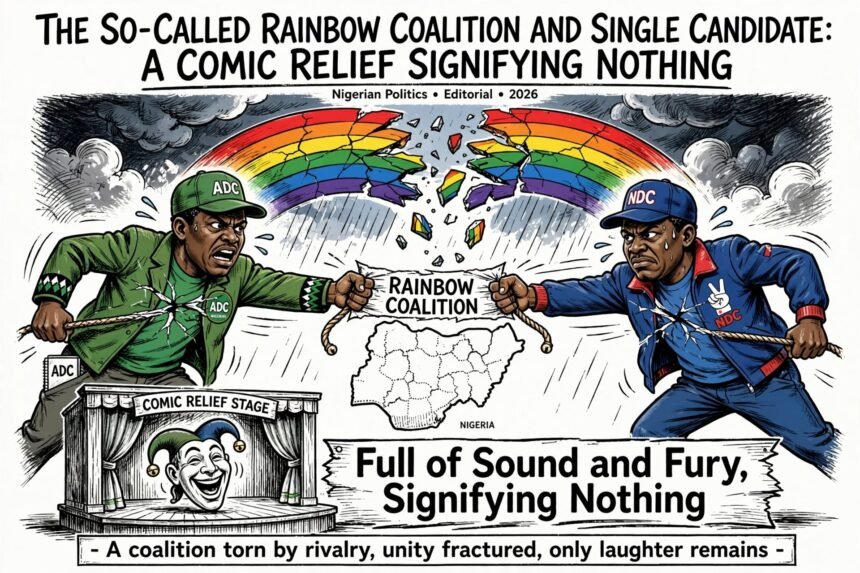
A rainbow, by definition, shows many colours together in harmony. This coalition shows two colours together in contradiction: the broom of APC at the top, and the umbrella of PDP below — as if the voter could stand under the umbrella while voting for the broom.
He cannot.
In Cross River, the voter will be asked to choose. He will choose, as he always has, not on the basis of posters and press statements, but on the basis of a simple test: who is coherent, who is disciplined, and who can be trusted to govern?
On that test, the Rainbow Coalition has already failed — and Cross River is the proof.