By Okoi Obono-Obla
WHAT IS POWER? THE TOGA OF LEGITIMACY AND ITS WITHDRAWAL
What is power?
Is it simply being stronger than your neighbour? Stronger physically, economically, strategically, financially, mentally, or psychologically in any measure you can name? Is that all there is to it?
Or is power defined, more precisely, as having the means, the capacity, and the ability to effect something — whether positively or negatively?
These questions become more urgent when we move from the private sphere to the public. Is power when you are elected by the people and the entire machinery of government and its apparatuses are bestowed upon you? Are you given that machinery to change lives, or to use it for your own glorification? To enrich yourself with the resources and commonwealth of the people you were elected to lead? To run a government with a clique or coterie of those close to you while the people watch?
What, truly, is power?
This is the question that has troubled political philosophers from Aristotle to our own time. Aristotle called the political community the polis — a community bound by shared rules and a common purpose. The people of the polis confer on one leader the toga of legitimacy through the ballot box, or through other accepted means of giving authority. They consent to be led.
But what happens when that consent is eroded?
Do you still have power when the consent, the rules, and the principles upon which you acquired that toga of legitimacy are delegitimized? When that approval is withdrawn because you have failed to do what the people expected you to do — the very reason they conferred legitimacy upon you in the first place? Can you still claim to have power when the political community has withdrawn its consent?
That brings us to the deeper question: How is legitimacy acquired in the first place?
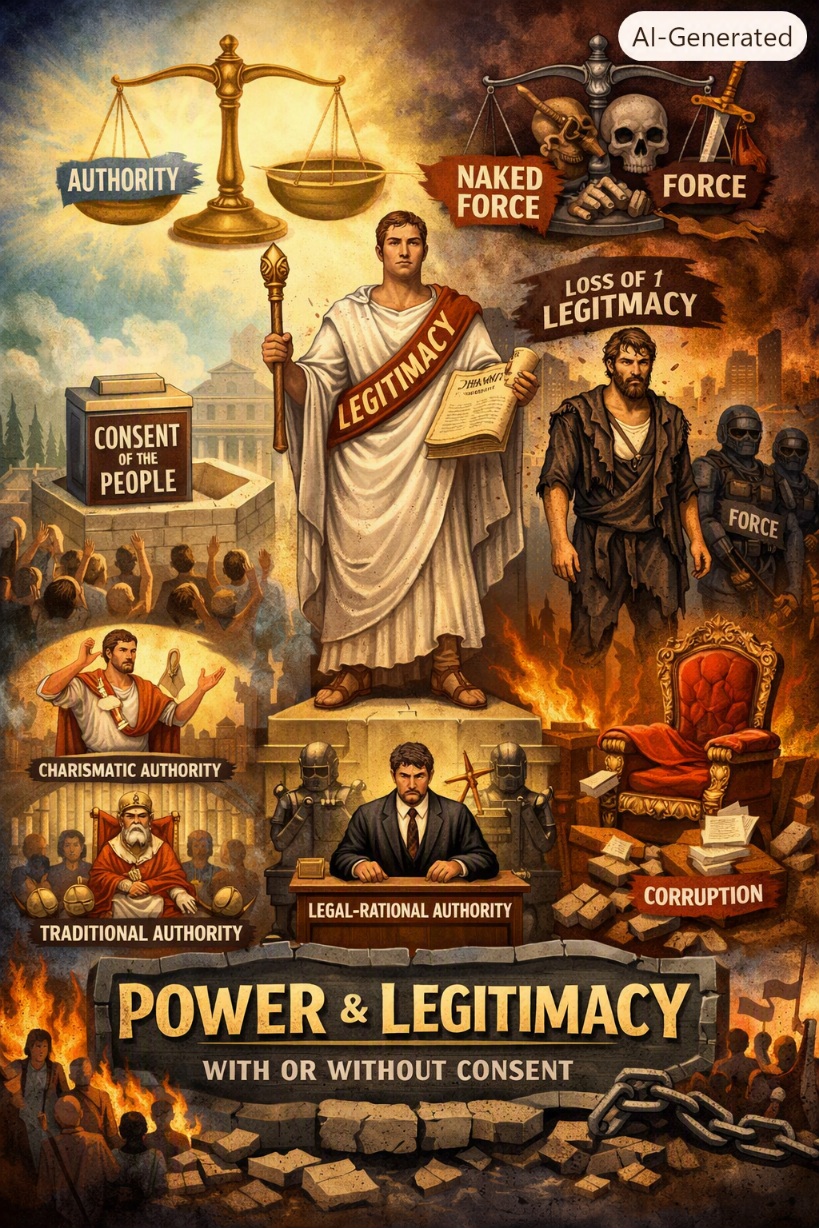
The great German sociologist Max Weber, in his classic works Economy and Society (1922) and Politics as a Vocation (1919), gave us the clearest answer. Weber distinguished between power — the mere chance to impose your will even against resistance — and authority, which is power that is accepted as legitimate by those subjected to it. Authority needs belief. Without belief, it is just naked force.
Weber identified three pure types of legitimate authority, and they mirror exactly the questions we are asking today.
The first is what we may call charismatic legitimacy. Is legitimacy acquired through the sterling qualities which Almighty God in His infinite wisdom has bestowed on you from birth? Weber called this charismatic authority — “the authority of the extraordinary and personal gift of grace.” He wrote, “Men do not obey him by virtue of tradition or statute, but because they believe in him.” People become attracted to you, they honour you, they respect your opinion and standpoint, and they believe whatever you say is the gospel truth which they must act upon. But Weber warned: charisma is emotionally unstable and volatile. It must be sustained by success. Once the leader fails, or once the magic fades, the followers withdraw their belief, and the authority collapses.
The second is traditional authority. Is it the authority which has been there from time immemorial, which you inherit through succession, or which you acquire because you were born into a society or community with such tradition? Weber called this “the authority of the eternal yesterday.” Its legitimacy comes from long-standing custom. The ruler is obeyed because it has always been so. It is the authority of monarchs, of patriarchs, of clan heads. It is the most common form in history, but it preserves inequality and often blocks progress.
The third is legal-rational legitimacy. Is it the legitimacy you get when authority is bestowed upon you by the consent of the people and you are required to act in certain ways in accordance with what has been laid down by the Constitution, by law, or even by convention? Weber called this rational-legal authority, where, as he put it, authority demands obedience to the office rather than the officeholder. The person is not the power; the office is. The president, the governor, the judge, exercises power only because the law says the office can. Once he leaves office, that authority is lost.
Modern democracy rests on this third type.
And that is why the question of withdrawal matters. A ruler elected under legal-rational legitimacy who abandons the Constitution, who governs for himself and his clique, who plunders the commonwealth rather than serves it, commits the gravest political error. He destroys the very belief that sustains him.
He may still control the police, the army, the treasury. He may still sit in the villa or the government house. But he no longer has authority. He only has force. And as Weber taught us, force without legitimacy is unstable, unsustainable, and ultimately doomed to face a reckoning — whether through the ballot, through protest, or through what Weber called a traditional revolution.
Power, therefore, is not merely strength. It is not merely winning an election. Power is legitimacy sustained by performance, by fidelity to the rules, and by the continuing consent of the polis.