By Okoi Obono-Obla
Ceasefire at the Strait of Hormuz: The USA–Iran Memorandum of Understanding in Historical Context:
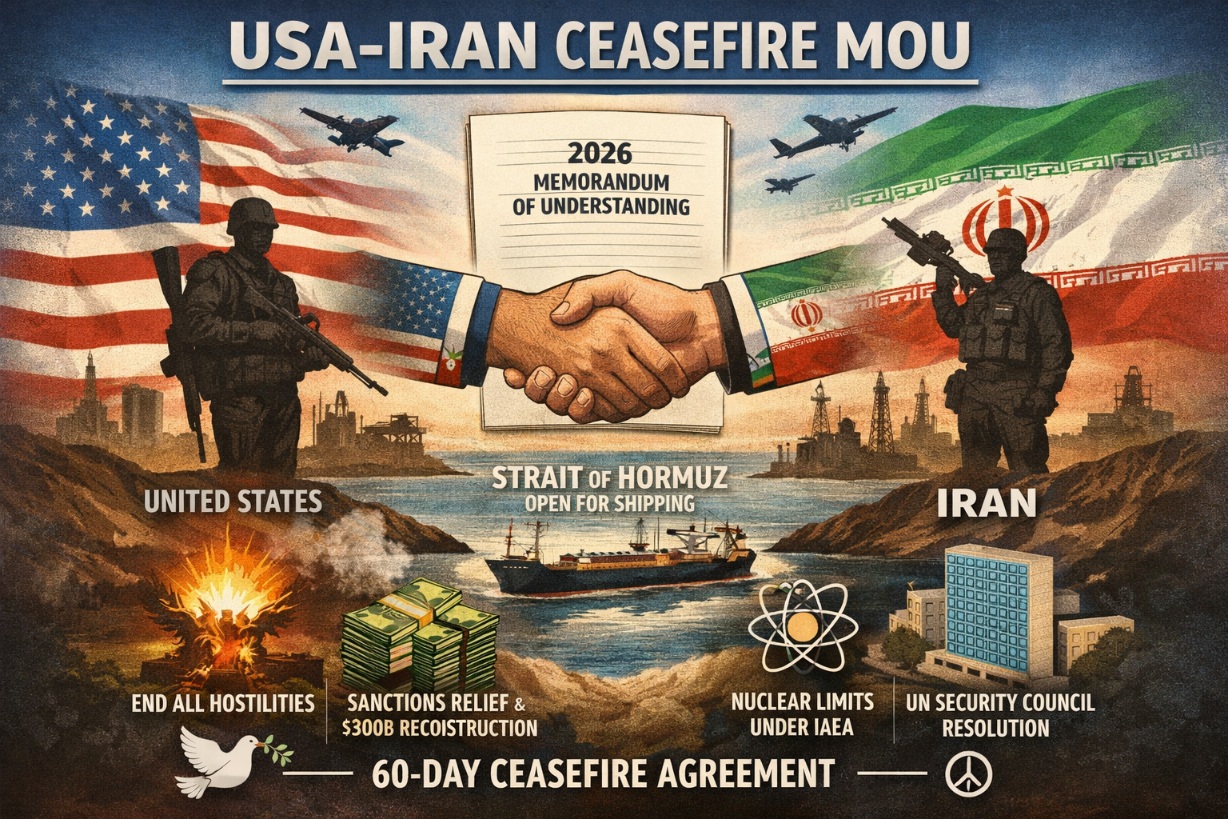
On 18 June 2026, the United States of America and the Islamic Republic of Iran are expected to sign a 14‑clause Memorandum of Understanding (MOU), establishing a 60‑day ceasefire in hostilities between the two nations, including the conflict involving Israel and Hezbollah in Lebanon. With this agreement, the Strait of Hormuz—through which 20% of global oil and gas flows to Africa, Asia, the Pacific, and Australia—will reopen to toll‑free international shipping. Energy prices, which have quadrupled since the war began on 28 February 2026, are anticipated to stabilize, easing the strain on the global economy.
The war erupted when the United States and Israel launched airstrikes on Iranian targets, prompting Iran to retaliate with projectiles and drones against U.S. military bases in Saudi Arabia, Bahrain, Oman, Qatar, Kuwait, and Israel. The MOU seeks to halt this escalation and lay the groundwork for a final peace deal. Its 14 clauses include commitments to end hostilities, respect sovereignty, negotiate within 60 days, lift blockades, ensure safe maritime passage, fund reconstruction, terminate sanctions, resolve nuclear issues under IAEA supervision, release frozen assets, and establish monitoring mechanisms, culminating in endorsement by a binding UN Security Council resolution.
Historical Analysis
The June 2026 MOU cannot be understood in isolation. It is the latest chapter in a long and turbulent history of U.S.–Iran relations, marked by cycles of confrontation, negotiation, and fragile compromise. Since the 1979 Iranian Revolution, relations have been defined by mistrust: the hostage crisis, decades of sanctions, and recurring disputes over Iran’s nuclear program. The 2015 Joint Comprehensive Plan of Action (JCPOA) briefly offered hope of normalization, but its unraveling in 2018 reignited tensions, leading to escalating military confrontations in the Persian Gulf.
The 2026 conflict represents one of the most dangerous escalations since the Iran–Iraq War of the 1980s, threatening not only regional stability but also the global energy supply chain. The reopening of the Strait of Hormuz under the MOU recalls earlier crises in which control of this strategic waterway became a flashpoint for international security. By embedding commitments to reconstruction funding, sanctions relief, and nuclear restraint, the MOU echoes elements of past agreements while attempting to address their shortcomings—particularly the failure to sustain trust and compliance over time.
Conclusion:
The June 2026 MOU is both a ceasefire agreement and a test of whether decades of hostility can give way to a more durable framework for peace. Its success will depend on whether both sides can move beyond tactical pauses in violence to genuine reconciliation. If implemented faithfully, it may mark a turning point in U.S.–Iran relations, easing tensions in the Middle East and stabilizing global energy markets. If not, it risks becoming yet another fragile accord in a long history of broken promises.