


by Boma West
Every child who sits in a classroom is a child kept away from the hands of a trafficker. That is not a metaphor. It is a fact that organizations working on the front lines of human trafficking in Nigeria understand deeply. And it is the conviction that drives the Blue North Initiative for the Prevention of Human Trafficking, one of Nigeria’s most active civil society organizations in the fight against modern-day slavery.
Founded and led by Mr. Calistus Ekenna, the Blue North Initiative operates from Abuja with a clear and urgent mission: to prevent and eradicate human trafficking and child exploitation in Nigeria and beyond. The organization believes that every individual deserves to live in freedom and dignity, free from fear and free from exploitation. But beyond belief, Blue North acts. And their most recent action speaks louder than any slogan ever could.
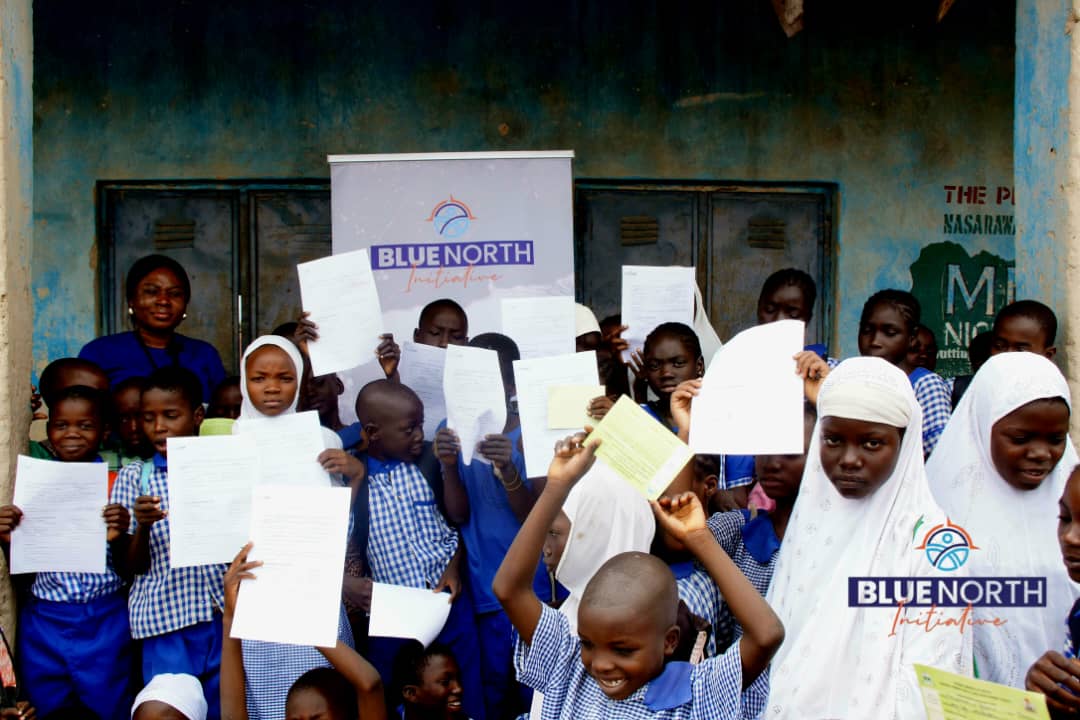
In Angwan Soja, a community within Masaka in Nasarawa State, fifty children now have something that most people take for granted: a guaranteed seat in school. Blue North Initiative has awarded scholarships to fifty students at a local government school in that community, covering their school fees and ensuring they can remain enrolled. What makes this intervention even more significant is that many of these children were previously out of school, making them exactly the kind of vulnerable young people that traffickers actively target. Because the scholarship did not come as a one-time gesture, Blue North Initiative signed a Memorandum of Understanding with the school, committing to sustain the programme for five years. That means fifty children, for five years, will not have to worry about whether they can afford to stay in class.

The connection between education and trafficking prevention is not incidental. Across Nigeria, children who drop out of school or who never enroll in the first place are far more likely to be lured or forced into trafficking networks. Poverty pushes families to make impossible choices, and traffickers exploit those moments of desperation. By paying school fees, Blue North Initiative is closing one of the most common entry points into trafficking. And by formalizing that commitment through an MOU with the school, they are ensuring that this protection does not vanish after one school term.
This scholarship programme is not the only partnership Blue North Initiative is building on solid institutional ground. The organization also holds a three-year Memorandum of Understanding with the National Agency for the Prohibition of Trafficking in Persons, better known as NAPTIP, the government body responsible for combating trafficking in Nigeria. That partnership places Blue North Initiative at the heart of Nigeria’s national response to a crime that affects millions. Working alongside NAPTIP means that the organization’s community-level interventions are connected to a broader legal and enforcement framework, making their work both deeper and wider in its reach.
Beyond policy work and school scholarships, Blue North Initiative also takes its message directly to the streets. In July, the organization will join the global observance of the World Day Against Trafficking in Persons by organizing a walk against human trafficking in Abuja. The walk is more than a public event. It is a statement, a gathering of voices that refuse to be silent about a crime that thrives in silence. For communities that have not yet heard or seen the damage trafficking causes, events like this one bring the conversation out of conference rooms and into the open air where it belongs. For survivors, it signals that they are not forgotten. And for potential donors and partners watching from across Nigeria and the world, it demonstrates that Blue North Initiative does not only work behind closed doors. They show up publicly, visibly, and consistently.
That consistency runs through everything the organization does. Their founder has authored a book titled “Trail of Desperation,” a casebook on human trafficking and child molestation that documents real cases and brings the human face of this crisis into sharp focus. The organization has also produced a student handbook with one hundred questions and answers about human trafficking and sexual and gender-based violence, designed to be used in schools and communities to educate young people before they become targets. They have held awareness campaigns, presented papers at universities including Nile University in Abuja, and built a growing platform for community education and victim support.
Yet with all of this, Blue North Initiative remains a young organization doing extraordinary work with limited resources. The scholarship programme for fifty children in Nasarawa, the NAPTIP partnership, the upcoming walk in Abuja, and the years of awareness campaigns have all been driven by a small team with a large vision. What they have built so far is proof of concept. What they need now is the funding to scale it. For every fifty children they are able to put back in school today, there are hundreds more in communities across Nigeria who are one school fee away from dropping out and becoming vulnerable. For every community walk they organize in Abuja, there are towns and villages in the North Central, North East, and across the country that have never once heard a public conversation about trafficking.
Donors who invest in Blue North Initiative are not simply writing a cheque. They are paying school fees that keep children out of trafficking networks. They are funding walks that shift public awareness in a country where stigma and silence still protect traffickers more than victims. They are supporting a team that has already earned the trust of NAPTIP, the trust of schools in Nasarawa State, and the trust of communities that have seen firsthand what this organization does when it shows up.
Human trafficking is a reality in Nigeria. Blue North Initiative has decided that this reality can change. With the right support, it will.
To donate, partner, or get involved, visit www.bluenorthinitiative.org or call +2348109293077.















This is a painful reminder that the safety of children cannot be taken lightly. Schools should be places of learning, hope, and protection. Supporting initiatives that keep vulnerable children in school and away from exploitation is critical to the future of our communities.