By Khaleed Yazeed
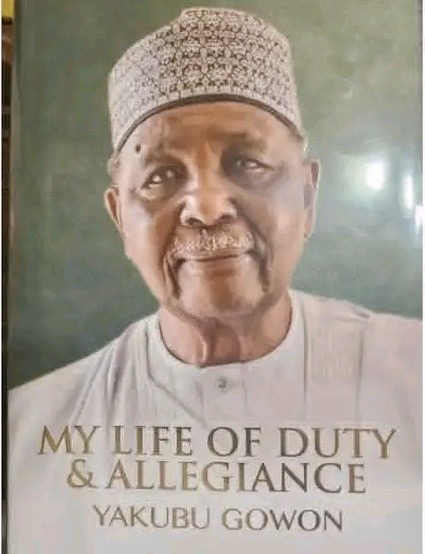
General Yakubu Gowon’s monumental 881-page autobiography, “My Life of Duty and Allegiance”, has finally been unveiled. It is being marketed as a shattering of decades-old silences from the last surviving central pillar of Nigeria’s most turbulent era. Written largely from memory after the heartbreaking loss of his personal records during the 1975 coup that sent him into exile, Gowon claims to offer an emotional and unvarnished account of betrayal, survival, and the heavy burden of power.
But after sixty years, after more than one million dead, after a generation of Igbos raised on the trauma of starvation, aerial bombardment, and mass displacement, what does this 881-page confession actually deliver? Less than a thimble of water to a forest fire. Far less than the nation deserves. And certainly nothing close to the healing that has been denied to the South-East for six decades.
I will not mistake this essay for a book review. This is a moral audit. This is an accounting of what Gowon chose to say, and far more importantly, what he chose to leave unsaid. And what he left unsaid is so deafening that it drowns out every word on every one of those 881 pages.
Part One: What the Book Reportedly Admits, And Why It Is Not Enough
According to excerpts, press releases, and the reviews of figures like Bishop Matthew Hassan Kukah, the book contains several long-overdue admissions.
Gowon finally acknowledges that after the January 1966 coup, he tried to protect his friend and brother, Chukwuemeka Odumegwu Ojukwu, from the ethnically charged reprisals that were consuming innocent Igbo officers and civilians. This is a significant admission. For decades, the official narrative painted the two leaders as irreconcilable enemies. Now we learn that the man who would lead the federal forces once tried to shield the man who would lead Biafra.
The book confesses that the Aburi Accord failed not merely because of bad faith, but because trust had evaporated between men who once shared meals and now shared only suspicion. Gowon reportedly walks readers through the exact moments where consensus fractured into civil war, the misunderstandings, the betrayals, the outside interference, the weight of history pressing down on every handshake.
He reveals that Nigeria’s Western allies, including Great Britain, abandoned the federal cause when the war turned bloody. The same Britain that had colonized Nigeria, that had drawn the lines on the map, that had created the conditions for ethnic rivalry, that same Britain refused to help when the country began to tear itself apart. Gowon was forced to beg the Soviet Union for weapons and even to deal with a Lebanese arms smuggler to keep federal troops equipped.
The book also exposes the hypocrisy of Nigeria’s political class. Gowon notes that the very same civilians who screamed loudest against military rule were often the first to line up for appointments, contracts, and favors the moment a coup succeeded. They would curse the generals in public and beg them for patronage in private.
For these admissions, some will say Gowon deserves gratitude. But gratitude for what? For telling us what we already suspected? For finally admitting what historians like Max Siollun, Nowa Omoigui, and Chimamanda Ngozi Adichie have documented for decades? For offering explanations without apologies, context without contrition, memory without remorse?
No. Gratitude is not the appropriate response. The appropriate response is a single, unbroken question: Why, after sixty years and one million dead, is there still no “I am sorry”?
Part Two: The Silence That Speaks Louder Than 881 Pages
The book speaks of duty, allegiance, sacrifice, and the burden of command. It speaks of keeping Nigeria one. It speaks of preventing balkanization. It speaks of all these things with the clarity of a man who has had decades to reflect.
But according to every review and excerpt, the book does not speak the words that millions of Igbos, and indeed all Nigerians who lost loved ones in that war have waited sixty years to hear:
“I am sorry. Forgive me.”
Not sorry for keeping Nigeria together. That was Gowon’s duty, and many Nigerians, including many Igbos, accept that a united Nigeria was worth fighting for. The question of whether Biafra should have been allowed to secede is a legitimate debate, and reasonable people can disagree.
But sorry for the blockade that starved children. Sorry for the air raids that leveled markets. Sorry for the mass graves that still bear no names. Sorry that the slogan “No victor, no vanquished” became a political convenience rather than a genuine embrace of reconciliation.
Bishop Matthew Hassan Kukah, in his review, praised Gowon for writing without bitterness. But bitterness is not the only emotion missing. Atonement is also missing. And at 90 years old, with this book as his final testament, Gowon has chosen duty over repentance. He has chosen explanation over apology. He has chosen to defend his legacy rather than to heal the wounds of the nation he claims to love.
Part Three: The Federal Blockade
The federal blockade was not an abstract strategy. It was a mother watching her child’s hair turn from black to reddish-brown, the telltale sign of kwashiorkor, the protein deficiency that comes from starvation. The child’s stomach swelled. The skin cracked and peeled. The child cried from hunger, then stopped crying because even crying required energy. The mother had no milk, no beans, no fish. The blockade had cut off all food supplies to Biafra. She could do nothing but watch and pray and weep. Sometimes the child survived. Often, the child did not.
The aerial bombings were not surgical strikes. They were a father burying his son without a name because the boy had been killed by a bomb that fell on a market. No coffin. No funeral. Just a hole in the red earth and a prayer whispered through tears. The father would spend the rest of his life wondering: what did my son die for?
The mass displacement was not a footnote. It was a family eating leaves, boiling water from muddy puddles, chewing on roots they had never eaten before. The world had turned its back. The Red Cross was blocked. The churches sent aid that never arrived. The family survived, barely, but they were never the same. The trauma of those years was passed from parents to children like an heirloom no one asked for.
The war ended in January 1970. But the hunger did not end. The trauma did not end. The sense of being punished for wanting a separate existence did not end.
The South-East today is still waiting for equity. It still struggles for a fair share of federal appointments, infrastructure projects, gas pipelines, railway lines, and dredged rivers. The federal government rebuilt the North and South-West after the war. The East was left to crawl out of the rubble on its own.
And yet, Gowon’s memoir reportedly does not address any of this. He writes as if the war was a surgical operation that saved the patient, ignoring the patient’s ongoing pain. He writes as if “No victor, no vanquished” actually meant something on the ground, when for most Igbos it was just a phrase to calm the world while the federal government continued to marginalize them.
Where in these 881 pages is the acknowledgment of the kwashiorkor children? Where is the recognition of the mothers who still weep at night? Where is the admission that the blockade was a crime against humanity, even if it was a military necessity?
There is none. There is only duty. Only allegiance. Only the burden of command.
Part Four: The Unfinished Business of Reconciliation, A Global Comparison
Let us look beyond Nigeria to see how other nations have confronted their past atrocities. Because Gowon’s refusal to apologize is not just a personal failure; it is a failure of Nigerian leadership that stands in stark contrast to the rest of the civilized world.
Germany after the Holocaust: Germany did not simply say “the war is over, let us move on.” Germany paid reparations. Germany built memorials. Germany educated its children about the horrors of the Nazi regime. And Germany apologized. Repeatedly. Sincerely. Without qualification. Chancellor Willy Brandt fell to his knees at the Warsaw Ghetto memorial in 1970. That gesture was not weakness. It was the strongest act of any German leader in the twentieth century.
South Africa after apartheid: South Africa did not simply say “let bygones be bygones.” South Africa created the Truth and Reconciliation Commission, where victims were heard and perpetrators could confess in exchange for amnesty. It was not perfect. But it was an attempt to heal a nation’s wounds through honesty. Archbishop Desmond Tutu spoke of “ubuntu”, I am because we are. The commission did not erase the pain, but it began the process of acknowledgment.
Rwanda after the genocide: Rwanda did not simply say “let us forget.” Rwanda created community courts called Gacaca, where perpetrators confessed and victims received compensation. The nation does not pretend that the genocide did not happen. It memorializes, it educates, and it demands accountability.
The United States after slavery and Jim Crow: America has not fully healed. But it has apologized. It has built memorials. It has created museums. It has, in recent years, begun to confront its history of racial violence with a level of honesty that was unthinkable a generation ago. The Equal Justice Initiative’s Legacy Museum and National Memorial for Peace and Justice are monuments to the victims of lynching. They do not erase the past; they force the nation to look at it.
Nigeria has done none of this. There is no monument to the millions who died in the civil war. There is no official apology from any federal government. There is no truth commission. There is no memorial museum. There is only silence, and the occasional political slogan trotted out during election season.
Gowon’s memoir could have been the beginning of that truth process. He could have been Nigeria’s Willy Brandt. He could have been Nigeria’s Desmond Tutu. He could have been the elder statesman who finally said, “I did what I thought was right, but I recognize the suffering my decisions caused. I am sorry. Forgive me.”
He did not, instead he chose duty and allegiance, He chose to defend his legacy rather than to heal his nation.
Part Five: A Direct Message to General Yakubu Gowon
Sir, No one doubts your love for Nigeria. No one doubts that you suffered greatly in service to this nation, overthrown, exiled, stripped of your personal records, and left to rebuild your life from memory. That is a burden that few men could bear. You have earned a place in Nigeria’s history. No one can take that from you.
But sir, with all due respect, the people of the South-East have also suffered. They lost their homes, their businesses, their children, their sense of belonging. They returned from the war to find that “reconciliation” meant accepting crumbs from the table of the federal government. They have been told for sixty years to forget the past and move forward. But moving forward without acknowledging the past is like walking with a broken leg and pretending it does not hurt.
You had the chance, in these 881 pages, to say “I am sorry.” The reports say you did not. Perhaps you thought it would be seen as weakness. Perhaps you thought it would open old wounds. Perhaps you simply did not think of it. Perhaps you believed that explaining your decisions was enough.
But sir, explanations are not apologies. Context is not contrition. Duty is not remorse.
Saying “I am sorry” would have been the strongest thing you have ever done. It would have required more courage than any battle you commanded. It would have been the greatest gift you could give to the children of Biafra, to the mothers who still weep, to the fathers who still wonder, to the grandchildren who still carry the weight of that war. It would have been the true meaning of “No victor, no vanquished.”
It is not too late. You are still alive. You still have a voice. You can still issue a statement. You can still grant an interview. You can still pick up the phone and call Igbo leaders and say the words that should have been spoken in 1970.
One sentence. Three words. “I am sorry.” That is all it would take to begin the healing that Nigeria has needed for sixty years.
The fact that you have not done so, even after 881 pages, even after ninety years of life, even after decades of reflection, is not a testament to your strength. It is a testament to the stubbornness of Nigerian leadership, a stubbornness that refuses to admit error, refuses to acknowledge pain, refuses to apologize even when apology is the only path forward.
Part Six: Why Gowon’s Silence Matters Now More Than Ever
Nigeria today is bleeding. Bandits have turned the North-West into a graveyard. Kidnappers have made the our roads a lottery of ransom. The national grid collapses more often than it functions. The naira has lost over seventy percent of its value since 2015. Over 133 million Nigerians live in multidimensional poverty. The government spends more on debt servicing than on education and healthcare combined.
And what are the root causes of these crises? They are the same root causes that led to the civil war: a centralized, extractive state controlled by a small elite; a political system that rewards ethnic and religious manipulation; a leadership culture that refuses accountability; and a national psyche that has never confronted its own history.
Gowon’s memoir arrives not as a relic of the past, but as a symptom of the present. It shows that even at 90, even after losing his records, even after decades of reflection, a Nigerian leader cannot bring himself to say “I am sorry.” If the man who led the federal forces during the civil war cannot apologize for the blockade that starved children, what hope is there for the politicians who came after him? If Gowon cannot admit that “No victor, no vanquished” was a slogan, not a solution, then what hope is there for the current administration to admit that its economic policies are killing the poor?
The refusal to apologize is not a personal quirk of Gowon’s. It is a systemic disease of Nigerian leadership. From Balewa to Buhari, from Ironsi to Tinubu, Nigerian leaders have consistently chosen to defend their legacies rather than to heal their nation. They have chosen to explain rather than to repent. They have chosen to blame others rather than to look inward.
And the nation has suffered for it. The civil war never truly ended. It just changed uniforms. The same distrust, the same accusations of marginalization, the same refusal to confront historical wrongs, these are the engines that drive Nigeria’s recurring crises.
Apology is not weakness. It is the beginning of healing. And Gowon has refused to start.
Part Seven: What Gowon Owes the South-East. A Moral Accounting
Let us be specific about what Gowon owes the people of the South-East. It is not enough to say “he owes an apology.” We must name what he owes.
He owes an apology for the blockade. The federal blockade was not a legitimate military strategy. It was a weapon of mass starvation. The blockade killed more people than bombs and bullets combined. It targeted civilians, children, women, the elderly, the sick. It violated the Geneva Conventions. It was a crime.
He owes an apology for the aerial bombings. The Nigerian Air Force bombed markets, hospitals, schools, and refugee camps. These were not military targets. They were civilian infrastructure. The bombing campaigns killed tens of thousands of non-combatants.
He owes an apology for the destruction of Biafran infrastructure. The federal forces systematically destroyed roads, bridges, telecommunications, and water systems in the South-East. The region took decades to recover, and in many ways, it has never fully recovered.
He owes an apology for the post-war marginalization. “No victor, no vanquished” was a lie. The federal government rebuilt the North and South-West. The East was given a pittance. Biafran currency was demonetized, wiping out the savings of millions. Biafran civil servants were dismissed from federal positions. The region was treated as a conquered territory, not as a partner in a restored union.
He owes an apology for the silence of sixty years. For six decades, Gowon has watched the South-East struggle. He has seen its children beg on the streets, its youths emigrate, its infrastructure crumble. And he has said nothing. He has not visited the mass graves. He has not commissioned a memorial. He has not used his influence to advocate for equity. He has been silent.
These are not small omissions. They are moral failures. And 881 pages of duty and allegiance do not erase them.
Part Eight: The Final Verdict – A Missed Opportunity for National Healing
Gowon kept Nigeria one. That is history. That is fact. That is not in dispute.
But keeping a nation together is not the same as healing it. A surgeon can save a patient’s life but leave them with chronic pain, permanent disability, and unaddressed trauma. Gowon saved Nigeria’s life. He did not heal its wounds. And sixty years later, those wounds are still infected.
The task of healing remains unfinished. It will not be finished by another memoir, another speech, another anniversary celebration. It will only be finished when a Nigerian leader, whether Gowon or another has the courage to stand before the nation and say, “I am sorry. We were wrong. Forgive us.”
Gowon had that chance. He had 881 pages. He had ninety years of life. He had decades of reflection. He chose not to take it.
881 pages. 90 years. One million dead. And still, the only sentence that could have truly healed is the one Gowon chose not to write: “Forgive me.”
The blockade that starved children, no apology. The bombs that fell on markets, no apology. The mass graves that bear no names, no apology. The slogan “No victor, no vanquished”, a political convenience, not a healing balm.
This is not about revenge. This is not about reopening old wounds. This is about closing them properly. A wound that is not cleaned and dressed does not heal. It festers. It infects the whole body. Nigeria’s body is infected. The South-East’s pain is everyone’s pain. The refusal to apologize is not just an insult to the Igbo. It is a poison in the bloodstream of the nation.
The civil war ended in 1970. The war of the heart has never ended. And Gowon’s silence has just made that war last a little longer.
Nigeria cannot move forward until we finally look backward with honest eyes. We cannot build a nation on the graves of the unapologized dead. We cannot sing “Nigeria, We Hail Thee.” while the wounds of our brothers and sisters here and there in the South-East are still bleeding.
The civil war ended in 1970. The war of the heart has never ended.
And Gowon’s silence has just made that war last a little longer.
It is time to end it. But ending it requires honesty. And honesty requires apology.
K-Y