


By Okoi Obono-obla
I recently entered into an argument with some young Nigerians who were angry at the removal of fuel subsidy and other measures by the Tinubu administration to free the economy from bureaucratic bottlenecks.
When I told them Nigeria is poor, they in unison vehemently disagreed.
Nigeria is rich, they said. It is the politicians who are taking all the money.
I asked them a simple question: If Nigeria is rich, where is the money?
They answered: Why are politicians rich?
I told them: politicians are not rich.
They answered again: Nigeria has a lot of resources.
That exchange is the tragedy of our national conversation. We have confused three different things: the wealth of politicians, the resources in the ground, and the wealth of a nation. They are not the same.
I was reminded of this when I read the interview of Prof. Sola Adeyeye in The Punch, where he isolated a few truths that resonated deeply with me. Let me isolate them here, because they explain our poverty better than any slogan.
1. We police a federation like a unitary state.
Of the roughly 195 countries in the world, only about 25 run a federal system. Of those 25, 19 have state, provincial or regional police.
Nigeria has the worst case of over-centralisation.
We are the only federation in the world with a single central police force. The Constitution forbids any other. Operational authority flows from the President to the Inspector-General in Abuja, to police a country of over 230 million people, speaking hundreds of languages.
When Adeyeye was Chairman of Ifedayo Local Government in Osun State, the Divisional Police Officer in charge of his local government was a man from Otukpo in Benue State who did not speak Igbomina. How could he effectively police a community whose language he did not speak?
In a federation, sovereignty belongs to the people. But when you deny that sovereignty the power to enforce its will, you create anarchy. That is why Tinubu’s move to restore state police matters. It is not a policy tweak. It is a return to federalism.
Who are the other federations? Let us be precise, so we stop arguing in the abstract.
Federalism is not an American invention. It is a system for big, complex, plural, multilingual, multinational countries. Here are the core 25, by region:
Africa:
Nigeria, Ethiopia, South Africa, Somalia, and Comoros. Sudan is also often listed as a federal or transitional federal state, though its system is now in crisis. These are the African countries that have attempted to govern diversity through federalism, not through central command.
Europe:
Germany, Austria, Belgium, Switzerland, Spain, and Bosnia and Herzegovina. Russia is also a federation, straddling Europe and Asia. Spain is sometimes called quasi-federal, but in practice its autonomous communities exercise federal-like powers.
Asia:
India, Pakistan, Malaysia, Nepal, the United Arab Emirates, and Iraq. India alone — with over 1.4 billion people, 22 official languages, and 28 states — proves that federalism is not weakness. It is the only way to hold a plural country together.
North America:
The United States of America, Canada, and Mexico. In all three, police, education, and much of taxation are not centralised in the capital. A sheriff in Texas does not take orders from Washington on routine policing. A provincial police officer in Ontario does not take orders from Ottawa.
South America:
Argentina, Brazil, and Venezuela. Brazil, like Nigeria, is a large, diverse, oil-producing federation. But Brazil does not police itself from Brasilia alone.
Australia and the Pacific:
Australia, Micronesia, and Palau. Australia has state police forces — New South Wales Police, Victoria Police, Queensland Police — each accountable to its state. No Australian would accept a single police force run entirely from Canberra for a continent-sized country.
That is the club Nigeria belongs to. And in that club, Nigeria alone polices itself like a unitary state. Every other serious federation has understood what we have refused to understand: you cannot govern a federation centrally.
2. One university is richer than our entire country.
Adeyeye put it starkly: the endowment of Harvard University, an institution with about 8,000 undergraduates, is the same as the entirety of Nigeria’s external reserves.
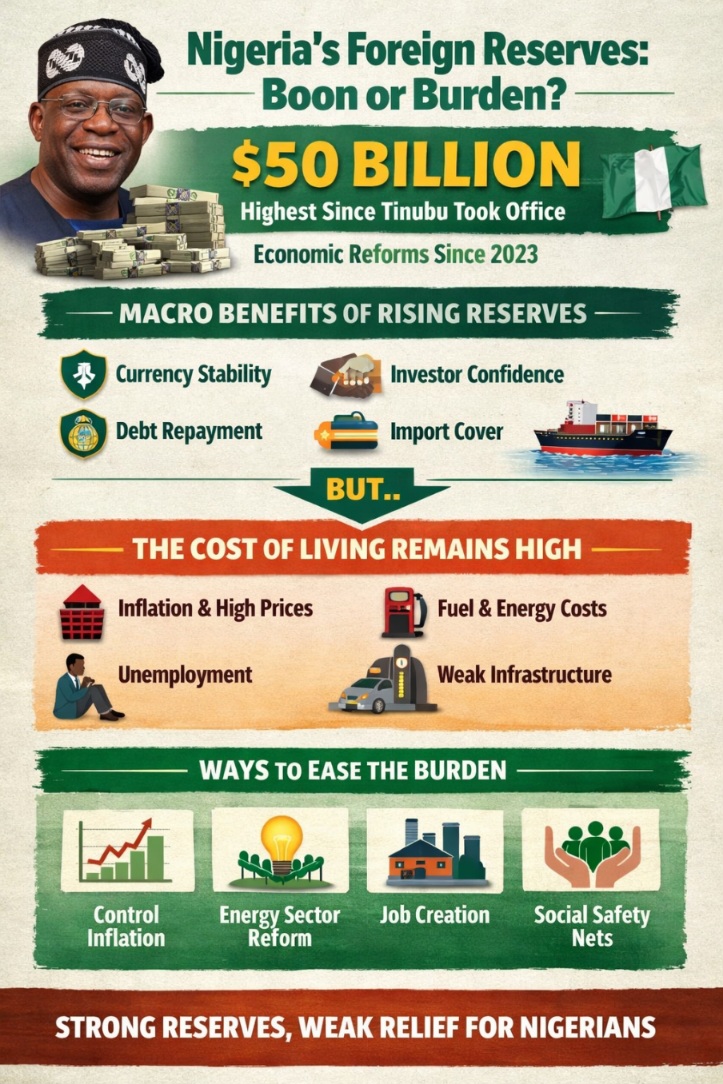
In fact, the reality is worse than he stated. Harvard’s endowment grew to 56.9 billion dollars in fiscal 2025. Nigeria’s external reserves, which Adeyeye quoted at 57 billion dollars, were actually 46.7 billion dollars as of November 14, 2025 — our highest in seven years.
One American university now holds more in its endowment than Nigeria holds in reserves for 230 million people.
If that does not humble us, nothing will.
3. No budget since 1999 has given 1 dollar a day to a Nigerian.
Divide any federal budget since 1999 by the population, and you will discover a painful truth: there has not been any year that the Federal Government allocated one dollar to spend on every Nigerian per day.
1 dollar a day means 365 dollars a year per person. We have never come close.
In 2025, the federal budget was 54.99 trillion naira, roughly 36.7 billion dollars, for about 230 million people. That is about 159 dollars per person per year. About 43 cents a day.
The young people who say Nigeria is rich should sit with that figure. 43 cents. That is what the Federal Government has to spend on you in a day — for roads, for schools, for hospitals, for power, for security, for everything.
We are not just poor. We are abjectly poor. And we have long been abjectly poor. We glorify the past as if it was golden. It was not.
4. Norway is not like us — and that is the point.
Norway has a population of about 5.6 million — the size of one Nigerian state like Osun or Ogun. Yet Norway’s government spends about 45,876 dollars per person per year. Nigeria spends about 135 dollars.
Adeyeye put Norway’s figure at 32,000 dollars. Even if you use the lower figure, the gap is obscene.
Norway also has oil. But Norway did not say, We are rich, let us share free petrol. Norway saved its oil. Its sovereign wealth fund — the Government Pension Fund Global — is now worth over 2 trillion dollars. In 2025 alone, it made a profit of 247 billion dollars. That is 36,500 dollars per Norwegian citizen in one year, from profit alone.
One Norwegian fund made in one year 30 times what Nigeria’s richest politician is alleged to be worth in his entire life.
Norway turned oil into investment, education and productivity. We turned oil into subsidy and freebies.
5. The anthem was a signal, not nostalgia.
On May 29, 2024, President Tinubu signed the National Anthem Bill into law, restoring Nigeria, We Hail Thee — our anthem at independence in 1960, replaced in 1978 by Arise, O Compatriots.
To some, it was mere symbolism. To Adeyeye, and to me, it was a declaration: the military-inspired quasi-federalism that has strangled Nigeria since 1966 is being dismantled, piece by piece.
The military gave us a constitution that was not we the people. It was we the military, pretending to be the people. It gave us a central police, a central purse, a central everything.
Tinubu’s restoration of the old anthem, his increase in states’ share of revenue, and his push for state police are all part of the same project: to return Nigeria to proper federalism.
6. Politicians are not rich. Resources are not wealth.
This brings me back to my argument with those young Nigerians.
Politicians look rich standing next to a hungry Nigerian. They are not rich standing next to the world.
Even the most inflated online lists put the richest Nigerian politician at 8.4 billion dollars — unverified. Compare that to Michael Bloomberg, a former mayor in America, worth about 76.8 billion dollars.
And most Nigerian politicians are not billionaires at all. They are men with 20 million dollars in a country where the average person lives on 807 dollars a year. A thief in a slum can be the richest man in the slum. The slum is still a slum.
If you seized all their alleged wealth and shared it, you would get a one-time payment of perhaps 130 to 217 dollars per Nigerian. Then we would be poor again tomorrow, because we still would not produce.
And resources? Resources are not money. Resources are potential.
Nigeria has 37 billion barrels of oil reserves. That sounds like wealth. Divided by 238 million people, it is only about 156 barrels per Nigerian — for our entire lifetime. At 65 dollars a barrel, that is about 10,140 dollars per person spread over 59 years. About 171 dollars per person per year, if we sold every drop and spent nothing on extraction.
Over 3.5 billion barrels remain locked in undeveloped fields, worth 227.5 billion dollars on paper, because we cannot convert underground wealth into revenue. We cannot even refine our own oil.
The proof is Congo. The Democratic Republic of Congo sits on an estimated 24 trillion dollars in minerals — 70 percent of the world’s cobalt, plus coltan, copper, gold and diamonds. Yet 73.5 percent of Congolese live on less than 2.15 dollars a day. Resources without a state strong enough to govern them, without power, roads, factories and skilled people, are just stones in the ground.
7. A warning to politicians — and to voters who love grandiose promises.
This is where I must sound a caution, to politicians of all parties, including my own, and to the young people who cheer them.
Do not make grandiose promises to win elections that reality will expose after you win.
Do not promise to restore fuel subsidy to win votes, when you know subsidy was consuming 4 trillion naira a year and was projected to consume 17 trillion naira — 77 percent of the budget — in 2023 alone. Do not promise to fix the naira to 500 naira to 1 dollar by fiat, when our reserves are 46.7 billion dollars and our import bill, debt service, and oil dependence make such a peg a fantasy without production to back it.
Do not promise cheap petrol, cheap dollars, free everything, and a strong naira at the same time. You cannot have all four in a country that produces 807 dollars per person.
Campaigns love resonance. Reality loves arithmetic.
When a politician promises to bring back subsidy, ask him: from where? From which budget? Will he cut education, health and defence to pay for it? Will he borrow again to pay people to burn fuel?
When a politician promises to regulate the naira by decree, ask him: with what reserves? With what exports? A currency is not strong because a president declares it strong. A currency is strong because a country produces things the world wants to buy.
Tinubu himself learned this. Subsidy is gone was painful, but it was honest. The pain would have been worse if we had continued to lie to ourselves. Its removal saved an estimated 15.8 trillion naira between June 2023 and December 2025. That money did not disappear — it went to the Federation Account, to states and local governments. Whether they used it well is a separate question we must ask them, not a reason to restore the lie.
The next election will bring a new round of promises. Some will promise to reverse reforms. Some will promise a new Eldorado. Voters must learn to ask the Adeyeye question: Divide the promise by the population. Divide it by the budget. Does it add up to 1 dollar a day?
If it does not add up, it is not a policy. It is a slogan. And slogans do not build refineries, do not generate power, do not pay teachers.
The real question
So I ask again: If Nigeria is rich, where is the money?
It is not in the politicians’ pockets. It is not in the ground.
The real question is not where is the money? The real question is where is the production?
A country that produces 807 dollars per person cannot live like a country that produces 14,213 dollars per person — the world average — no matter how honest its leaders are.
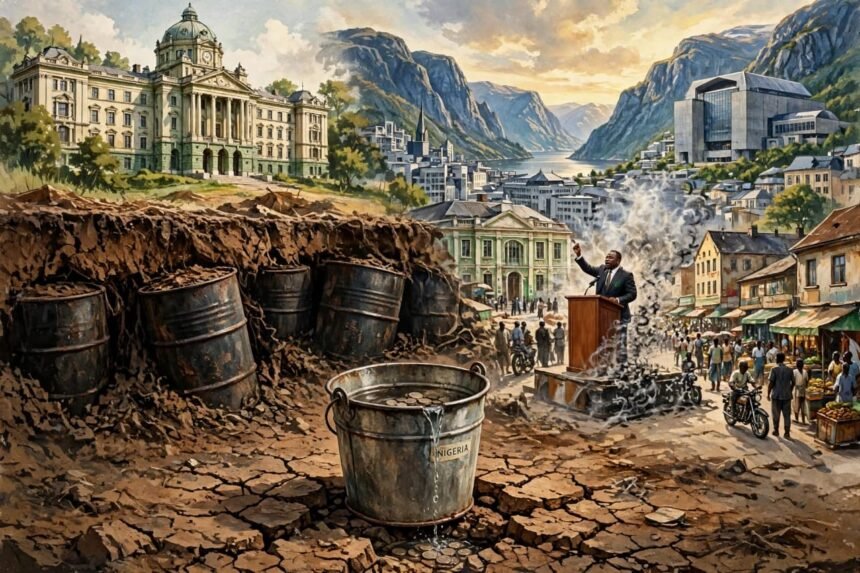
Corruption is real. It costs us about 18 billion dollars a year, about 3.8 percent of GDP. It must be fought ruthlessly. But corruption is a leak in a small bucket. The problem is the bucket is small.
Our bucket is small because of wrong economic policies, because of our predisposition to freebies, because of low productivity.
Our labour productivity is 6.8 dollars per hour worked, against 146 dollars in Luxembourg. Our tax-to-GDP ratio is about 6 percent, against 15.6 percent for Sub-Saharan Africa and 34 percent for the OECD. A country that does not collect tax cannot build.
Nigeria is not rich. We must face that reality. We must cut our coat not according to our size but according to the fabric we have in hand.
Only then can we grow the economy, produce more, and one day — truly — become rich. Not by promise, but by production.