by Okoi Obono-Obla
The Tikar people are a culturally rich Central African ethnic group living primarily in the Bamenda Grassfields and the Tikar Plain of Cameroon. The Tikar and the Bamileke are distinct ethnic groups, but they share close historical, cultural and linguistic connections.
Modern genetic testing and anthropological studies show that they are separate peoples with their own specific identities. According to oral tradition and historical records, many Bamileke trace their ancestral roots to migrations from the Tikar or Adamawa region. Under pressure from Fulani invasions in the 17th century, groups moved southward from the area now occupied by the Tikar into the Western Grassfields. 7ea5
This distinction is important for understanding the Nigerian question.

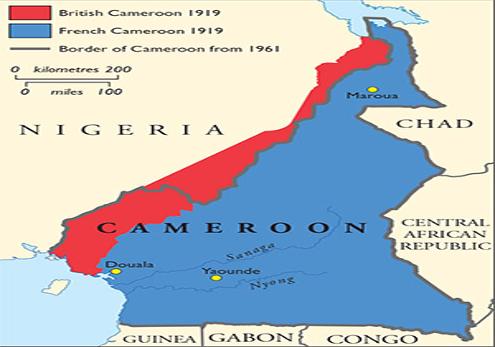
A reader asked why the “Bamileke people of Cameroon” decided not to belong to Nigeria. In fact, the Bamileke were never part of Nigeria. Their homeland — the Western Highlands around Bafoussam, Dschang and Foumban — was part of German Kamerun that was handed to France after World War I, and became French Cameroon. It was never administered from Nigeria.
What was administered as part of Nigeria was British Southern Cameroons — Victoria, Kumba, Mamfe and Bamenda. The Bamenda Grassfields part of this territory is home to many Tikar-descended groups and related Grassfields kingdoms, not the Bamileke heartland itself.
How Southern Cameroons became part of Nigeria:
After Germany’s defeat in the First World War, the League of Nations partitioned German Kamerun. France received the larger eastern portion and Britain received two narrow strips: Northern Cameroons and Southern Cameroons.
For reasons of administrative convenience and cost, Britain administered Southern Cameroons as part of Nigeria. When regionalism was introduced by the Richards Constitution of 1946, which came into force on 1 January 1947, Nigeria became a country of three regions — Northern, Western and Eastern. Southern Cameroons was made a province of the Eastern Region.
Under the Macpherson Constitution of 1951, the province was represented in the Eastern Region House of Assembly.
In 1953, a crisis erupted in the Eastern House. The NCNC asked the Leader of Government Business, Professor Eyo Ita from Calabar Province, to resign to make way for Dr. Nnamdi Azikiwe, who had failed to become Premier of Western Nigeria after NCNC parliamentarians cross-carpeted on the floor of the Western House. Pandemonium broke out, polarising the Eastern House between Igbo members and members from Calabar, Ogoja and Rivers Provinces.
The crisis stunned the Cameroonians. They felt that if people from within Eastern Nigeria itself could be treated with such contempt by their supposed brothers, then they as Cameroonians would not be safe. The Cameroonian delegation began agitating for their own region and severance from the Eastern Region.
The British Government conceded. Under the Lyttelton Constitution of 1954, Southern Cameroons was separated from the Eastern Region and granted its own quasi-regional status with its own House of Assembly in Buea.
The final decision was made at the United Nations plebiscite held on 11 February 1961. Voters in British Cameroons were asked to achieve independence by joining either the Federation of Nigeria or the Republic of Cameroon, which had become independent from France on 1 January 1960. Northern Cameroons voted to join Nigeria, while Southern Cameroons voted overwhelmingly to join the Republic of Cameroon, taking effect on 1 October 1961.
Conclusion
So, to be precise: The Bamileke did not “leave” Nigeria — they were never in Nigeria. The peoples who were in Nigeria were the peoples of Southern Cameroons, including many Tikar-related Grassfields groups around Bamenda. Their experience of being a mere province of the Eastern Region, and the shock of the 1953 Eastern crisis, convinced them they needed a separate political future. That search for security led first to regional autonomy in 1954 and finally to reunification with French-speaking Cameroon in 1961, while their Tikar and Bamileke cousins share a deeper ancestral bond that predates both colonial borders.
By Okoi Obono-Obla