By Okoi Obono-Obla
Introduction
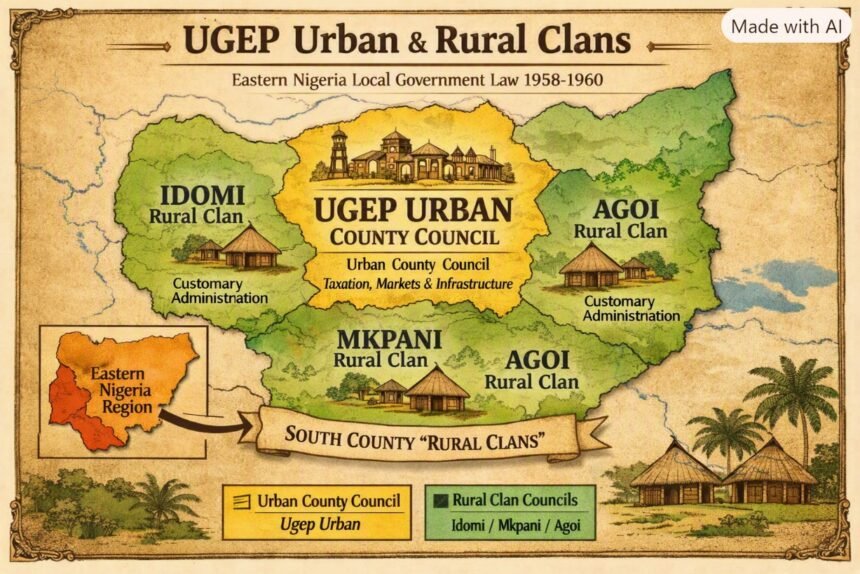
The passage of the Eastern Nigeria Local Government Law of 1958, followed by amendments in 1959 and 1960, marked a turning point in the colonial administration of local governance in the Eastern Region. These laws sought to modernize governance structures by distinguishing between urban councils and rural clan councils, thereby reshaping the political landscape of communities such as Ugep Urban and the neighboring clans of Idomi, Mkpani, and Agoi.
Ugep Urban: Emergence of an Urban County Council
The 1958 Law formally recognized Ugep Urban as an Urban County Council. This designation reflected Ugep’s growing importance as a commercial and administrative hub. As an urban council, Ugep was granted:
– Authority over taxation and revenue collection.
– Responsibility for markets, sanitation, and infrastructure.
– A more centralized administrative framework, aligning with colonial priorities of urban modernization.
This recognition elevated Ugep above its rural neighbors, embedding it within the broader colonial strategy of privileging urban centers as engines of development.

Rural Clans: Idomi, Mkpani, and Agoi
In contrast, the clans of Idomi, Mkpani, and Agoi were administered separately under Rural Clan Councils. These councils:
– Retained authority over customary law and traditions.
– Exercised limited administrative powers, focusing on minor local governance.
– Were often grouped administratively under what was informally referred to as the “South County”, though this term was not consistently codified in the laws.
This separation reinforced colonial distinctions between “modern” urban governance and “traditional” rural administration.
The 1959 Amendment: Refining Boundaries
The 1959 Law refined the framework established in 1958. While Ugep retained its urban status, the rural clans continued to operate independently. However, the amendment emphasized:
– Integration of rural clans into regional development programs.
– Efforts to harmonize rural governance with the expanding urban councils.
– A gradual shift toward administrative consolidation.
The 1960 Law: Consolidation and Independence
The 1960 Law consolidated earlier amendments and prepared the Eastern Region for Nigeria’s independence. Key features included:
– Continued recognition of Ugep Urban as distinct from surrounding clans.
– Maintenance of rural clan councils, though discussions began about merging them into larger administrative units.
– A vision of governance that anticipated the post-independence unification of rural and urban councils.
Historical Significance
The distinction between Ugep Urban and the rural clans illustrates broader colonial strategies:
– Urban privilege: Ugep was elevated as a modern administrative hub.
– Rural marginalization: Idomi, Mkpani, and Agoi were confined to customary governance, limiting their access to modern administrative powers.
– Administrative dualism: The separation of urban and rural councils reflected colonial priorities but sowed seeds of tension that would later influence post-independence reforms.
Conclusion
The Eastern Nigeria Local Government Laws of 1958–1960 institutionalized a dual system of governance that distinguished Ugep Urban from its rural neighbors. While Ugep thrived under the privileges of an Urban County Council, the clans of Idomi, Mkpani, and Agoi remained under rural administration, collectively referred to as “South County.” This framework not only shaped local governance during the late colonial period but also laid the foundation for debates on administrative unification in the early years of Nigeria’s independence.