By Ibrahim BUNU
ibrahimbunu@gmail.com
SB.1034: THE FOREIGN AID BILL NIGERIANS MUST READ BEFORE THEY REJECT IT
Terrorism Financing, Foreign Grants, NGO Accountability and the Dangerous Politics of Misinformation

Nigeria is once again confronting a difficult policy debate.
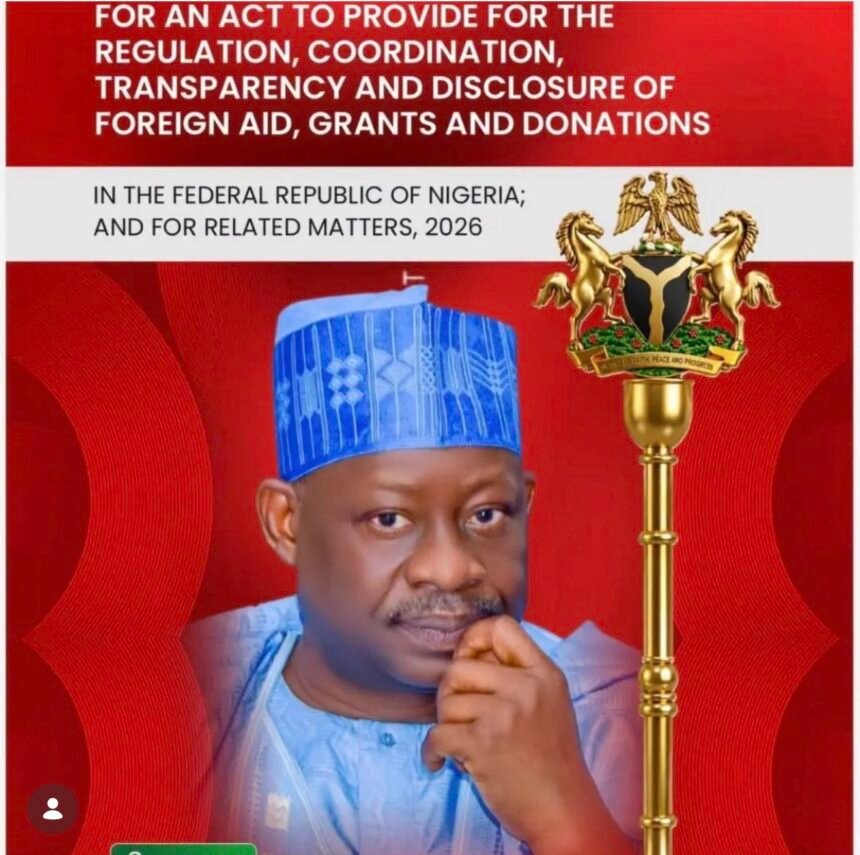
At the centre of it is the Foreign Aids (Regulation, Transparency and Disclosure) Bill, 2026 (SB.1034), sponsored by Senator Ibrahim Hassan Dankwambo.
The Bill was introduced in the Senate on 6 May 2026 and has subsequently passed Second Reading. It is therefore not yet law. It remains subject to committee consideration, stakeholder engagement, possible amendment, passage through the legislative process and, ultimately, presidential assent. (NALTF)
That distinction must be made from the beginning.
SB.1034 is a proposal, not an existing law.
Yet the public debate surrounding it has already become extremely polarised.
One side says:
“This is an attack on NGOs and civil society.”
Another says:
“Anyone opposing it must be protecting hidden foreign money.”
Both positions are too simplistic.
The intelligent Nigerian position should be:
Foreign assistance must be transparent. Legitimate NGOs must be protected. Terrorist financing must be prevented. Government regulatory powers must also be restrained by law.
Those principles are not contradictory.
They are the foundation of responsible legislation.
1. FIRST, LET US GET THE NAME AND PURPOSE RIGHT
Calling SB.1034 simply an “NGO registration bill” does not adequately describe its scope.
The proposal concerns foreign aid, grants, donations and technical assistance received in Nigeria by governments, civil-society organisations, private entities and other recipients.
PLAC describes it as a broader proposal than earlier NGO-specific regulatory initiatives. (PLAC National Geographic)
That distinction is important.
It means the debate should not be reduced to:
“Government wants to register NGOs.”
The real question is:
How should Nigeria account for foreign financial assistance entering the country, particularly when that assistance passes through multiple public and private organisations?
That is a legitimate question for any sovereign state.
2. WHY HAS THIS BILL ATTRACTED SO MUCH ATTENTION?
Because it touches almost every sensitive nerve in modern Nigeria:
* foreign money;
* NGOs;
* humanitarian organisations;
* national security;
* terrorism financing;
* corruption;
* development assistance;
* sovereignty;
* freedom of association;
* political advocacy;
* human-rights work;
* government accountability.
It is therefore inevitable that the Bill would attract controversy.
But controversy is not proof that a bill is bad.
Nor is controversy proof that it is good.
The correct response to controversy is:
Read the legislation.
Examine the clauses.
Hear the stakeholders.
Test the constitutional implications.
Compare it with international practice.
Then amend what needs amendment.
That is how serious legislation is made.
3. THERE IS A LEGITIMATE PROBLEM TO SOLVE
Let us begin with the uncomfortable truth.
Foreign assistance can do enormous good.
Nigeria has benefited from international support in:
healthcare, education, food security, humanitarian relief, agriculture, refugee assistance, maternal health, disease control, poverty reduction and emergency response.
Many Nigerian NGOs perform extraordinary work.
But acknowledging that does not mean pretending that every financial transaction connected to the non-profit sector is automatically safe.
Nigeria already recognises the risk of terrorist-financing abuse within the non-profit sector.
The EFCC’s Special Control Unit Against Money Laundering (SCUML) lists regulations specifically addressing non-profit organisations at risk of terrorism-financing abuse, alongside Nigeria’s anti-money-laundering and terrorism-financing laws.
The EFCC also launched a national terrorist-financing risk assessment for Nigeria’s non-profit sector in 2026.
That is not evidence that NGOs are collectively suspicious.
It is evidence that risk assessment is already recognised as part of modern counter-terrorism policy.
4. WHY WOULD TERRORISTS CARE ABOUT THE NON-PROFIT SECTOR?
Because terrorists need more than weapons.
They need:
money.
logistics.
transportation.
communications.
access to communities.
legitimate-looking financial channels.
intermediaries.
sometimes concealment.
Humanitarian organisations often operate in places where government agencies have limited access.
That is an enormous humanitarian advantage.
But it can also create vulnerabilities.
A terrorist organisation does not necessarily need to establish its own charity.
It can potentially attempt to exploit an existing organisation through:
* diversion of funds;
* manipulation of beneficiaries;
* compromised staff;
* dishonest intermediaries;
* shell partners;
* false invoices;
* cash movements;
* fictitious projects;
* fraudulent subcontracting.
That is why the issue should be approached through risk, not suspicion.
5. FATF’S MODEL IS NOT “ALL NGOs ARE BAD”
This point is frequently lost in public arguments.
The Financial Action Task Force (FATF) recognises that parts of the non-profit sector can be vulnerable to terrorist-financing abuse.
But FATF does not advocate indiscriminate regulation of every organisation.
Its approach is fundamentally risk-based and proportionate.
In other words:
Identify the risk.
Understand the risk.
Apply proportionate safeguards.
Investigate credible concerns.
Avoid unnecessarily burdening organisations that present little or no risk.
That distinction is critical. (PLAC National Geographic)
Nigeria should learn from this principle.
6. LOOK AT ADVANCED COUNTRIES
Those who argue that financial scrutiny of charities is inherently undemocratic should look at how established democracies actually operate.
The United States conducts national assessments of terrorist-financing risks involving non-profit organisations.
The U.S. Treasury has documented cases where charitable structures were allegedly abused or created to support terrorist-linked activities.
But it simultaneously recognises that the overwhelming majority of charitable organisations present little or no terrorist-financing risk.
That is the important lesson:
Regulate the risk, not the entire population.
America does not say:
“Every charity is a terrorist organisation.”
It asks:
Which organisations, transactions, structures or activities create identifiable risk?
That is a much more intelligent model for Nigeria.
7. CANADA ALSO USES RISK ASSESSMENT
Canada similarly recognises vulnerabilities within sections of the non-profit sector while acknowledging the enormous public value of legitimate charities.
Its national risk assessment considers potential vulnerabilities involving:
* diversion of funds;
* terrorist-linked relationships;
* intermediaries;
* movement of money;
* crowdfunding;
* indirect support;
* abuse of organisational structures.
Again, the principle is not collective suspicion.
It is targeted risk management.
8. THE UK DOES NOT TREAT CHARITIES AS ABOVE SCRUTINY
The United Kingdom’s Charity Commission expects charities to maintain appropriate governance and financial controls.
The principle is straightforward:
If an organisation is entrusted with charitable resources, it should be able to demonstrate that those resources are being used for legitimate charitable purposes.
That does not destroy charity.
It protects charity.
Indeed, serious NGOs should welcome systems that make it harder for fraudulent organisations to masquerade as legitimate humanitarian institutions.
9. NIGERIA HAS A PARTICULARLY STRONG SECURITY REASON
Nigeria is fighting serious security threats.
Boko Haram.
ISWAP.
Kidnapping.
Banditry.
Ransom financing.
Arms trafficking.
Money laundering.
Illicit financial networks.
Nigeria therefore cannot afford to treat financial intelligence as an academic exercise.
If money enters a conflict-affected area, the state should be capable of answering:
Who sent it?
Who received it?
What was it for?
Who ultimately benefited?
Was it actually spent as reported?
Those are reasonable national-security questions.
They do not automatically imply that the recipient is guilty.
They simply mean that financial blindness is dangerous.
10. BUT THERE IS AN EQUALLY IMPORTANT WARNING
This is where supporters of the Bill must be intellectually honest.
There are legitimate concerns about SB.1034.
Civil-society and human-rights organisations have argued that the proposed framework could create a Foreign Aid Regulatory Commission with substantial powers over organisations receiving foreign assistance. They have raised concerns about registration, audits, sanctions, suspension and possible duplication of existing regulatory institutions. (Front Line Defenders)
Those concerns should not be dismissed as “anti-government propaganda.”
They deserve examination.
A government with regulatory power must itself be regulated.
Otherwise, a law intended to promote transparency could become an instrument for administrative harassment.
That possibility must be prevented.
11. THIS IS WHY THE BILL SHOULD BE AMENDED WHERE NECESSARY
The answer to a problematic provision is not automatically:
“Kill the entire Bill.”
Nor is it:
“Pass everything exactly as drafted.”
The responsible answer is:
Fix the Bill.
If there is duplication with CAC, SCUML, NFIU, FIRS or other institutions, clarify institutional boundaries.
If powers are excessively broad, narrow them.
If emergency humanitarian grants could be delayed, create an expedited mechanism.
If confidential information could expose vulnerable beneficiaries, protect it.
If public disclosure could endanger human-rights defenders, survivors or witnesses, create exemptions.
If officials can suspend organisations without adequate due process, establish independent review and appeal.
If the Bill creates criminal penalties for minor administrative mistakes, introduce proportionality.
That would produce better legislation.
12. THE GREAT TEST: CAN WE CATCH THE BAD ACTOR WITHOUT DESTROYING THE GOOD ONE?
Imagine two organisations.
NGO A
It receives international humanitarian funding.
It maintains audited accounts.
It knows its donors.
It documents beneficiaries.
It uses formal banking channels.
It reports its activities.
It maintains proper governance.
It cooperates with legitimate investigations.
Why should such an organisation be treated as a terrorist threat?
It should not.
Now consider:
NGO B
It receives unexplained foreign transfers.
Its beneficial owners are unclear.
It moves substantial cash.
Its projects cannot be independently verified.
It uses multiple shell intermediaries.
Its beneficiaries cannot be properly identified.
Its financial records are contradictory.
It operates in a conflict environment.
It refuses legitimate financial scrutiny.
That organisation deserves significantly greater attention.
That is what risk-based regulation means.
13. TRANSPARENCY CAN ACTUALLY PROTECT LEGITIMATE NGOs
This is one of the most overlooked benefits.
Suppose every legitimate foreign-funded organisation is properly registered, verifiable and financially accountable.
Then the public can distinguish it from:
fake NGOs,
shell organisations,
fraudulent charities,
political fronts,
and
criminal enterprises.
Transparency therefore does not necessarily weaken the NGO sector.
It can strengthen its credibility.
A reputable NGO should be able to say:
“Here is our registration.”
“Here are our donors.”
“Here are our audited accounts.”
“Here are our projects.”
“Here are our results.”
That is credibility.
14. THERE IS A DIRECT LESSON FROM THE FAKE-AGENCY SCANDAL
This is where the present national debate becomes particularly interesting.
Nigeria is simultaneously confronting allegations that fictitious organisations were able to acquire the appearance of government legitimacy.
The central lesson is:
Government identity must be verifiable.
The same principle applies to NGOs.
A legitimate organisation should be verifiable.
Who registered it?
Who controls it?
Who funds it?
What does it do?
Where does its money go?
Who audits it?
What projects does it implement?
Who benefits?
The objective is not persecution.
It is institutional verification.
15. FOREIGN MONEY IS NOT THE ENEMY
Let us make this absolutely clear.
Foreign funding has helped Nigerians.
International assistance has supported:
hospitals,
schools,
vaccination programmes,
disaster relief,
food programmes,
refugee assistance,
agricultural development,
women’s empowerment,
children’s welfare,
public-health interventions,
and countless other programmes.
Therefore:
Foreign funding is not inherently suspicious.
But:
Foreign funding should be traceable.
Those two statements can coexist.
16. WHAT NIGERIANS STAND TO GAIN
If properly designed and implemented, an effective foreign-aid transparency framework could provide several benefits.
1. FINANCIAL VISIBILITY
Nigeria can know what foreign assistance enters the country.
2. ANTI-CORRUPTION
It becomes harder to divert donor funds through fictitious projects.
3. COUNTER-TERRORISM
Suspicious financial patterns can be identified and referred to competent authorities.
4. BETTER DEVELOPMENT PLANNING
Donor-funded projects can be mapped against national needs.
5. LESS DUPLICATION
Multiple organisations can be prevented from unknowingly doing the same work in the same communities.
6. BETTER VALUE FOR MONEY
Projects can be measured against their stated objectives.
7. DONOR CONFIDENCE
Serious donors can have greater confidence that their money is properly accounted for.
8. PROTECTION OF THE NGO SECTOR
Legitimate organisations can distinguish themselves from fraudulent ones.
9. NATIONAL SECURITY
Foreign financial channels become harder to exploit for criminal purposes.
10. PUBLIC ACCOUNTABILITY
Citizens can ask what money entered the country and what happened to it.
17. THE PUBLIC DATABASE IDEA DESERVES SERIOUS ATTENTION
A national foreign-aid database could be extremely useful if properly designed.
Imagine being able to verify:
Organisation
Donor
Amount
Purpose
Project
Location
Implementation period
Implementing partners
Reported result
Audit status
That would be a significant improvement in public accountability.
But transparency must not become indiscriminate exposure.
Sensitive information concerning:
victims,
human-rights defenders,
whistleblowers,
witnesses,
children,
conflict-sensitive operations,
and
legitimate security information
should receive appropriate protection.
The answer is smart transparency, not unlimited disclosure.
18. WHAT ABOUT THE BACKLASH FROM DR SHEHU MAHADI?
This is where Nigerians must become more intellectually disciplined.
Dr Shehu Mahadi and other commentators are entitled to oppose the Bill.
They are entitled to argue that it threatens civic space.
They are entitled to challenge the government.
They are entitled to demand amendments or withdrawal.
But the public should ask a simple question:
Which exact provision creates the danger being alleged?
That is the proper standard.
If a provision violates constitutional rights, identify it.
If it duplicates existing institutions, demonstrate it.
If it creates excessive executive discretion, identify the clause.
If it could endanger humanitarian operations, explain how.
If it could facilitate political victimisation, demonstrate the mechanism.
Then lawmakers should respond.
This is better than attacking the personality of the critic.
At the same time, criticism should not become alarmism in which the mere existence of regulation is presented as proof that civil society is about to be abolished.
The text matters.
Evidence matters.
The actual powers created by the law matter.
19. WE SHOULD NOT MAKE THE BILL A POLITICAL WAR
This is perhaps the biggest mistake Nigeria can make.
The Bill should not become:
APC versus PDP.
Government versus opposition.
North versus South.
Muslims versus Christians.
NGOs versus government.
Civil society versus security agencies.
Those are distractions.
The actual question is:
Can Nigeria design a transparent, proportionate and constitutionally sound system for foreign assistance without damaging legitimate civil society?
That is the question.
20. WHAT THE FINAL LAW SHOULD CONTAIN
If SB.1034 is to become useful legislation, I would argue for at least ten safeguards:
ONE — RISK-BASED REGULATION
Not every organisation should face the same compliance burden.
TWO — CLEAR THRESHOLDS
Small grants should not automatically attract the same reporting obligations as large cross-border programmes.
THREE — HUMANITARIAN EXEMPTIONS
Emergency humanitarian assistance should be processed rapidly.
FOUR — CONFIDENTIALITY PROTECTION
Sensitive information about vulnerable people should not automatically become public.
FIVE — JUDICIAL OVERSIGHT
Suspension or closure of organisations should be subject to meaningful legal review.
SIX — INDEPENDENT APPEALS
Organisations should have a clear right to challenge regulatory decisions.
SEVEN — INSTITUTIONAL COORDINATION
The new framework must not create needless duplication.
EIGHT — CIVIL-SOCIETY REPRESENTATION
Legitimate stakeholders should have input into implementation.
NINE — PUBLISHED GUIDELINES
Organisations must know exactly what is required of them.
TEN — RECIPROCAL GOVERNMENT TRANSPARENCY
Government agencies receiving foreign assistance must face equivalent accountability.
That last point is essential.
21. GOVERNMENT MUST ALSO OPEN ITS OWN BOOKS
This cannot be a one-way street.
If government demands:
“Tell us where your foreign money comes from.”
Then government should also be prepared to answer:
“Tell Nigerians where public money goes.”
If NGOs must disclose funding:
government projects should be auditable.
If NGOs must report beneficiaries:
government programmes should report beneficiaries.
If NGOs must account for grants:
government agencies must account for appropriations.
If donors must be transparent:
public procurement must be transparent.
Accountability cannot be selectively applied.
22. THE BILL SHOULD BE TESTED AGAINST THE CONSTITUTION
This is another reason why the public hearing matters.
Freedom of association and expression are constitutionally protected.
Any regulatory framework affecting civil society must therefore be:
lawful,
clear,
necessary,
proportionate,
and
subject to due process.
Critics have already raised constitutional concerns, including potential effects on freedom of association and expression. Those arguments deserve a serious legal response rather than dismissal. (Legis360)
If the Bill contains provisions that cannot survive constitutional scrutiny, lawmakers should amend them.
That is precisely what parliamentary review is for.
23. THIS IS WHY WITHDRAWAL SHOULD NOT BE THE ONLY OPTION
Some civil-society organisations are calling for the Bill to be withdrawn entirely. (Front Line Defenders)
Their concerns should be heard.
But withdrawal is not necessarily the only democratic solution.
There is another possibility:
Public hearing → clause-by-clause examination → amendments → safeguards → institutional clarification → constitutional review → improved legislation.
That would allow Nigeria to preserve the legitimate objective of foreign-aid transparency while removing provisions that could unnecessarily threaten civic space.
That is a more constructive approach.
24. THE MOST DANGEROUS POSITION IS BLINDNESS
Nigeria cannot afford two types of blindness.
BLINDNESS TO TERRORIST FINANCING
This creates a national-security vulnerability.
BLINDNESS TO GOVERNMENT OVERREACH
This creates a democratic vulnerability.
A serious country must prevent both.
The answer is not to choose between security and liberty.
The answer is to design institutions that protect both.
25. THE FIVE-WHY TEST
WHY 1 — Why regulate foreign assistance?
Because foreign financial flows can involve legitimate development, but can also be exposed to fraud, diversion and terrorist-financing risks.
WHY 2 — Why not simply trust NGOs?
Because trust is not a substitute for financial controls — just as government agencies, banks and corporations are not exempt from accountability.
WHY 3 — Why not give government unlimited regulatory power?
Because regulators themselves can abuse power, particularly where laws contain vague or excessive discretion.
WHY 4 — What is the solution?
Risk-based regulation, transparency, due process, judicial oversight, confidentiality safeguards and clear institutional boundaries.
WHY 5 — What is the ultimate objective?
To create a system in which:
legitimate money can move efficiently, legitimate organisations can operate freely, suspicious money can be traced, criminal networks can be exposed, and government cannot arbitrarily silence lawful civil society.
That is the balance Nigeria needs.
THE BOTTOM LINE
SB.1034 should neither be worshipped nor demonised.
It should be examined.
Its transparency objectives are legitimate.
Its potential counter-terrorism and anti-corruption benefits are real.
International practice demonstrates that democratic countries do not leave charitable and foreign-funded financial systems completely outside regulatory oversight.
But the concerns raised by Nigerian and international civil-society organisations are also real and deserve serious examination. (Front Line Defenders)
The answer is therefore neither:
“Kill the Bill.”
Nor:
“Pass the Bill exactly as it is.”
The answer is:
“Make the Bill better.”
Make it tough on:
terrorist financing.
fraud.
money laundering.
fake NGOs.
shell organisations.
financial diversion.
false reporting.
corruption.
But make it equally tough against:
arbitrary government action.
political victimisation.
unlawful surveillance.
unnecessary bureaucracy.
selective enforcement.
abuse of regulatory powers.
And protect:
humanitarian work.
freedom of association.
legitimate advocacy.
human-rights work.
journalism.
emergency assistance.
lawful civic activity.
CONCLUSION: TRANSPARENCY SHOULD PROTECT THE HONEST — NOT TERRIFY THEM
The debate around SB.1034 is becoming too emotional.
We need less shouting and more reading.
Less political labelling and more clause-by-clause analysis.
Less social-media alarm and more evidence.
Nigeria has a legitimate national interest in knowing where foreign assistance comes from, who receives it, how it is spent and whether it reaches its intended beneficiaries.
Nigeria equally has a constitutional interest in protecting legitimate civil society from arbitrary government interference.
Both truths can exist simultaneously.
The United States regulates terrorist-financing risks in the non-profit sector.
Canada does.
The United Kingdom does.
International anti-money-laundering standards recognise the problem.
Nigeria itself already has regulatory mechanisms addressing NPO terrorist-financing risks.
Therefore, the principle of financial accountability is not inherently authoritarian.
But neither should international practice be used as an excuse for giving Nigerian regulators unlimited powers.
Nigeria must learn the right lesson from advanced democracies:
Not:
“Control everybody.”
But:
“Identify risk, regulate proportionately, investigate evidence and protect legitimate activity.”
That is the model.
And that is what Nigerians should demand from SB.1034.
Let the public hearing be genuine.
Let NGOs speak.
Let security agencies speak.
Let financial-intelligence experts speak.
Let human-rights lawyers speak.
Let development partners speak.
Let ordinary beneficiaries speak.
Let lawmakers examine every controversial clause.
Then amend the Bill until it can pass the most important test of all:
Can this law make Nigeria safer and more accountable without making Nigeria less free?
If the answer is yes, Nigeria should have the courage to pass it.
If the answer is no, lawmakers should have the courage to amend it.
And if a provision is fundamentally defective, remove it.
That is democracy.
The objective should not be to create a state powerful enough to silence civil society.
Nor should it be to create a civil-society environment so opaque that terrorists, criminals, corrupt officials or fraudulent actors can hide behind humanitarian language.
The objective is much simpler:
Let the honest NGO operate without fear.
Let the honest donor give without suspicion.
Let the Nigerian public know where the money goes.
Let investigators follow suspicious money.
Let terrorists find fewer financial channels.
Let corrupt actors find fewer hiding places.
And let government itself remain accountable to the same principles it demands from everyone else.
That is not an attack on civil society.
That is not hostility to foreign assistance.
That is not a declaration that NGOs are criminals.
It is the beginning of a transparent financial architecture in which legitimate assistance is protected and illicit finance is exposed.
Nigeria does not need less accountability.
Nigeria needs better accountability.
And SB.1034 should be judged by whether it can deliver exactly that.
By Ibrahim BUNU
ibrahimbunu@gmail.com
Editorial note: SB.1034 has passed Second Reading but is not yet law. The final text may change during committee review, public hearings and subsequent legislative stages. Claims concerning its effects should therefore be assessed against the enacted text rather than assumptions about provisions that may ultimately be amended or removed.