
By Okoi Ojomo-Obla
I have previously written about the Okoyong dialect of the Kiong language, spoken in Odukpani Local Government Area, which is fast going into extinction and is now critically endangered. As of 2010, not more than 20 elders, all in their 70s, were still speaking it.
Kiong or Korup is also spoken in Akamkpa and Biase Local Government Areas of Cross River State. I also noted that the Ojor people of Akamkpa Local Government Area once spoke Lokaa but have lost it; they now speak Lubila.[Yakurr]
Some respondents have also narrated that several languages in Cross River State are going extinct. Indeed, Aig Otala wrote thus: “In Calabar and Odukpani LGAs, there are two languages facing similar problems. The Qua language is still standing on one leg; only very few people are speaking it. Most families are comfortable speaking Efik and Ibibio. And for the Efut language, it is extinct. They are left with only titles that are still in use, e.g., Muri, Mukafo, Ndabo, Mbonka, etc.”

In this regard, the contribution of Amissine Ogban is worthy of note. He wrote:
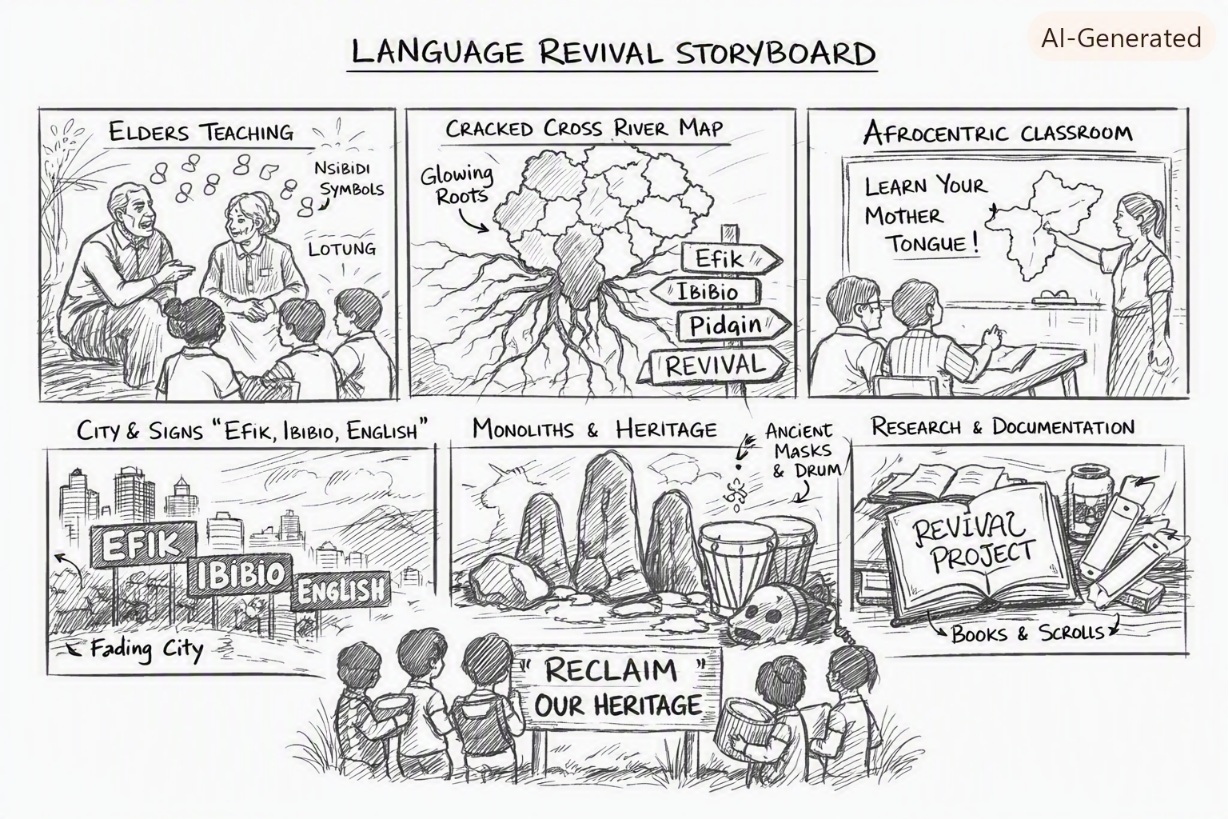
“Obol, my brother, we are getting closer every day to the re-discovery of ourselves and our origin. I feel deeply concerned about language extinction. It is very unfortunate that the Efut language in Calabar South, Calabar Municipality, Odukpani, Akpabuyo and Akamkpa is facing total extinction. The Efut people in these LGAs now speak Efik and English. As God may have it, the original Efut language is still spoken in Biase, between Akpet 1, Akpet Central group of villages, Betem and Ehom. There is a need for linguistic scholars, anthropologists and government to start looking inward, as well as create an Afrocentric curriculum and sponsor research to build studies that are more African. We have to tell our own story to the world.
In our former discussion, I did very little work on Princess Ibum, to refute our Akwa Ibom brother’s position. It could be that he is trying to track down their migration route. Let us give everyone a listening ear and let superior arguments hold sway.
The monoliths in the upper and central Cross River Basin have more to their glory than is mentioned now. For example, our monoliths connote the remembrance of our days in Egyptian civilization and the science of embalming the dead. They represent traditional beliefs in our ancestors and our connectivity to the spiritual world through them. They are altars of worship and libation pouring. They are the origin of the modern burial ground which the white man borrowed from Africa to establish in Europe. The Agwagune people travelled with their monoliths in their journey of migration and conquest. The monolith stones were used to set up altars of worship. This dates back to old-time religion, equally practiced in North-East Africa and the Middle East.”[cemetery]
Ogban’s intervention captures the heart of the matter.
When I was young, Agwagwune was like a second language in Ugep, especially in my part of Ugep – Ijiman and Okurubong – and all my uncles were fluent speakers of Agwagwune, but now that is all gone.
One of my grand-uncles once told me that Lotung was the language of the ancestors of the Yakurr when I asked him why the Nsibidi cultural troupe of Ijiman sings in Lotung rather than in Yakurr. He simply said, “It is the language of our fathers.” I was stunned and confounded.[Ejagham]
Why are our languages dying?
What we are witnessing is driven by several interlinked forces.
1. Dominance of larger languages: Efik, Ibibio, English and Pidgin have greater prestige and economic value. Parents choose to speak them to their children, and intergenerational transmission stops. This is why the Efut in Calabar and Odukpani now speak Efik, why Qua is standing on one leg, and why Ojor now speaks Lubila.
2. Urbanization and migration: Our youths leave for Calabar, Abuja, Lagos and beyond. In the cities, their mother tongue has little value, and inter-ethnic marriages entrench a lingua franca at home.
3. An alien educational system: Our schools have no curriculum, textbooks or teachers for small languages like Okoyong, Qua, or Efut, and historically punished children for speaking them.
4. Lack of documentation: As Ogban rightly said, we need Afrocentric research. Most of these languages have no dictionary or orthography. When the last elders die, the entire library dies with them.
Language is part of the culture, identity and heritage of a given people. When you lose your language, you invariably lose your self-esteem, identity and heritage. When you leave no heritage, you are completely and totally derobed, unmasked and stripped of your humanity and well-being in all ramifications.
We are indeed getting closer to the re-discovery of ourselves. Our monoliths, our Nsibidi, our history of Princess Ibum and our migration stories are all linked to our languages. As Ogban noted, we must tell our own story to the world. We must now urgently document the languages in Cross River State that are endangered or going extinct and start a deliberate project to revive them.