


By Eneojo Herbert Idakwo
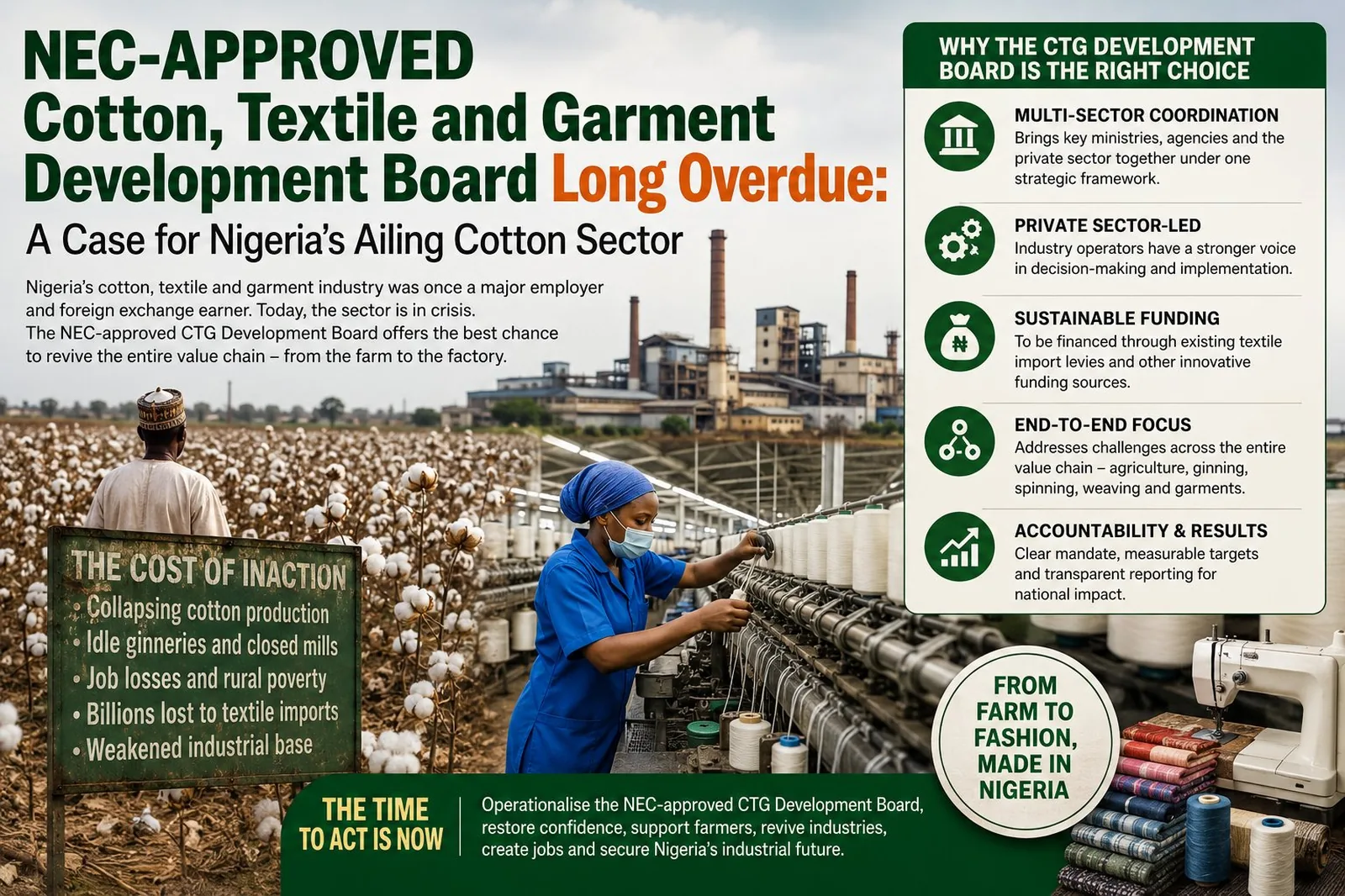
Nigeria’s cotton, textile and garment industry is dying quietly.
Across the country’s major cotton-producing states, thousands of hectares that once yielded the white fibre that fed a thriving manufacturing sector have been converted to other crops. Cotton farmers who once looked forward to each planting season now hesitate, uncertain whether growing the crop is worth the risk. Ginneries built to process tonnes of seed cotton remain largely idle, while textile factories that once echoed with the sound of spinning and weaving machines stand as monuments to a vanished industrial era.
The decline has not occurred because Nigeria lacks fertile land, experienced farmers or an established textile tradition. Rather, the industry’s greatest weakness has become the absence of coordinated leadership capable of connecting every stage of the value chain, from the farm to the finished garment.

It is against this background that many operators in the sector believe the National Economic Council’s approval of the Cotton, Textile and Garment Development Board (CTGDB) marks one of the most important policy decisions for the industry in recent years. Yet more than a year after that landmark decision, implementation remains incomplete, even as the industry’s challenges deepen.
For stakeholders, every passing planting season without a fully operational Board represents another missed opportunity to restore one of Nigeria’s oldest and most strategic manufacturing sectors.
A Sector That Once Drove Industrial Growth
There was a time when cotton was among Nigeria’s most valuable industrial crops.
Cotton grown in Kaduna, Katsina, Kano, Zamfara, Gombe and other producing states supplied dozens of ginneries. The processed lint moved to spinning mills before reaching textile factories that produced fabrics for local consumption and export. Garment manufacturers transformed those fabrics into uniforms, fashion products and industrial clothing, creating hundreds of thousands of jobs across the country.
The industry was more than manufacturing. It was a complete economic ecosystem.
When cotton production flourished, rural communities prospered. Transporters moved raw materials between farms and factories. Banks financed agricultural production and industrial expansion. Small businesses emerged around textile clusters, while government earned revenue from taxes and exports.
Today, much of that ecosystem has collapsed.
The Missing Link
Industry analysts argue that Nigeria’s textile crisis cannot be traced to a single cause.
Poor access to quality seeds, inadequate financing, insecurity in farming communities, obsolete equipment, inconsistent trade policies, smuggling, unreliable electricity and weak institutional coordination have all contributed to the sector’s decline.
What has become increasingly apparent, however, is that these problems cannot be solved independently.
Cotton production falls under agricultural policy.
Industrial development lies within manufacturing policy.
Financing depends on economic institutions.
Trade competitiveness requires customs, fiscal and export reforms.
Without a mechanism that brings all these institutions together, interventions often remain fragmented.
That reality explains why many stakeholders regard the NEC-approved Cotton, Textile and Garment Development Board as long overdue.
Why the Board Matters
Unlike previous interventions centred within individual ministries, the CTG Development Board was conceived as a national coordinating institution under the Presidency, reflecting the interministerial nature of the industry.
Supporters believe this governance structure offers several strategic advantages.
First, it provides a single platform capable of coordinating the activities of ministries responsible for agriculture, industry, finance and economic planning, reducing duplication and policy inconsistency.
Second, it places greater emphasis on private sector participation. Cotton farmers, ginners, textile manufacturers, garment producers and investors are expected to play meaningful roles in shaping policy and implementation, recognising that sustainable industrial growth cannot be driven by government alone.
Third, stakeholders say the proposed funding framework, supported through existing textile import levies, offers the prospect of more predictable financing than relying solely on annual government appropriations.
Perhaps most importantly, the Board recognises that cotton production and industrial manufacturing are inseparable. Strengthening one without the other cannot revive the value chain.
The Cost of Delay
Agriculture operates according to seasons, not policy announcements.
When planting opportunities are missed, the consequences extend far beyond the farm.
Industry stakeholders argue that recent planting seasons have highlighted this reality. Expectations of expanded intervention programmes were followed by uncertainty over implementation, leaving many farmers without the confidence or resources to continue cotton cultivation.
As production declined, the impact spread rapidly across the value chain.
Ginneries struggled to secure raw materials.
Spinning mills faced shortages of lint.
Textile factories operated below capacity or remained closed.
Garment manufacturers increasingly relied on imported fabrics.
Each missed planting season weakened another link in the production chain.
For many operators, restoring confidence among farmers has become the industry’s most urgent priority.
Lessons from Other Nations
Countries that have rebuilt their textile industries have done so through coordinated national strategies rather than isolated institutional programmes.
India integrates cotton production with research, manufacturing and export promotion.
Bangladesh’s garment industry grew through sustained collaboration between government and private investors.
Egypt strengthened its globally recognised cotton industry by aligning agricultural reforms with industrial development.
Ethiopia combined cotton production with investment in industrial parks and export-oriented manufacturing.
Although their governance models differ, they all demonstrate one consistent principle. Successful textile industries depend on institutions capable of coordinating the entire value chain.
Many Nigerian stakeholders believe the NEC-approved Board reflects that same philosophy.
Beyond Institutions
Even the strongest governance structure will succeed only if matched with decisive implementation.
The sector requires improved seed varieties, accessible financing, stronger agricultural extension services, enhanced security in farming communities, competitive energy costs, modernised processing facilities and policies that encourage local manufacturing.
The operationalisation of the Steering Committee inaugurated by the Secretary to the Government of the Federation therefore represents an important opportunity to move beyond policy design and into execution.
For stakeholders, the challenge is no longer identifying what needs to be done.
It is ensuring that every institution works through one coordinated framework capable of delivering measurable results.
A National Imperative
The revival of Nigeria’s cotton, textile and garment industry is not simply an agricultural or manufacturing objective.
It is a national economic imperative.
A functioning CTG value chain would reduce dependence on imported textiles, conserve foreign exchange, stimulate rural economies, create employment across agriculture and manufacturing, expand non-oil exports and strengthen Nigeria’s industrial competitiveness under the African Continental Free Trade Area.
Those opportunities remain within reach.
Yet they will require institutional clarity, sustained political commitment and coordinated implementation.
For many stakeholders, that is precisely why the NEC-approved Cotton, Textile and Garment Development Board can no longer remain an idea awaiting execution. It has become a necessity whose time has come.
The future of Nigeria’s cotton industry may depend less on announcing new initiatives than on implementing the one national framework already approved to bring farmers, manufacturers, investors and government onto the same page.
Only then can Nigeria begin to weave together the broken threads of an industry that once clothed the nation and held the promise of powering its industrial future.














I’m of the considered opinion that this write-up is timely, appropriate and represents the mind of all CTG stakeholders.
It’s within the armbit of the Federal Government to expedite the immediate take-off of the CTGD Board.