By Eneojo Herbert Idakwo
ABUJA, Nigeria — A leadership crisis is unfolding within the National Cashew Association of Nigeria (NCAN), threatening to cast a shadow over one of the country’s fastest-growing agricultural export industries. At the centre of the dispute is an attempt to inaugurate a new national leadership, an exercise that state chairmen across Nigeria’s major cashew-producing regions insist is unconstitutional and capable of destabilising the industry.
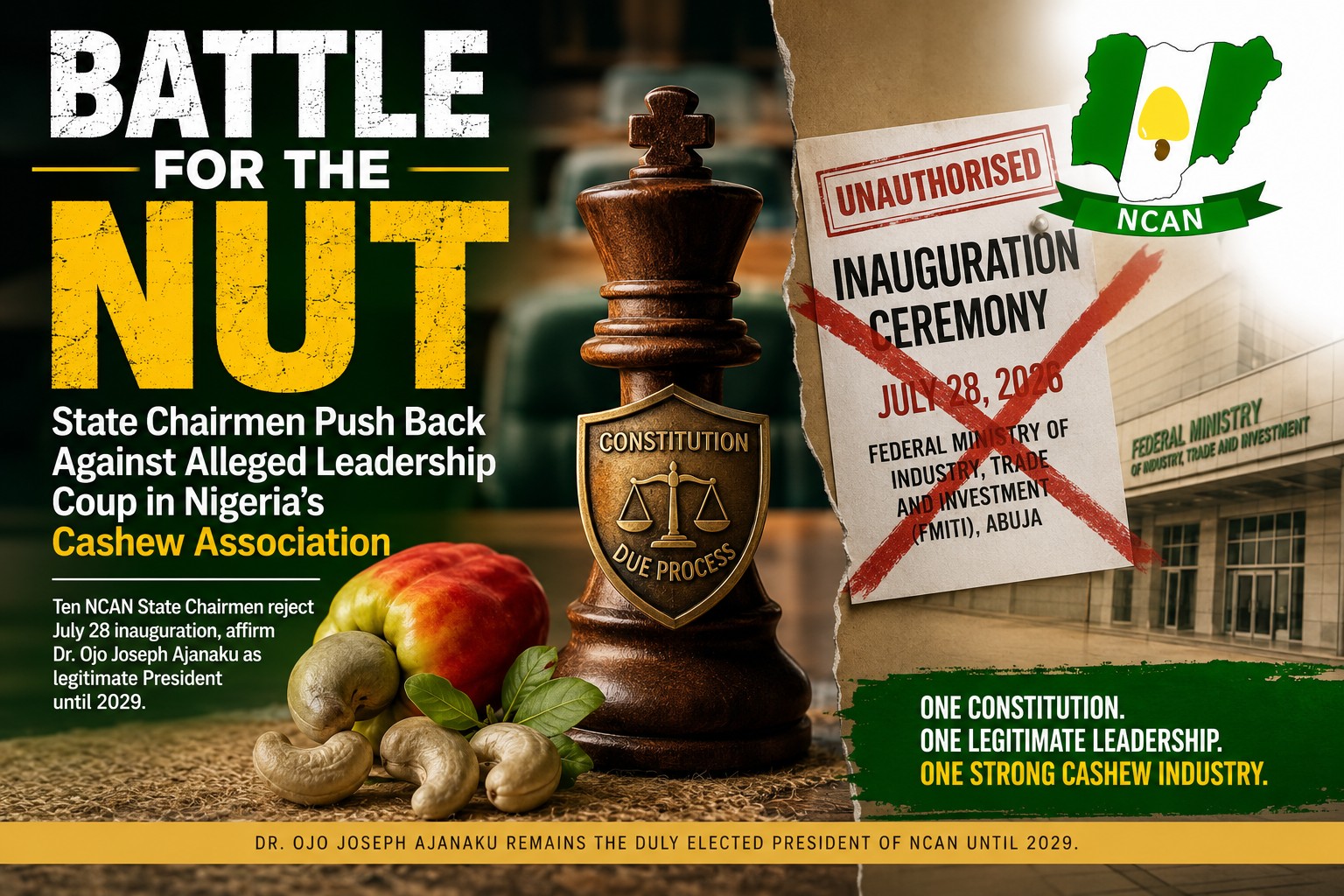
In a joint press statement issued in Abuja on 22 July 2026, ten NCAN State Chairmen rejected a planned inauguration of a purported National and State Executive Committee scheduled for 28 July at the Federal Ministry of Industry, Trade and Investment (FMITI). They described the proposed event as lacking constitutional authority and reaffirmed that Dr. Ojo Joseph Ajanaku remains the association’s duly elected President, with a mandate that runs until 2029.
The development has exposed growing tensions within an industry that has, in recent years, become one of Nigeria’s most important non-oil export sectors. Beyond the internal contest for leadership, the disagreement raises broader questions about institutional governance, constitutional order and investor confidence in commodity associations that play a significant role in agricultural development and export promotion.

A Contest Over Constitutional Authority
The controversy followed the circulation of a notice announcing the inauguration of a new National and State Executive Committee in Abuja. According to the State Chairmen, the notice was issued by individuals who lacked the constitutional authority to convene such a ceremony or alter the association’s leadership structure.
They argued that the NCAN Constitution provides clear procedures for electing national officers, convening meetings and effecting leadership transitions. In their view, none of those procedures has been followed.
“The proposed event is unauthorized, without constitutional mandate, and incapable of creating or conferring legitimate leadership on any individual or group acting in the name of NCAN,” the chairmen declared.
According to the signatories, the controversy centres on the proposed inauguration scheduled for 28 July 2026 at the Federal Ministry of Industry, Trade and Investment in Abuja. They insist that no National Executive Committee meeting, Annual General Meeting or duly conducted election has taken place to justify a change in leadership.
The chairmen therefore reaffirmed that Dr. Ojo Joseph Ajanaku remains the duly elected President of the National Cashew Association of Nigeria, with a constitutionally protected tenure extending until 2029. Any attempt to inaugurate another executive before the expiration of that mandate, they argued, amounts to a violation of the association’s constitution and cannot create lawful authority.
Their declaration was endorsed by ten State Chairmen representing the country’s principal cashew-producing states across the North Central, North West, South West, South South and South Eastgeopolitical zones. They contend that their collective position reflects the will of the association’s grassroots leadership and demonstrates a broad commitment to preserving constitutional governance within NCAN.
Can a Government Venue Confer Legitimacy?
One of the most striking aspects of the dispute is the choice of venue for the proposed inauguration. By scheduling the ceremony at the Federal Ministry of Industry, Trade and Investment, organisers risk creating the impression that the Federal Government has endorsed the exercise.
The State Chairmen rejected that interpretation, arguing that the use of a government facility cannot substitute for compliance with an association’s constitution.
“The selection of a government facility or the presence of public officials cannot confer legal or constitutional legitimacy upon an activity that has not been authorized by the Association’s duly constituted leadership,” the statement added.
The warning was directed not only at members of the association but also at government agencies, financial institutions, exporters, processors, development partners and international buyers who regularly engage with the Nigerian cashew industry. The chairmen urged all stakeholders to recognise only actions taken by the constitutionally recognised leadership of NCAN.
Why the Dispute Matters
Leadership disputes within commodity associations often extend beyond internal politics. They can influence government engagement, affect investor confidence and create uncertainty among international trading partners.
Nigeria remains one of Africa’s leading producers of raw cashew nuts, supplying major processing markets in Asia while also seeking to expand domestic value addition through local processing. The Federal Government has repeatedly identified cashew as a strategic non-oil export capable of generating foreign exchange, creating rural employment and supporting agricultural industrialisation.
For these ambitions to succeed, industry stakeholders argue that representative institutions such as NCAN must remain stable, credible and governed by transparent constitutional processes.
Any prolonged uncertainty over leadership could complicate policy advocacy, weaken engagement with development partners and undermine coordinated efforts to improve production, processing, financing and export competitiveness.
Governance Beyond Personalities
Although the immediate dispute concerns who legitimately leads the association, the State Chairmen insist that the issue is fundamentally about institutional governance rather than personalities.
Their position is that constitutional procedures exist precisely to prevent arbitrary changes in leadership and to protect members’ confidence in the association’s democratic processes. If those procedures can be bypassed, they argue, the integrity of the institution itself comes into question.
For investors, exporters and international buyers, predictable governance is often as important as production volumes. Stable institutions provide continuity in policy engagement, contract implementation and industry representation, all of which are essential for sustaining long-term commercial relationships.
A Broad Regional Coalition
The declaration rejecting the proposed inauguration was signed by chairmen representing virtually every major cashew-producing region of the country.
From the North Central came Alhaji Ichapi Muhammed Agala (Kogi), Mrs. Bridget Mwuese Yough (Benue) and Mr. Alabi Babatunde Dauda (Kwara). The South West was represented by Mr. Adedokun Moses (Osun) and Deacon Aremu Adewale Ezekiel (Oyo). The North West delegation included Mallam Auwal Ahmed Sarki (Kaduna) and Alhaji Abdulmalik Ubandoma (Kebbi), while the South South was represented by Mr. Osas Ojeikere (Edo). Representing the South East were Mr. Anthony Onah (Enugu) and Mr. David Nduejuafor (Imo).
The geographical spread of the signatories underscores the significance of the dispute and signals that concerns over the proposed inauguration extend well beyond a single state or regional bloc.
Looking Beyond July 28
As the scheduled inauguration date approaches, attention has shifted to the Federal Ministry of Industry, Trade and Investment and other relevant authorities to see whether the disputed ceremony will proceed and whether any official clarification will be issued regarding the ministry’s role.
Regardless of the immediate outcome, the controversy has become a test of governance within one of Nigeria’s most strategically important agricultural industries. At stake is not only the leadership of the National Cashew Association of Nigeria but also the confidence of farmers, processors, exporters, investors and international partners who depend on a stable and credible industry institution.
For the State Chairmen, the message is unequivocal. Leadership in NCAN, they argue, cannot be determined by public announcements or ceremonial inaugurations. It must derive from the constitution, the collective will of members and the due process that gives legitimacy to any democratic institution. In an industry increasingly central to Nigeria’s export diversification agenda, they believe those principles are too important to compromise.