By Okoi Obono-Obla
- APC’s Governance and Nigeria’s Democratic Progress
The APC has performed remarkably well when considering the state of the country in 2015. The party brought sanity to Nigeria’s electoral process. Between 2003 and 2015, electoral malpractice was rampant, to the extent that President Umaru Musa Yar’Adua admitted the election that brought him to power was fraudulent. He promised reforms that led to the fundamental changes introduced in the 2010 Electoral Act.
Living standards during that period were not genuinely better; they were largely a façade. Nigeria experienced two oil booms between 2007 and 2015, but the revenues were misappropriated by PDP apparatchiks and their cronies in government. The government subsidized petroleum products, spending billions of dollars to sustain what became one of the greatest scams in history. Billions more were spent monthly to shore up the national currency so Nigeria could trade internationally. Meanwhile, universities were closed for years due to strikes, and critical infrastructure such as electricity, roads, airports, and railways was neglected.
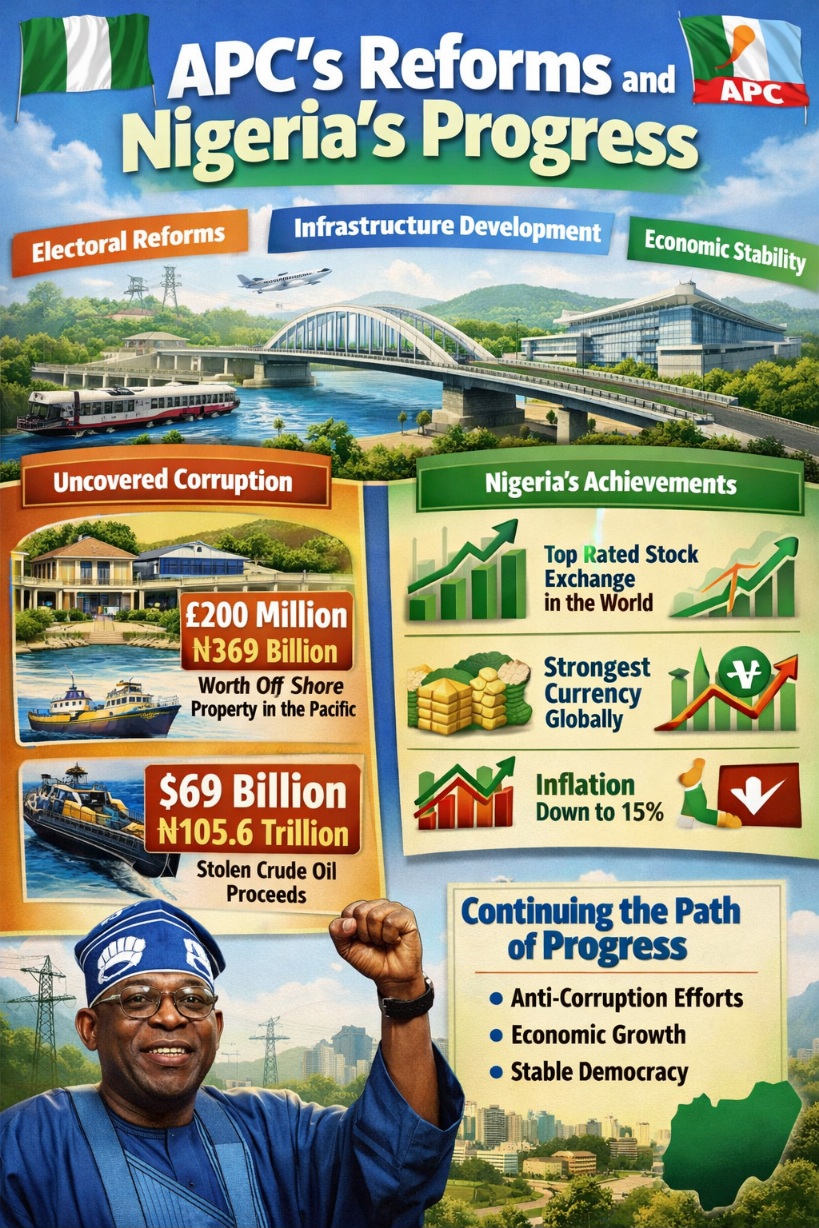
As an anti-corruption czar between July 2017 and August 2019, I uncovered monumental evidence of corruption. One opposition party chairman owned offshore property in the Pacific worth £200 million (₦369 billion today). Additionally, $69 billion (₦105.6 trillion today) in stolen crude oil proceeds was traced to the USA.

The APC government under President Buhari adhered to party guidelines. For example, the Ikom Bridge linking Cross River State at Etung Local Government Area with Cameroon was completed. Contrary to claims of a merger of government branches, the judiciary remains independent. What some perceive as a merger of the executive and legislative arms is, in reality, cooperative democracy — a practice also evident in the USA, which recently celebrated 250 years of democracy.
Where monopolies exist, such as in the cement industry, citizens can challenge them before the Federal Competition and Consumer Protection Commission. Unfortunately, Nigerians often fail to hold state and local governments accountable, preferring instead to blame the Federal Government. Even after the Supreme Court granted autonomy to Local Government Areas, citizens have not pressured state governments to comply.
While I remain a critic of government, I cannot denounce the APC. Since 2015, the party has performed fairly well, though it has not solved all of Nigeria’s multifaceted problems. Opposition parties, apart from issuing sensational press releases, have failed to articulate alternative roadmaps. The devil you know is better than the saint you do not. Current reforms are essential; without them, Nigeria would have faced bankruptcy and dire consequences.
Today, Nigeria is recognized by international rating agencies, Western banks, the IMF, and the World Bank. Recently, the Nigerian Stock Exchange was rated the best in the world, and the naira was ranked the strongest currency globally. Inflation, though not eradicated, has dropped from 33% in 2023 to 15% today. This is progress in motion, and electing President Bola Ahmed Tinubu is crucial to deepening and internalizing his economic reform agenda.
Conclusion
Nigeria’s journey under APC has been far from perfect, but it has been marked by significant reforms, anti-corruption efforts, and economic stabilization. The opposition has yet to present a credible alternative, making continuity of reform a pragmatic choice for Nigeria’s future.