By Khaleed Yazeed
The greatest lie ever sold to the masses is the illusion that “national security” and “unity” are valid excuses for the suppression of justice. Whenever rulers wish to silence the truth, they drape their tyranny in the cloak of state security. But the legacy of Islam completely shatters this lie. The life, struggle, and exile of Abu Dhar Al-Ghifari stand as an eternal, unshakeable precedent that demanding accountability from the elite is not a crime against the state; it is the highest form of Islamic worship.
The Prophet Muhammad (PBUH) said of him: “The earth has not carried anyone more truthful than Abu Dharr.” (Sunan al-Tirmidhi). Yet, look at how the political establishment of the early Islamic empire treated this paragon of truth.
During the era of Caliph Uthman ibn Affan, the Islamic empire expanded rapidly, and immense wealth began to flow into the hands of the governors and the ruling class. Governor Muawiyah ibn Abi Sufyan built lavish palaces and accumulated wealth while many in the ummah struggled. Abu Dhar saw this hoarding and stood in the mosque, reciting the verse: “And those who hoard up gold and silver and spend them not in the way of Allah, announce unto them a painful torment.” (Surah At-Tawbah 9:34).

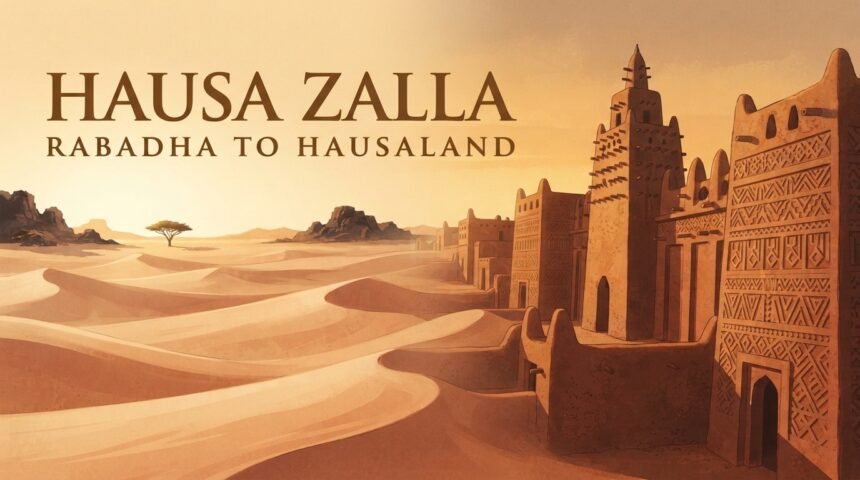
Abu Dhar’s crime was demanding that the state account for its wealth. He demanded that the leaders live by the standard of justice they preached. The response of the Caliphate establishment? They could not handle his truth. They marginalized him. They labeled him a divisive troublemaker who was threatening the “unity” and “security” of the empire. The political elite, specifically Muawiyah, sent him to Caliph Uthman, who eventually exiled Abu Dhar to Rabadha, a desolate, barren desert outpost. He died alone there, away from his family and the center of power.
The majority of the people at the time viewed Abu Dhar as a nuisance, a threat to the general well-being of the state. But history vindicated him. He is immortalized as a hero of social justice, while those who hoarded and exiled him are forever remembered as the corrupters of the faith.
The Modern-Day Rabadha: The Hausa Zalla Movement
This is the exact mirror of the Hausa Renaissance and the Hausa Zalla movement today.
The modern-day Abu Dhars are the advocates of Hausa Zalla. They look at the palaces of the political, clerical, and royal elites in the North. They see the luxury cars of the emirs, the stolen billions of the politicians, and the clerics who bless the corruption while the Hausa masses are slaughtered by bandits, raped, and starved of basic education. When the Hausa Zalla speak up, they are branded as threats to the state. They are arrested, like Bichiia Maisango, and thrown into DSS cells without trial.
The critics of the Hausa Zalla movement are the modern equivalents of those who accepted the exile of Abu Dhar. They tell the youth to be patient, to stop complaining, and to respect the “tradition” of their elders. But the Prophet (PBUH) warned us about this type of silence. He said: “The best of Jihad is a word of truth before a tyrannical ruler.” (Sunan Abi Dawud). He also said: “Whoever among you sees an evil, let him change it with his hand; if he cannot, then with his tongue; if he cannot, then with his heart, and that is the weakest of faith.” (Sahih Muslim).
The clerics and elites who tell the Hausa youth to be quiet are telling them to have the weakest of faith. They have sided with the palace over the Prophet.
The most dangerous enemy of the Hausa Zalla movement is not the politician who steals, but the cleric who blesses the theft. Throughout Islamic history, the palace cleric has always been the first line of defense for a corrupt ruler. They stand in the pulpits, quoting scripture out of context, telling the masses that obedience to the ruler is a religious obligation, that patience in the face of injustice is a sign of piety, and that those who question the elite are merely seeking worldly power.
When the Prophet (PBUH) was approached by the Quraysh elite and offered wealth, status, and power in exchange for silence, he replied: “By Allah, if they place the sun in my right hand and the moon in my left to abandon this cause, I will not do so until Allah makes it prevail or I perish in the process.” (Seerah Ibn Hisham). The Prophet never told his followers to be patient with tyranny. He told them to oppose it with everything they possessed.
The clerics who tell the Hausa youth to be quiet are the descendants of those who sat comfortably in the courts of the Umayyad and Abbasid caliphs, justifying the accumulation of palaces while the poor starved. They are the ones who told the people that Abu Dhar was a troublemaker. They are the ones who signed the fatwas that legitimized the exile of the righteous. Their descendants are still doing the same thing today, using the name of Islam to protect the oppressor and silence the oppressed.
There is a painful lesson in the isolation of Abu Dhar. The Prophet (PBUH) did not just say he was the most truthful man on earth; he also prophesied his loneliness. He said: “Abu Dhar walks alone on the earth, and he will die alone, and he will be resurrected alone.” (Sahih al-Bukhari).
This prophecy was fulfilled in the most agonizing way. When the political elite turned against him, the crowds that had once listened to him fell silent. The companions who knew his status did not rise up to defend him. The ummah, comfortable in its obedience to the state, allowed the most truthful man of his generation to be cast into the desert. He died with no one by his side except his wife and a passing caravan that did not even know who he was.
This is the tragedy of the Hausa Zalla movement today. The Hausa masses know that Bichiia Maisango and others are speaking the truth. They know that the emirs have hoarded wealth while their children are killed. They know that the politicians have stolen the future. But they are afraid. They are comfortable in their silence. They have been conditioned to believe that opposing the elite is a sin, that questioning the emir is disrespectful, and that complaining about poverty is a lack of faith.
The ummah that forsook Abu Dhar is the ummah that forsook the truth. And the consequence was a Caliphate that descended into civil war, political assassination, and the corruption of the faith itself. The silence of the majority did not save the state, it destroyed it. The same fate awaits the Hausa masses if they continue to abandon their advocates and cling to the comfort of their silence.
The critics of the Hausa Zalla argue that the movement is a threats to Northern Nigeria‘s unity. They say that the youth are being manipulated by outside forces. They say that the struggle is against the Islamic faith itself. Every one of these accusations is a lie.
At the very core of this movement is the fundamental, God-given right of a people to rule themselves. The Hausa are fighting to reclaim their sovereignty in their own ancestral land. They are fighting to control their own resources, to secure their own communities, and to determine their own political destiny without the suffocating grip of a distant, uncaring center or the feudal domination of local elites. The struggle for Hausa Zalla is the struggle for self-determination—the right to govern their own affairs justly, to protect their own children, and to build an economy that serves the masses rather than the palaces.
The Caliphate of Umar ibn Al-Khattab was the most powerful state of its time. Yet, a single woman could stand in the mosque and challenge the Caliph over a piece of cloth. A poor man could ask the Caliph why he was given less than others and the Caliph would explain, or apologize, or adjust. The power of the state did not make the Caliph immune to accountability. The sanctity of his office did not silence the voices of the weak.
That is the standard. That is the model. And by that standard, the current political and traditional leadership of the North has failed catastrophically. They have built palaces while the people starve. They have bought private jets while the farmlands are abandoned. They have sent their children to London while the children of the poor are abducted from their schools.
The Quran commands: “O you who have believed, be persistently standing firm in justice, witnesses for Allah, even if it be against yourselves or parents and relatives.” (Surah An-Nisa 4:135).
This is no longer a mere request for accountability; it is the thunderous dawn of a Hausa revolution against a compromised and complicit leadership. The Hausa Zalla are rising to demand a brutal reckoning from the emirs. They are asking the questions that the palace clerics are paid to bury: Why do the rulers’ children fly to London while Hausa children roam the streets without schools? Why do the palaces overflow with hoarded wealth while the state watches bandits slaughter our farmers?
This is the exact platform of Abu Dhar, but the struggle has now evolved. The people are declaring that if any emir continues to back a corrupt and oppressive system against the survival of the masses, the people possess the divine and historical right to demand their dethronement. The throne is not a license for tyranny. The leadership must be stripped from the hands of those who have sold their souls to the oppressors and returned to its genuine owners, the Hausa masses.
We are demanding the very justice that the Sahabas and the Prophet (PBUH) commanded us to uphold. The revolution has arrived, and it will not be silenced until the thrones of the complicit are shaken and the power is restored to its indigenous people.
Our arrest is an injustice. Our exile or silencing is a repeat of Rabadha. But just like Abu Dhar, truth does not require the permission of the oppressor to exist. The struggle of the Hausa Zalla is not a rebellion against Islam; it is the resurrection of the Prophetic tradition.
The state can lock up Bichiia Maisango, but it cannot lock up the idea. The spirit of Abu Dhar lives in Hausaland, and the struggle continues.
khaleed yazeed
founder wakilin yamma youth development network Katsina state Nigeria.