
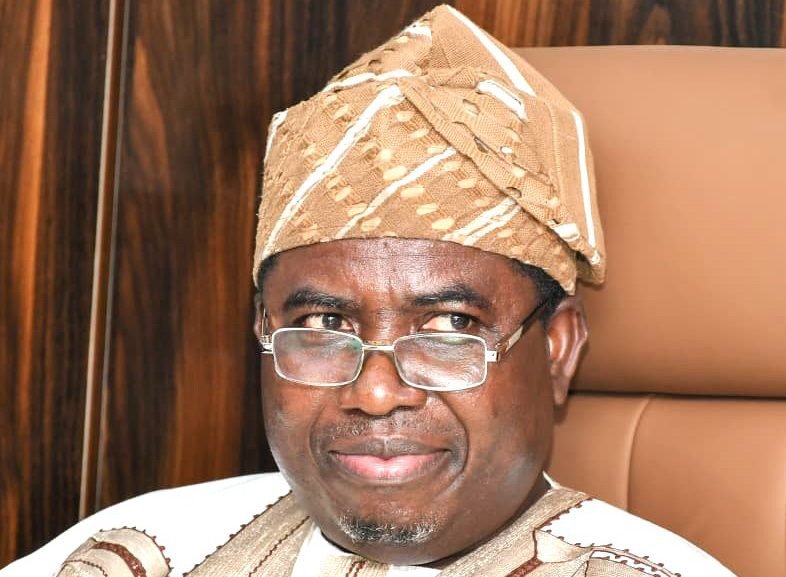
By Suyi Ayodele
(Published in the Nigerian Tribune on Tuesday, November 3, 2026)
https://tribuneonlineng.com/amupitan-how-many-ghosts-will-vote-at-our-election/
Real politicians would tell you that ‘elections are not rigged on the day of voting.’ They would say that real rigging of any election begins with the voters’ registration process. It is at this stage that those who would win would win, and those destined to fail would fail. Election days are mere coronation days.

I recall an incident that occurred years back in December 1987 during the zero-party local government election introduced by the regime of Military president, General Ibrahim Badamasi Babangida.
In the voters’ register of one of the polling units in a neighbouring community where I served as the Presiding Officer (PO), we saw names like Akikaragba Joseph, Esiso Jumoke and Usemole Gbenga.
The first name, Akikaragba, in Ekiti dialect, means broken calabash; Esiso means palm fruit’s sharp spine and Usemole is the name of a popular festival in the locality! Our would-be ‘voters’ registered with those names, collected their voter cards and the unit had about 500 registered voters in all! We laughed at the names. I asked my Assistant Polling Officer (APO) to look out for the names and their bearers. We waited for the prospective voters to show up and vote, they never did!
That was a period when voters’ registration was done manually and no photograph was attached to the voters’ card issued. The advent of technology ought to have eliminated such demons in our electoral system. One would have thought that in this 21st century, Nigeria would have moved beyond the level of having ghosts as voters. But, we now know that Nigeria is a country of ghosts, and ghosts are immortal, they don’t die.
Nigeria is ranked the 36th most corrupt country in the world! The ranking by the Transparency International’s Corruption Perceptions Index shows that “Nigeria ranks 142nd out of 182 countries with a score of 26 out of 100.” The index is for the year 2025 as released early this year. For the year 2024, Nigeria ranked 140th out of 182 countries. The 2025 figure indicates that the country has gone down by two points!
Nothing worries us again here. Nigerians would only be scared if the result had shown a strand of improvement. Corruption in Nigeria permeates every segment of the society; governments, private sector, corporate institutions and individuals. We all have our share of the blame. This is why corrupt practices have become the new normal for us. A few who try to do things differently are viewed as weird! Na only him wan make Nigeria better, is a common saying among the people!
And we spare no institution. Nothing is too sacred for Nigerians to corrupt; we compromise just any system! The latest victim of the malady is the Independent National Electoral Commission (INEC). The electoral umpire, in the last one week, has been in the news for the wrong reasons. The voters’ register compiled and released by the Commission came up with Artificial Intelligence-generated photos and names of non-existent people. Ghosts are potential voters come 2027!
INEC has admitted the error. The Commission’s Director of Information and Communication Technology, Lawrence Bayode, stated that INEC’s Automated Biometric Identification System (ABIS) flagged 268 records for review. He blamed the irregularities on registration officers, whom he claimed used their login details to introduce questionable records into the database. “What we are currently doing now is looking at all these 268 records that ABIS already flagged as AI-generated or even something of irregularities”, he said.
This was just as Professor Joash Àmúpìtàn, the Chairman of INEC, assured that the Commission would investigate the matter and “take corrective action based on verified findings.” This is the only beautiful thing about the saga; the admittance of error by INEC. However, the admittance does not vitiate the danger the discovery poses to the credibility of the January 2027 general election. It does not also erase the people’s fears that the electoral system has been compromised. Rather, it heightens the fear among the people that the 2027 election would go the way of others before it!
During the 2023 general election, we observed so many anomalies on the INEC Election Result Viewing Portal (INEC-IReV), where the results of the elections were viewed. While the Presidential and the National Assembly election took place simultaneously, the portal could only display the results for the senatorial and the House of Representatives elections. The result for the presidential election remained completely grayed out.
In some states, on the portal, what one found were photographs of people in bathrooms, in restaurants and other funny items. Later, INEC declared the incumbent President Bola Ahmed Tinubu as the winner of the election! That was Nigeria’s eighth wonder of the world; the INEC system that could display the results for the other two elections failed to display that of the presidential election which was held on the same day, time and places as the other two!
This is why the latest discovery of AI-generated voters’ photos on the INEC voters’ register should arouse more than our curiosity. Our elders say: bí ọjọ́ ti má rí, àárọ̀ la tií mọ̀ (morning shows the day). It is not an issue that should be viewed as a mere error imported into the system by “registration officers, who used their login details” as explained by Bayode. It is even more worrisome that Edo State is one of the states where the issue of fake voters’ identity is more pronounced!
Nigerians, home and in the Diaspora, will recall that since his assumption of office in November 2024, the greatest preoccupation of Governor Monday Okpebholo of Edo State has been the re-election of President Tinubu. No matter the seriousness of the event, Okpebholo will never allow any opportunity to slip by without reiterating his commitment to Tinubu’s second term and the assurance that Edo State will deliver 2.5 million votes to the President in the coming election.
Just last Wednesday, while speaking with pensioners in the state, Governor Okpebholo told them that he was able to pay the retired senior citizens because, when he raised their matter with the President, “he gave me the go-ahead. The President cares for us. That is why, whenever I am taking a decision, I consult him, and when he gives me the go-ahead, I proceed.”
The question Nigerians have been asking is: where will Governor Okpebholo get the 2.5 million votes for Tinubu? If the All Progressives Congress (APC) gets 2.5 million votes, how many votes will the other opposition parties get? And more importantly, what is the voting population of Edo State?
These questions are germane for the obvious reason that in the election that brought in Okpebholo in 2024, the total votes for him; his close rival, Asue Ighodalo of the Peoples Democratic Party (PDP) and Olumide Akpata of the Labour Party (LP), came to 561,704, with Okpebholo scoring 291,667 votes; Ighodalo, 247,724 and Akpata scoring 22,763. If in September 2024, all the three major political parties scored a total of 561,704 votes, which magic will give APC alone 2.5 million votes in January 2027?
It will be too dangerous for us to guess that the answer lies in the fake voters’ identity scam that was just discovered in the voters’ register released by INEC! This is why the electoral umpire must do more than taking “corrective action based on verified findings”, but should, and must go the whole nine yards of identifying who smuggled those AI-generated voters into the register. And that should not be rocket science for the Commission.
In the first instance, INEC recruited the registration officers. The Commission took the bio data of all the ad hoc staff it used for the exercise. The umpire has the backend to check where the AI-generated voters were prevalent and those responsible for their uploading into the system. So, the Commission has all it takes to ensure that everybody involved in the scam is brought to book.
For Pete’s sake, the issue interrogates the credibility of the forthcoming poll more than anything else. This is the position the Director of the Policy and Legal Advocacy Centre, Clement Nwankwo, raised last Thursday, and was relayed on the Arise TV News. Nwankwo’s interrogation of how the figure of 90 million registered voters jumped to 103 million is very crucial. How many of the additional 13 million names in the register are AI-generated? How many are fake, manipulated and imposed?
In the mess, Governor Okpebholo’s Udomi Primary School Polling Unit 001, Ward 2, Udomi, Esan Central Local Government Area, Edo State was named. Likewise, Comrade Adams Oshiomhole’s Etsako West Local Government Area was also tagged as where the AI-generated register was prevalent. These two areas cannot be treated as mere coincidences. How a figure of 397 voters suddenly rose to 4,783 voters in a single registration exercise should attract world attention for an election that has put Nigeria on the edge!
This is why Professor Àmúpìtàn should take a deep reflection of his name. I alluded to this in my April 7, 2026 offering on this page, when, while writing on the topic, “We are all Àmúpìtàn”, I submitted thus: “…. On this Àmúpìtàn’s shoulder lies the fate of over 200 million Nigerians. His pronouncements as the head of the nation’s electoral umpire can make or mar the nation. His decisions, actions and inactions have the capacity to break Nigeria or bind it together in unity.”
Àmúpìtàn, as a professor, is by all means a great philosopher and thinker. The 18th century English classical writer, Benjamin Jowett, while analysing Plato’s Republic, Book IX, says, choosing among a philosopher, an ambitious soldier, and a greedy businessman, who should be engaged as an umpire, Plato picks the philosopher. His argument is that ‘only the philosopher can serve as an unbiased umpire because only he possesses the reason, experience, and insight required to weigh all three pleasures objectively.’
This is the burden nature has imposed on Professor Àmúpìtàn at this critical stage of our nation. The task is herculean, no doubt. But the professor of Law must have weighed his options before accepting to serve as INEC Chairman. Let it not be said that it was during his time, ghosts voted to elect a president.
Let it not be recorded that Àmúpìtàn presided over an exercise which allowed artificial human beings to be part of our electoral system. I warned in April that “Nigeria is on edge.” Nothing has changed. Rather, the tension in the land has heightened. We cannot afford to have AI-generated voters to be part of those who will decide the fate of the country in 2027.
Our electoral problem starts with the skewed Nigerian system that allows a sitting President to appoint INEC Chairman. This is what the sophist, Thrasymachus, vigorously argues in Book I of Republic, when he says: “justice is nothing other than the advantage of the stronger.” Only men of honour can change the narrative. Plato devotes the remaining Books of Republic, arguing that the narrative can be changed and that ‘true justice must be an objective cosmic harmony rather than a rigged game managed by biased elites.’
This is what Professor Àmúpìtàn is called upon to do at this critical stage; get to the roots of the AI-generated voters’ register. Let the Commission pay more than due attention to states like Edo where the reality of less than 700,000 votes, two years ago, does not support the projection of 2.5 million votes in 2027. Human beings are not like a litter of pigs. This is the only way the INEC Chairman can avoid, as predicted on this page on April 7, 2026, the substitution of his name, Àmúpìtàn, “with a new multi-syllabic phonological realisation of À-mú-pì-tàn-bu-rú-kú (the one whose deeds will be retold in bad history).”
The irony is disturbing. A government that claims to have done so well should not be caught in the web of voters’ register manipulation! While every other political party has come out to condemn the AI-generated voters’ photos, only the ruling APC appears to be comfortable with the saga with its deafening silence.
The silence from Aso Rock Villa and the ruling APC over the matter notwithstanding, like our elders are wont to say, if the neighbourhood Ìyá Alákàrà will not allow another woman to fry, the palm oil seller should also learn not to sell palm oil to her in large quantities. This is the fair game INEC under Professor Àmúpìtàn is called to play. May the Kogi-born INEC Chairman know the true import of his name, Àmúpìtàn – the one whose deeds will be retold in history!