By Okoi Obono-Obla
The PDP governed Edo State from 1999, when democratic civil rule was restored in Nigeria after a military interregnum that lasted from 31 December 1983 to 29 May 1999.
However, the PDP lost power in 2008 when the Election Petition Tribunal in March 2008 nullified the victory of Professor Oserheimen Osunbor, who had been fielded by the PDP in the 2007 gubernatorial election. The judgment was affirmed by the Court of Appeal on 11 November 2008, which declared Comrade Adams Oshiomhole of the defunct Action Congress (AC), which later became the Action Congress of Nigeria (ACN), as the duly elected governor in that election. Thus, the control of the Edo State Government by the PDP came to an inglorious end.
Governor Oshiomhole held sway in Edo State from 12 November 2008 to 2016. He won re-election in 2012 and was succeeded in 2016 by Godwin Obaseki, who was elected on the platform of the All Progressives Congress (APC).

The APC itself emerged from the merger of the Action Congress of Nigeria (ACN), the All Nigeria Peoples Party (ANPP), and the Congress for Progressive Change (CPC), alongside a faction of the All Progressives Grand Alliance (APGA). The party was formed on 6 February 2013 and registered on 31 July 2013, not in 2015. The New PDP (nPDP) did not merge into the APC; rather, its leadership and followers, including several serving governors, defected into the APC in late 2013 and 2014, ahead of the 2015 general elections.
The APC subsequently lost power to the PDP in Edo State in 2020, when Governor Godwin Obaseki defected to the PDP after losing the APC ticket and was re-elected on the PDP platform. The APC also lost the presidential elections in Edo State in 2019 and 2023. Atiku Abubakar of the PDP won in 2019, while Peter Obi of the Labour Party won the State in 2023, along with a number of State and National Assembly seats.
One would have thought that the Labour Party was going to win the gubernatorial election in Edo in 2024, but it lost disastrously to the APC. The governorship election was held on 21 September 2024, not in 2025. The Independent National Electoral Commission (INEC) declared Senator Monday Okpebholo of the APC winner with 291,667 votes, defeating Asue Ighodalo of the PDP who scored 247,274 votes, while Olumide Akpata of the Labour Party polled 22,763 votes to come third.
The fortunes of the PDP have dwindled considerably in Edo State, and with the alliance of the Nyesom Wike group in the PDP with President Bola Ahmed Tinubu ahead of the 2027 general election, it is doubtful whether the PDP’s loss in Edo State will not be to the gain of the APC.
Peter Obi, who won Edo State in the 2023 presidential election, joined the Nigeria Democratic Congress (NDC) in May 2026 from the African Democratic Congress (ADC), which he had joined in July 2025. The NDC, which was registered in May 2026 via a court order, is still struggling to establish a foothold across the Federation.
THE 2027 INEC POSITION AND HOW PARTIES STAND IN EDO
As of October 2026, INEC has released the final lists for the 2027 general elections. Contrary to earlier expectations, there will be no governorship election in Edo in 2027. Governorship will not hold in Edo, Bayelsa, Ondo, Ekiti, Osun, Imo, Anambra and Kogi because they are off-cycle. Edo will only participate in the National Assembly elections on 16 January 2027 and the State House of Assembly elections on 6 February 2027.
For President, INEC cleared 18 candidates: APC – Bola Ahmed Tinubu/Kashim Shettima; ADC – Atiku Abubakar/Chibuike Amaechi; NDC – Peter Obi/Rabiu Kwankwaso; PDP – Sandy Ojang Onor/Umaru Babangida; APM – Seyi Makinde, plus LP, AA, ADP, APP, AAC, BP, DLA, NDP, NRM, PRP, SDP, YPP and ZLP.
For Edo’s 36 legislative seats, INEC cleared 213 candidates: 22 for 3 Senate seats, 49 for 9 House of Representatives seats, and 142 for 24 House of Assembly seats. The APC, NDC, ADC and SDP have candidates in all 24 Assembly constituencies. The PDP has candidates in only 13 Assembly constituencies, 4 Reps constituencies and 2 senatorial districts, confirming its dwindling fortune. Former Governor Adams Oshiomhole is among those cleared for the National Assembly race.
PROJECTION: WHAT 2027 WILL LOOK LIKE IN EDO
1. Presidential: Edo will be a three-horse race. NDC (Obi/Kwankwaso) retains the urban and youth sympathy that gave Obi victory in 2023 in Benin City (Oredo, Egor, Ikpoba-Okha), but APC now has the advantage of controlling both the Federal Government and the Edo State Government under Okpebholo, plus the federal might and the support of the Wike faction of the PDP. ADC will split the old PDP votes. Projection: NDC 38-42%, APC 35-40%, ADC 15-18%. Obi will be competitive but will not replicate his 2023 landslide.
2. Senate and House of Representatives: With full slates, APC and NDC dominate. Edo North and Central lean APC due to Okpebholo’s Esan and Etsako base and Oshiomhole’s machinery. Edo South will be a fierce battle between APC and NDC. Projection: Senate – APC 2, NDC 1; House of Representatives – APC 5, NDC 3, ADC 1.
3. State House of Assembly: This is where APC’s consolidation will show. With PDP absent in 11 constituencies, APC is projected to take 14 seats, NDC 6, ADC 2, and others 2, giving Governor Okpebholo the compliant Assembly that Obaseki lacked in his second term.
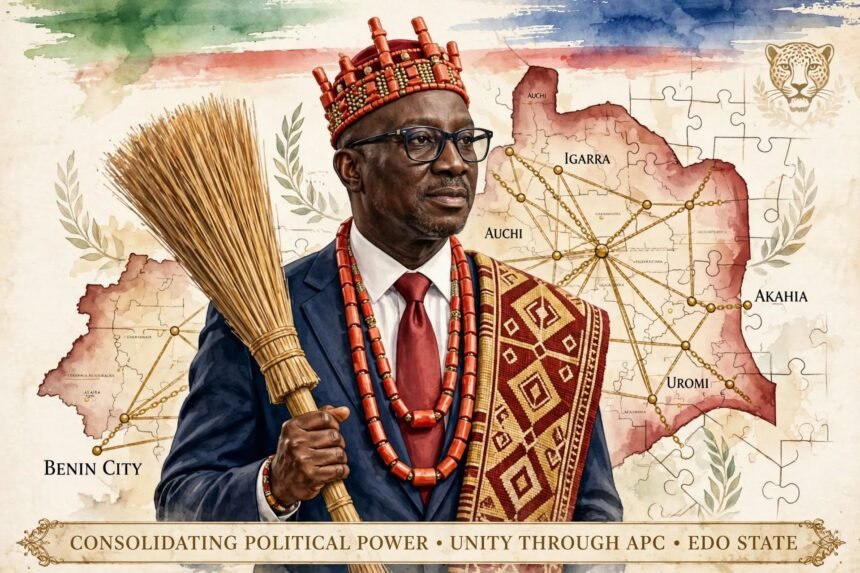
In summary, the variables and dynamism that helped Peter Obi win Edo in 2023 have changed. With ³ takeover of Edo State by the APC, its digging in and consolidation, the collapse of PDP structures, and the federal might of the APC, the 2027 general elections in Edo will represent an interesting spectacle, but one in which the APC enters as the clear favourite to consolidate.