By Okoi Obono-Obla
The Independent National Electoral Commission (INEC) has fixed the dates that will define Nigeria’s next political cycle. Presidential and National Assembly elections will hold on Saturday, 16th January 2027, while Governorship and State Houses of Assembly elections will hold on Saturday, 6th February 2027.
This analysis moves away from social media polling and examines the leading parties – APC, ADC, NDC, Labour Party, PDP, APGA and Accord – through two cold lenses: legal stability and structural depth.
1. The Arithmetic of Nigerian Elections

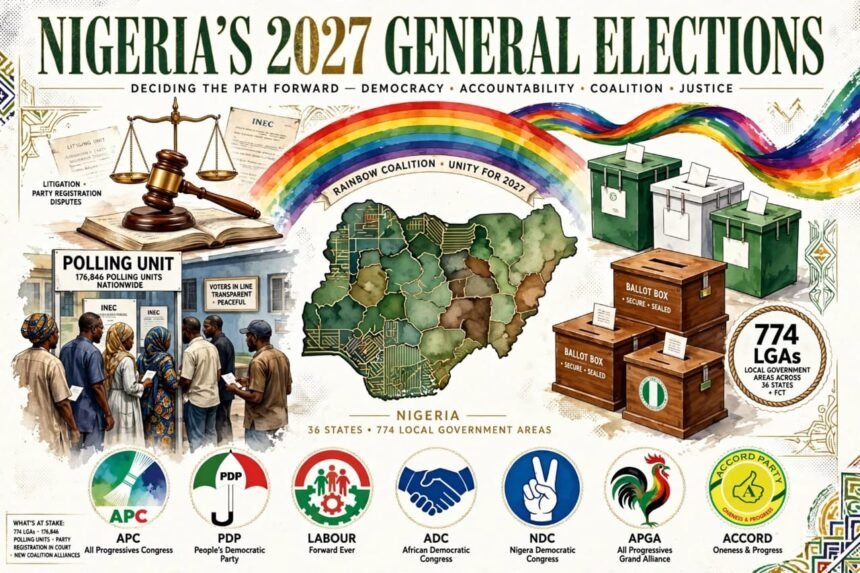
Elections in Nigeria are not won on social media. They are won in 774 Local Government Areas, 8,809 electoral wards and 176,846 polling units. INEC itself states it will deploy materials to 774 LGAs, 8,809 Wards and 176,846 polling units.
Any party that cannot produce agents in all 176,846 polling units cannot protect its votes.
2. All Progressives Congress (APC) – The Party With a Full Slate
The APC remains the only party with proven structure at every level. INEC’s final list shows APC fielding 360 candidates for the House of Representatives and 109 for the Senate – full national coverage. For State Assemblies, its ICT department confirmed it uploaded 1,015 State Assembly candidates for the 993 available seats.
It controls about 30 of 36 states and, as of early 2026, holds 282 seats in the House and 71 in the Senate. It has no existential legal threat.
Chance: 60-65% favourite for the Presidency if the contest is about machinery.
3. The Rainbow Coalition and the PDP Working for APC
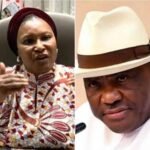
The Minister of the Federal Capital Territory, Nyesom Wike, a PDP leader serving in an APC-led Federal Government, is promoting what he calls the Rainbow Coalition in Rivers State to support President Bola Tinubu’s re-election in 2027. Wike disclosed the strategy himself: voters would support different parties at different levels – APC for President and Senate, PDP for House of Representatives, with governorship and State Assembly choices to be announced later.
Wike himself said: “Most importantly, Rainbow Coalition has nothing to do with the APC… Our people know who they are.” His own clarification was that the coalition is for the presidential election only, while PDP can contest other elections. APC governors have openly criticised the model.
In effect, a faction of the PDP is working for APC at the presidential level. This explains why PDP’s presidential candidate list has been weak and why its National Assembly slate dropped from 316 to 302 House candidates in the final list.
4. African Democratic Congress (ADC) – Wounded by Factionalisation
ADC was meant to be the grand opposition coalition, but it is torn by litigation. INEC’s provisional data showed 346 House candidates; the final list shows 107 Senatorial and 220 House candidates. The 232 House figure sometimes quoted is actually for APM, which has 103 Senatorial and 232 House candidates.
The reason is legal: the Court of Appeal voided ADC’s State Executive Committees, and there are pending cases seeking to bar Senator David Mark and Rauf Aregbesola from parading as National Chairman and Secretary. ADC still manages full slates in states like Rivers where it fielded candidates for all 32 Assembly constituencies, but nationally it is patchy.
Chance: Strong spoiler, but cannot win a legislative majority.
5. Nigeria Democratic Congress (NDC) – A Party Born in Court
NDC’s registration was not through normal INEC verification but by a Federal High Court, Lokoja, order of 10 December 2025 directing INEC to register it. That judgment was set aside by the same court on 26 June 2026, on the ground that it affected the rights of the Peace Movement Party, which claimed ownership of the victory sign logo.
INEC prepared to delist NDC. The Court of Appeal, Abuja, in a 2-1 decision, restored the registration, holding that a Federal High Court cannot sit on appeal over its own judgment. The matter is now on appeal.
Consequences: NDC fielded only 103 Senatorial and 327 House candidates, and has no structure in all 774 LGAs, 8,809 wards and 176,846 polling units. Like ADC, APM and Labour Party, it cannot produce polling unit agents nationwide. Labour itself admitted it could only produce 776 State Assembly candidates out of 993.
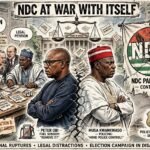
NDC does have a formidable presidential ticket – Peter Obi and Rabiu Kwankwaso – on INEC’s final list.
Chance: Can win 8-12 states in the presidential election, but will collapse in the State Assembly elections.
6. The Accord and APGA Factor – Endorsements for APC
Two other verified developments tilt the field further toward APC:
Osun State – Accord: Governor Ademola Nurudeen Jackson Adeleke, who won re-election on the platform of Accord Party, has reaffirmed support for President Tinubu’s 2027 re-election. APC National Secretary Ajibola Basiru visited him in Osogbo and disclosed that an APC-Accord alliance would target 1.5 million votes for Tinubu in Osun. Adeleke said he would support Tinubu “big time” and be on the field campaigning.
This is not a defection, but a presidential-level alliance. Accord will field its own Assembly candidates while working for APC at the top.
Anambra State – APGA: Governor Charles Soludo announced at Alex Ekwueme Square, Awka, during President Tinubu’s working visit, that the All Progressives Grand Alliance (APGA), the governing party in Anambra, has officially adopted President Bola Tinubu as its candidate for the 2027 presidential election. Soludo stated APGA and APC would work together as both share progressive ideals, while APGA seeks to retain National Assembly and State Assembly seats in Anambra.
These endorsements mean APC does not need to win Anambra or Osun with its own structure; APGA and Accord will deliver presidential votes.
Who Likely Wins?
Presidential (Jan 16): With PDP’s Rainbow Coalition faction, Accord in Osun, and APGA in Anambra all working for APC at presidential level, the mathematical path for an opposition victory narrows drastically. APC remains favourite to win by plurality. NDC second, ADC third.
National Assembly (Jan 16): APC will retain majority, though reduced to 180-200 seats, because opponents have incomplete slates – APC 469 NASS seats, NDC 430, PDP 405, ADC 327 in one analysis.
Governorship and State Assembly (Feb 6): Where structure decides, APC will win 22-25 governorships. The Rainbow Coalition model – APC for President, PDP/APGA/Accord for legislature – will produce split-ticket results.
Final Assessment: The 2027 elections will be decided not by popularity alone, but by legal validity to be on the ballot and by human beings to protect the ballot in 176,846 polling units. APC has both. Its opponents have court-created validity, but not nationwide structure. With PDP, APGA and Accord now openly endorsing APC’s presidential candidate, the opposition is not just fragmented – part of it is actively working for the ruling party.